
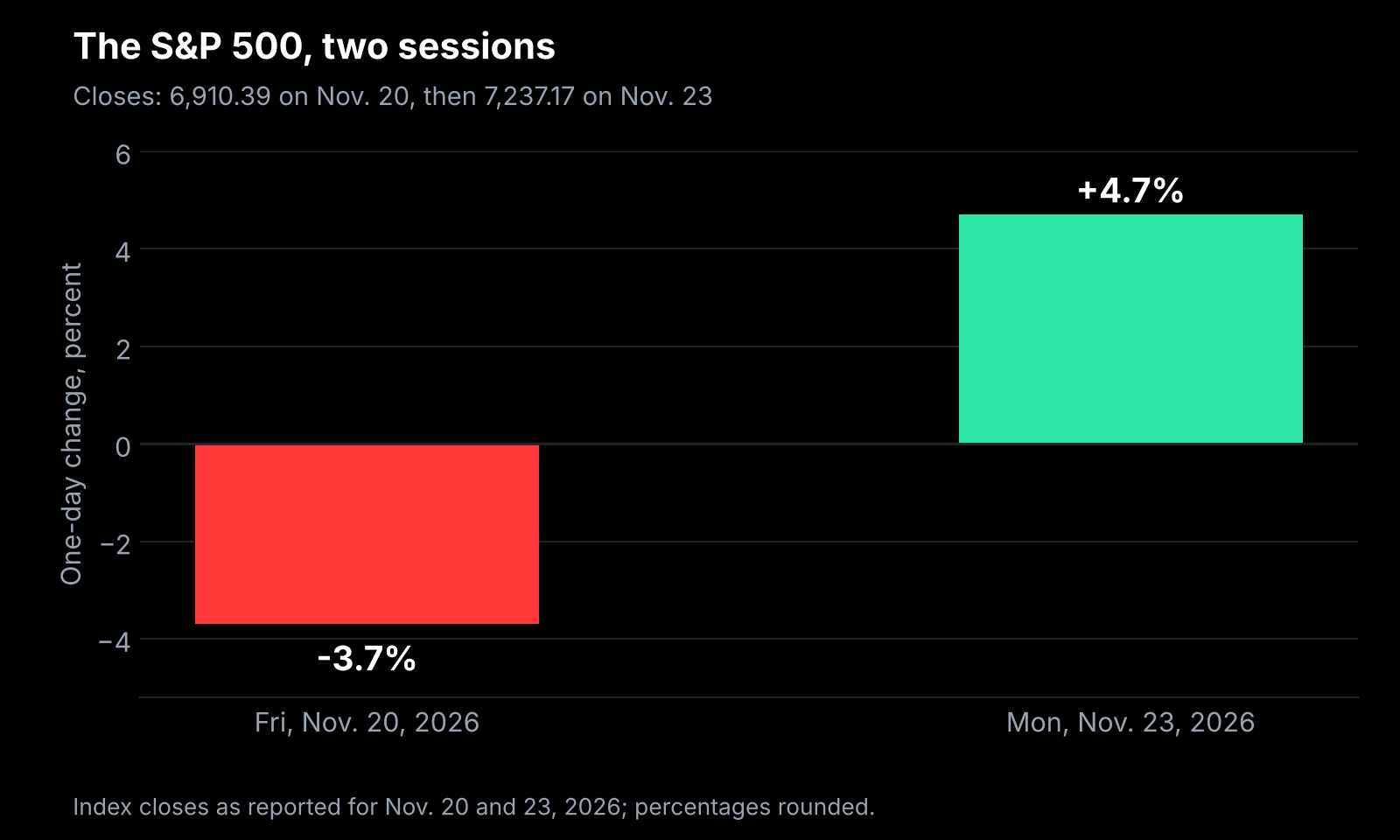
On Friday, November 20, 2026, the S&P 500 closed at 6,910.39, down 3.7% in one day, after seven straight losing sessions. Three days later, on Monday, November 23, 2026, it closed at 7,237.17, up 4.7%, its biggest one-day gain since April 2025.
So did the market just hit its bottom? Goldman Sachs strategist Ben Snider put out a note that week listing three conditions that would support one. Most people will tell you a bottom is simply the day prices stop falling. Hold that thought, because Goldman's list says something different.
My question is this: what does a market bottom actually need? I will take Goldman's three conditions in order. First, confidence in what artificial intelligence spending will earn. Second, a Federal Reserve that sounds friendlier. Third, a drop in how much money is already invested in stocks, which turns out to be the one with the most unfinished business.
Why should your own money care? A bottom is the point where a drop stops and a recovery starts, and nobody knows it is the bottom until after. If your retirement account holds stock funds, the difference between a pause and a recovery is the difference between waiting and worrying.
What is the first condition, and where does it stand?
Goldman's first condition is news that raises investors' confidence in the earnings that come from artificial intelligence investment. People need to believe the huge spending on data centers and chips will pay for itself.
This one is hard to judge. Goldman estimates that artificial intelligence lifted the profits of S&P 500 companies about 25% above their normal trend, and that spending on it produced about half of this year's profit growth. The same note says the outlook for 2028 and beyond is "highly uncertain." Goldman's basket of artificial intelligence stocks was down about 32% from Tuesday, October 6, 2026.
Snider also wrote that the decline had widened from an artificial intelligence unwind into a broader downgrade of growth expectations.
The spending itself has not slowed. On Thursday, October 29, 2026, Amazon's chief executive said the company expects to "spend meaningfully more in 2027." The money keeps going out. What investors are waiting for is proof that it comes back.
Did the rally on November 23 supply that proof? The headline that day was that Nvidia's board reinstated Jensen Huang as chief executive. That is news about who runs a company. I could not find a report that it changed anyone's view of what the spending will earn, so I would not count it toward this condition. That is my reading, and Goldman has not said otherwise in anything I found.
BUT even if earnings confidence returns, there is a second condition that does not depend on companies at all.
What is the second condition, and where does it stand?
The second condition is "an improvement in the macro backdrop, such as a dovish signal for Fed policy." Macro means the big picture of the economy. Dovish means the Fed sounds more willing to hold rates down or cut them, the opposite of hawkish, which means more willing to raise them. A rate is the price of borrowing, and higher rates generally make stocks less attractive compared with safer investments.
The Fed raised its rate by a quarter point on Wednesday, September 16, 2026, to a range of 3.75% to 4.00%. According to the Goldman note as reported, futures markets put the odds of another hike at the meeting ending Wednesday, December 9, 2026 at about 95%. Goldman's own economists expect hikes in December and March, with the rate peaking between 4.25% and 4.5%.
So of the three conditions, this one looks like the least likely to arrive soon. One summary of the note said exactly that, calling the Fed the least likely near-term trigger. Goldman's trading desk went further in a client report on Sunday, November 22, 2026. It said continued rate hikes are the main risk and compared the setup with the fourth quarter of 2018, when the S&P 500 fell another 6.8% after its October drop.
A report on inflation is due on Wednesday, November 25, 2026, according to one source, and it could change the talk.
THEREFORE the first two conditions are waiting on events I cannot predict. The third is about money, and it is where the most data exists.
What is the third condition, and where does it stand?
The third condition is "a major decline in investor positioning, such as has often marked the bottoms of past drawdowns." Positioning means how much money is already invested in stocks or bet on their direction. When everyone is already out, there are fewer people left who might dump shares, and a bottom becomes more likely. A drawdown is a fall from a peak.
Goldman's trading desk wrote on Sunday, November 22, 2026 that hedge funds, which are private investment firms that use borrowed money, have mostly given up. Net leverage, meaning how much borrowed money they have on stocks, fell to 42.3%, the lowest since April 2025. They made bets against stocks at the highest weekly rate for individual shares since June 2022. And Goldman's own panic measure hit 9.8 out of 10 on Friday, November 20, 2026, close to its extreme.
Trend-following funds, which are firms whose models follow price direction, sold about 57 billion dollars of stocks in a month, by Goldman's estimate. They are now net short about 19 billion dollars, which means they hold more bets against stocks than for them. Goldman estimated they would purchase stocks only if the market rises. That matters for November 23, because it means a rise can force more purchases.
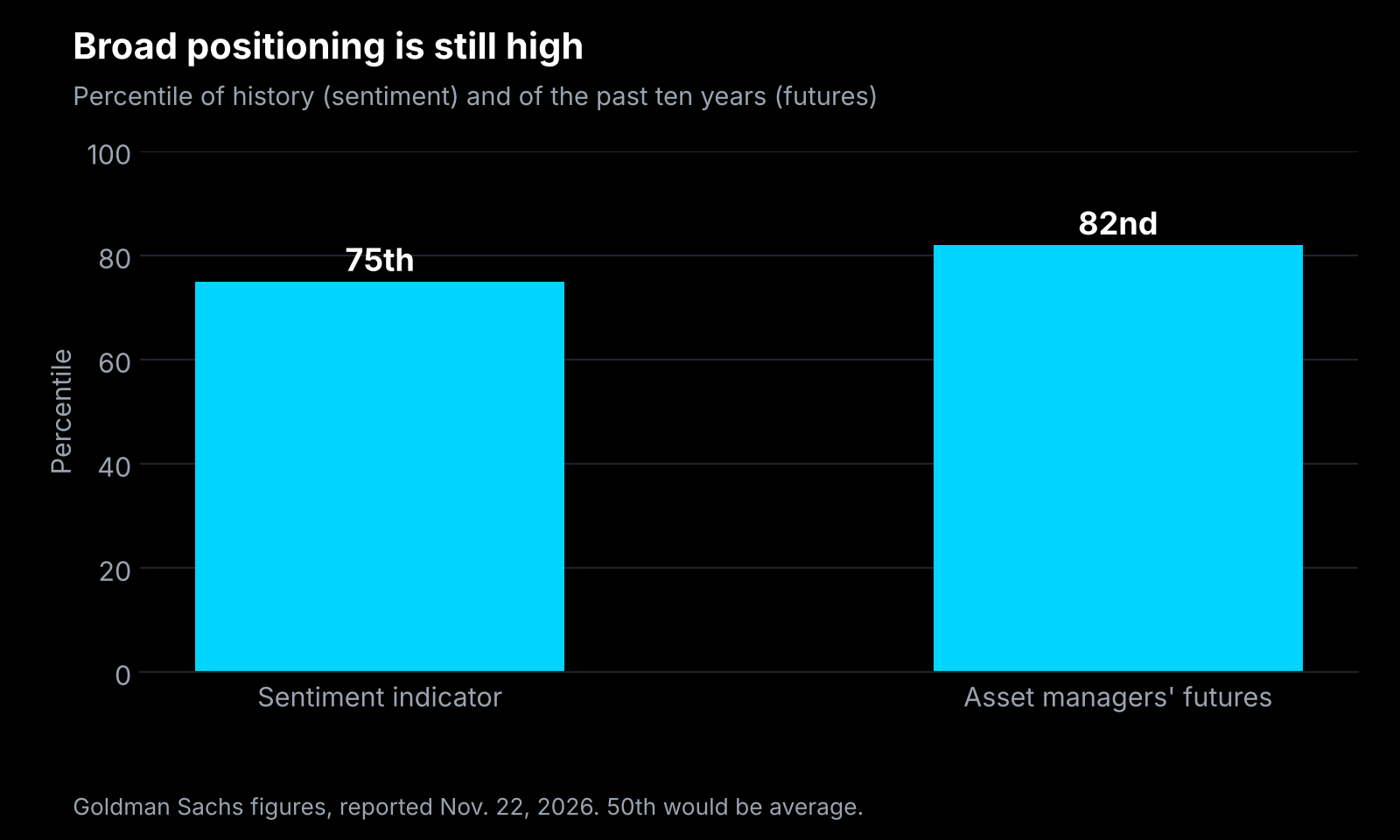
BUT Goldman said the clearing is not broad. Its sentiment indicator, which measures how optimistic investors are, was still above average at the 75th percentile of its history. Asset managers' positions in stock futures sat at the 82nd percentile of the past ten years. Investors put nearly 170 billion dollars into US stock funds since the start of the fourth quarter. Goldman's summary was that hedge funds have given up, but the broader group of investors has not.
That gap changes how to read the November 23 jump. According to a live market blog, Charlie McElligott of Nomura called the rally a "mechanical" bounce from people closing out bets against stocks, and said it "guarantees us nothing." I could not read the original note, so treat that quote as secondhand.
What this does not tell you
I do not know where the market goes next, and neither does Goldman. Its note was written with data through Thursday, November 19, 2026, before the full drop on Friday, November 20, 2026, so conditions may have been worse than it knew. I found no update from Goldman after the November 23 close.
It also does not tell you that Goldman is right. This is one bank's framework. Goldman put the average gain at about 4% over the following three months after 22 drops of 10% or more since 1980, but in five past cases where its panic measure was above 9 during a rate-hiking cycle, the average gain over three months was only 0.4%. Both numbers are Goldman's, reported secondhand, and neither is a forecast.
What does a market bottom need?
According to Goldman, any one of three things: news that restores faith in what artificial intelligence earns, a Fed that sounds friendlier, or a major drop in positioning. It does not need all three, and it does not need prices to simply stop falling.
As of the close on Monday, November 23, 2026, I count one condition partly met, in a narrow part of the market. Hedge funds have cleared out, but the broad group of investors has not, the Fed is not sending a dovish signal, and artificial intelligence earnings have not yet given investors a new reason for confidence.
That brings me back to the 4.7% day. A jump that large can happen because people who bet against stocks have to close those bets quickly, without any condition on the list changing. It may mark a bottom or it may be a pause. The three conditions are how I would tell the difference.
Where to look next
Watch the inflation report on Wednesday, November 25, 2026, markets closed on Thursday, November 26, 2026 and open for a half day on Friday, November 27, 2026, and the Fed decision on Wednesday, December 9, 2026. Watch the next news about artificial intelligence earnings, and watch Goldman's positioning data for a broader clearing.
If you want to see what any stock you follow is worth, its fair value range, sign up at techdamentals.com. It also shows a company's fundamentals alongside technical analysis of its chart. After each earnings report, it reads the company's own filing and compares the financials with what analysts expected, line by line, so you can see the real reason a stock moved. Try Techdamentals for 3 days, no card needed
This is educational content, not financial advice. Techdamentals is an educational tool and does not recommend any security.