
At 8:57:54 in the morning, Eastern time, on November 23, 2026, the filing system of the US Securities and Exchange Commission accepted a document from Nvidia that is two sentences long.
The Securities and Exchange Commission is the US government agency that polices the stock market. Any company whose shares trade publicly has to tell it about major events on a form called an 8-K, the box a company checks when something happens that shareholders need to know right now. Nvidia's 8-K said this, and nothing else:
"On November 22, 2026, the Board of Directors of NVIDIA Corporation reinstated Jen-Hsun Huang as NVIDIA's President, Chief Executive Officer and member of the Board of Directors, effective immediately. Following the reinstatement of Mr. Huang, Ms. Kress will continue to serve as NVIDIA's Executive Vice President and Chief Financial Officer."
Jen-Hsun is the legal name of the man everyone calls Jensen Huang, Nvidia's founder, who had resigned eleven days earlier. Ms. Kress is Colette Kress, 59, Nvidia's chief financial officer since September 2013, who had been running the company as interim chief executive and who, as of that sentence, went back to being only the finance chief.
By 10:00 a.m. Eastern, about ten minutes before I wrote this line, Nvidia traded 34.28% above its November 20, 2026 close of $125.53. The market is open as I write, on November 23, 2026, so there is no closing price for the session yet, and every number from it will have moved by the time you read this.
Now the part that stopped me. Six days earlier, on November 17, 2026, on Nvidia's own quarterly earnings call, board chair Harvey C. Jones said out loud: "The NVIDIA board unanimously accepted his resignation and does not intend to reinstate Jensen as CEO." Then the board reinstated him, and used the same word, unanimously, about that decision too.
So why did Nvidia bring back the chief executive it had just let go?
The easy answer is the share price, and I want to test that one first, because it is what almost everybody reached for. Then I want to walk through what a board of directors actually is, and what it means for a board to "accept" a resignation, because that is the machinery that makes a reversal possible at all. And then there is one sentence in the press release about where the board got its information before it decided. I will come back to it at the end.
Why this lands in your retirement account
If you have never purchased a single share of anything, you probably still own Nvidia. It designs the chips that train and run artificial intelligence systems, and in the three months that ended October 25, 2026 it reported $115.8 billion of revenue, $107.6 billion of it from data centers. At 10:00 a.m. Eastern on November 23, 2026 the whole company was worth about $4.07 trillion, the single heaviest weight in the US stock indexes that sit inside most workplace retirement plans, roughly 5.6% of the Nasdaq-100 on its own.
That is why Nvidia's bad days are everyone's bad days. On November 20, 2026 Nvidia fell 14.01% and touched a 52-week low during the session, while the Nasdaq Composite fell 5.28% to 22,617.73 and the S&P 500 fell 3.70% to 6,910.39. On the morning of November 23, after the 8-K, the Nasdaq Composite was up 6.64% at 10:03:58 a.m. Eastern. One caution, because it matters later: Nvidia is such a large piece of those indexes that when Nvidia moves 34%, the index moves partly because of Nvidia. The index is not independent evidence of anything.
Suspect one: the board was staring at a 47.53% decline
The share price story writes itself. Nvidia's highest closing price on record is $239.24, on October 6, 2026. The stock fell 9.26% in a single session on November 5, 2026, and after the resignation it fell for seven trading sessions in a row, from November 12 through November 20, 2026, taking 27.74% off the stock measured from the November 11 close. From the October 6 record close to the November 20 close it was down 47.53%. By my own arithmetic, using 24.15 billion shares outstanding, the company's market value went from about $5.76 trillion to about $3.03 trillion, a loss of roughly $2.73 trillion.
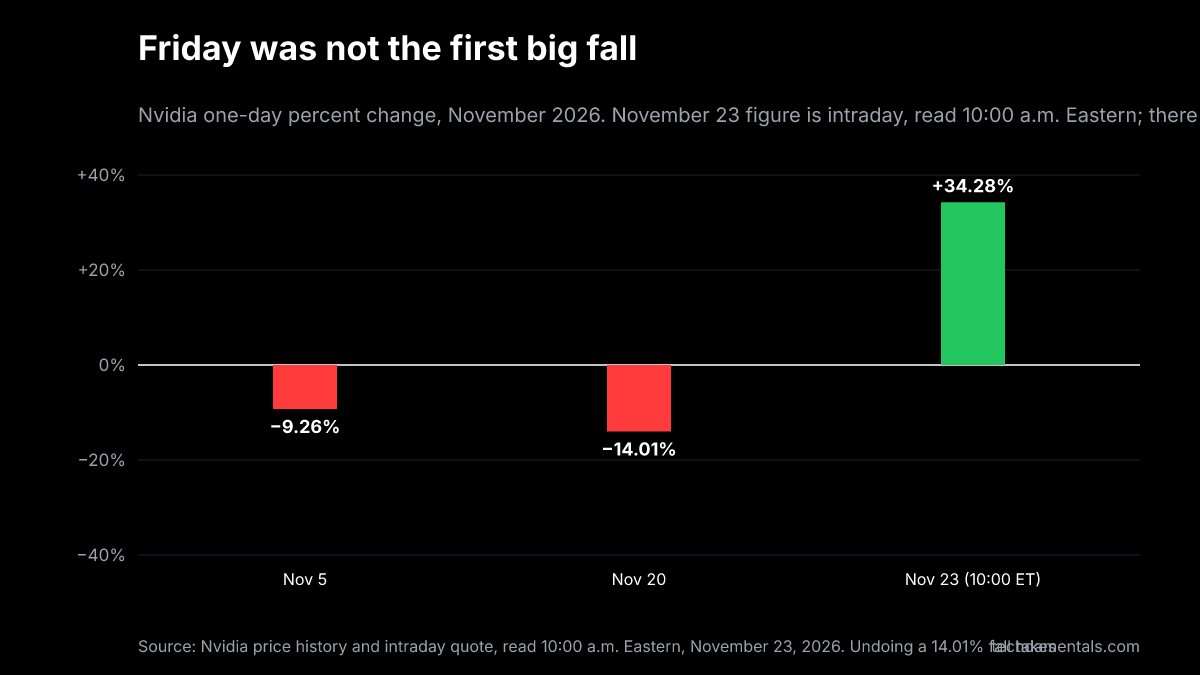
So: board watches half the company's value evaporate, board folds. Except the chronology does not cooperate. The board said "does not intend to reinstate" on November 17, 2026, before the 14.01% fall on November 20. And the board's decision is dated November 22, 2026 in the 8-K, before the November 23 rally. Whatever the board reacted to, it was not the November 23 price, because that price did not exist yet.
There is a second piece of evidence, and I like it because it is a price rather than an opinion. On prediction markets, where people put real money on whether an event will happen, the chance of Huang being reinstated before the end of 2026 traded at about 3%, on more than $7.6 million of cumulative volume, right up to the reversal. That comes from a single source I could not corroborate, so hold it loosely. But if a falling share price mechanically forced boards to rehire founders, that market would not have sat at 3%.
Something changed between November 17 and November 22, 2026, and the share price was not it.
What a board of directors actually is, and why a resignation can be undone
Most people picture a board as important people who show up, nod and approve whatever management wants. That is mostly fair about the day to day. But there is one thing a board, and only a board, controls: who the chief executive is.
Shareholders, the people who own the company's stock, elect the directors. The directors hire and fire the chief executive. That is the whole chain of accountability in a public company. Nvidia's board had ten directors until it expanded to eleven effective July 13, 2026. Jones, 73, has been a director since 1993, and when Huang resigned he became the board's first ever chair, a role that had not existed before.
Now the part that unlocks this. Nvidia's November 12, 2026 8-K reads: "On November 11, 2026, the Board of Directors, or the Board, of NVIDIA Corporation accepted the resignation of Jen-Hsun Huang." Accepted. A chief executive resigning is not like you quitting a job by email. It is an offer, and the board takes it or does not.
If the exit is something a board decides to accept, it is also something a board can decide to stop accepting. And one reason that is so frictionless here: Nvidia's proxy statement, the annual document a company sends shareholders before they vote, says its executives are employed at will, with no employment agreements, no severance agreements and no change-in-control agreements. No contract to negotiate out of, no package to unwind. On the way back in, the 8-K discloses no pay, no new employment agreement, no equity grant. Nothing at all.
That is how a board reverses itself in eleven days. The harder question is what made it want to.
What the board says changed: one word
The two-sentence 8-K explains nothing. Everything else lives in Exhibit 99.1, the press release attached to the filing. Unanimity, the reasoning, the government, the committees, the compliance hire: none of it is in the filing body.
The operative passage, verbatim:
"The Board of Directors voted unanimously to reinstate Mr. Huang following a series of discussions and meetings with Mr. Huang, after which the Board was satisfied with respect to Mr. Huang's candor and ability to lead NVIDIA. In the process of reaching its decision, the Board received input from senior levels of the United States government, and based on that input, the Board is confident that Mr. Huang's reinstatement poses no national security risk."
Two stated grounds. Candor, and government input. That is the complete list of reasons Nvidia has given. No mention of the share price, no mention of the petition, no finding from any investigation.
"Candor" is doing specific work. It means forthrightness, telling your own board the truth without being asked. It is also the term at the center of the most famous chief executive removal of the last decade: on November 17, 2023 OpenAI's board fired Sam Altman, saying he "had not been consistently candid in his communications," and reinstated him five days later, on November 22, 2023, after roughly 97% of employees signed a letter demanding it. Same calendar days, three years apart, the same word in both directions.
Satisfied about what? On November 17, 2026 Jones said on the call that "after disclosure of personal behavior inconsistent with the company's code of conduct, standards, and cultural norms, Jensen Huang voluntarily resigned." That is as specific as the company has ever been, and it was said on a call, not written in a filing. Neither 8-K gives a reason. Outlets have reported specifics Nvidia has never confirmed in any document, and I am not going to repeat them.
The release also says the board formed a committee of independent directors to investigate reporting that Huang "has been the target of a foreign intelligence effort," and that "the committee's investigation will proceed to conclusion." The board put him back before its own investigation finished, and said so in the same press release.
The thing I keep rereading
A board of a US public company wrote, in a document filed with the SEC, that it "received input from senior levels of the United States government" while deciding who its chief executive would be, and that based on that input it was confident the appointment "poses no national security risk." Nvidia names no person, no agency, no letter, no call, no meeting, no date.
Two public events sit nearby. At 9:54 p.m. Eastern on November 22, 2026, according to an unofficial archive of his posts, President Trump wrote: "I hope the Board of Nvidia rehires Jensen Huang. It would be the best thing for the Company, and also, for the U.S.A." On television over the weekend of November 21 and 22, 2026, Treasury Secretary Scott Bessent said "Jensen is on the outside now," adding that he was confident "the Nvidia committees are moving very quickly on this."
The 8-K gives a date for the board's vote and no time, and the post is stamped that same night, so I cannot tell you whether the board voted before or after it, and neither can anyone else working from public documents. Nothing connects either official's words to the filing's phrase. The link is an inference, and I am not going to dress it up as a fact.
The supervision was already built, for a company without him
This is where my first read was wrong, and the correction is more interesting than what I thought I had. I assumed the oversight structures in the November 23 release were the price of Huang's return. They are not.
On November 17, 2026, the same day it said it did not intend to reinstate him, Nvidia put out a separate press release establishing a National Security and Export Control Oversight Committee as a new standing committee of the board, chaired by Suzanne Nora Johnson, a retired vice chairman of Goldman Sachs seated as a director in July 2026, with Stephen C. Neal, 77, the board's lead director since 2019, and John O. Dabiri, 46, a Caltech professor and director since 2020. Nvidia's national security and global trade compliance teams were to report to that committee and to interim chief executive Colette Kress.
The board built the machinery for an Nvidia run by someone other than Huang, then five days later put Huang inside it. Of the three governance items in the November 23 release, only one is new: Nvidia is "commencing a search" for a Chief Compliance Officer. The investigation committee is "previously announced," and the security committee was already formed on November 17, 2026.
And its powers are blank. The announcement says the committee meets at least quarterly, retains outside experts and receives reports from the trade teams. It says nothing about whether it can stop a customer order, review past chip shipments or veto an order into a particular country.
The November 23 move, and what nobody can attribute
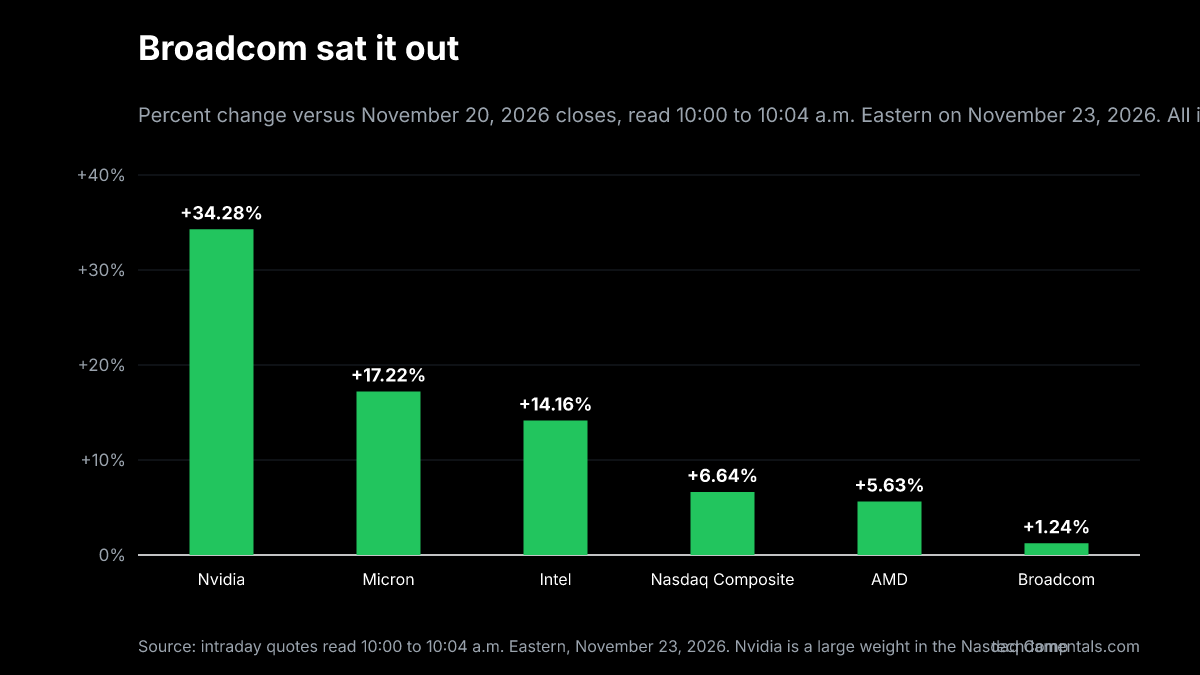
At the times I read them on the morning of November 23, 2026, Nvidia was up 34.28%, Micron up 17.22%, Intel up 14.16%, Advanced Micro Devices up 5.63% after trading as much as 12.57% higher earlier in the session, and Broadcom up just 1.24%. Nvidia's largest one-day gain in the previous three years was 18.7%, on April 9, 2025, so this was roughly double anything in that window. I cannot call it a record, because I could not get a clean series going back far enough.
Why did it move that much? Several explanations fit and I cannot separate them. The reinstatement itself is the only one with a primary document and a matching clock: the 8-K hit at 8:57:54 a.m. and the stock went from up 8.9% before the open to up roughly 30% after it. A broad market rebound is real too, with the Nasdaq Composite up 6.64% after the 5.28% fall on November 20, and Intel and Micron rising double digits with no company news of their own. An oversold bounce fits, off a 52-week low and seven straight down sessions. The political statements may have amplified the move, though they cannot explain a decision already dated November 22. Nobody can tell you the weights.
One correction on a figure you may see elsewhere: 34.28% above the November 20 close still left Nvidia 9.69% below its November 6, 2026 close of $186.64, roughly 70% of that drawdown recovered, not nearly all.
What this does not tell you
Nvidia has not said who in the government it spoke to, in what form, or when. It has not said what the board learned about Huang's candor between November 17 and November 22, 2026. It has not said what the investigation has found, because it is still running. It has not disclosed any compensation terms, and it has not said whether the security committee can block an order. There is also a reported SEC examination of the company's accounting, from one wire story citing unidentified people, with the agency declining to comment and nothing in any filing. I am not treating that as established.
Outside the boardroom, a petition asking the board to bring Huang back while an independent investigation established the facts passed 206,000 signatures by the morning of November 23, 2026, published as 10,307 current employees, 1,838 former employees, 107,929 shareholders and 86,043 others. Neither Nvidia nor Huang has endorsed it, and the release does not mention it.
Not everyone thinks this was good governance. Peter Andersen, a professional money manager, said he was "absolutely astonished" and called it a "textbook example of poor governance from the board." The sharpest objection is arithmetic: no board completes a real inquiry in eleven days, and this one says its inquiry is not finished.
So why did Nvidia bring back Jensen Huang?
On the documents, for two reasons and no others: the board satisfied itself about his candor in a series of private meetings, and it received input from a government it will not name.
What it did not do is charge him for the privilege. That was my assumption going in, and the dates kill it. The oversight committee existed before the reversal, created on the day the board said no, built to supervise a company run by somebody else, with its powers left undefined. The compliance officer who would enforce any of it has not been hired. The investigation meant to establish what happened is still open. The board reversed itself inside architecture it had just finished building to run without him, and told shareholders almost nothing about what changed its mind, except that part of the answer came from Washington.
Which brings me back to those two sentences that landed at 8:57:54 in the morning on November 23, 2026. That 8-K is the legally operative document, and it contains no reasoning whatsoever. Everything you can learn about why the most valuable company in the world changed its chief executive twice in eleven days is in an attachment, and neither the November 17 statement nor the creation of the national security committee appears in any SEC filing at all.
What I will be watching is that empty space where the committee's powers should be. Nvidia's chips are restricted by the US government according to where they are shipped, and a standing board committee now oversees exactly that. If it gets real authority over which orders ship where, it changes how a chip company gets to ship abroad, and the first place you would see it is the next proxy statement or the next 8-K.
If you want to see what any stock you follow is worth, its fair value range, sign up at techdamentals.com. It works that range out four different ways, then shows the company's fundamentals and explains what each one means. After each earnings report, it reads the company's own filing and shows what the headline left out: the numbers that came in different from what analysts expected. You can also set a value alert, so you hear when a stock moves into the part of its range you pick: undervalued, fair value or overvalued. You decide what that means for your plan; the alert only tells you when it gets there. And on the technical side, you can paste a screenshot of any stock chart, any timeframe, and it reads whether the chart has a bullish or bearish bias. That is 7 days free, with 3 analyses in each app. Try Techdamentals for seven days, no card needed
This is educational content, not financial advice. Techdamentals is an educational tool and does not recommend any security.