
On Friday, November 20, 2026, at a White House press briefing, President Trump said, "We're not going to allow our companies to build data centers outside of our country." He said companies that try would face "tremendous penalties," and he floated "a tremendous tax." He also said he had not told his own staff about it beforehand.
Nothing was signed that day. No rule, no order, no tax rate. And the same administration had spent more than a year pushing the other way. On Wednesday, July 23, 2025, Trump signed an executive order whose stated policy is to support the worldwide use of American artificial intelligence technology, including the data centers that run it, with government loans and loan guarantees to help pay for it.
So the question I want to answer is this: can Trump actually stop overseas data centers? I will take it in three stops. First, what he said and what he has the power to do. Second, the control he already holds, which is not a tax at all. Third, what it would cost the companies if more of the building happened at home, because that part turns out to be smaller than you would guess.
Why should your own money care? These companies spend so much on data centers that the spending shows up in their profit reports for years, and those reports are what stock prices react to. If you own a fund, you own a slice of them.
What did he actually say, and what can he do?
A data center is a large building full of computers. Companies like Google, Amazon, Microsoft and Meta rent that computing power out or use it to run their own artificial intelligence tools, and they are building a lot of them. Some of those buildings are in the United States and some are not. One report says Google announced a 13 billion euro program in Finland in September 2026, and that Trump posted then that he was "not happy about this." I could not check that post myself, so treat it as one report's account.
At the briefing, Trump named China and European countries such as Finland as places he worried about. He said the companies should build at home instead. Reporting on the briefing says no mechanism was described and that he did not name a rate for the tax.
That matters, because the Constitution gives Congress the power to tax. A president can ask for a tax, but a tax needs a law. A ban is a different tool, and the question there is under what authority it would be imposed, and nobody has said. As of Saturday, November 21, 2026, I could find no executive order and no bill. What exists is a statement at a podium.
BUT there is one thing the government already controls that reaches overseas data centers, and it has nothing to do with taxes.
What control does he already have?
The control is over the chips. The advanced computer chips that make these data centers useful are made with American technology, and the Commerce Department decides who outside the country may receive them. Shipping them abroad can require an export license, which is a permission slip from the government for one specific shipment to one specific customer.
On Monday, November 16, 2026, Commerce announced a new rule on exactly this, scheduled to be published in the government's official register on Thursday, November 19, 2026. It requires a license to send advanced chips to any data center in the world that provides a large amount of computing power to companies headquartered in China. It also adds license requirements for shipments to five countries: Indonesia, Malaysia, Singapore, Thailand and Brazil. And it formally cancelled a Biden-era chip rule from Wednesday, January 15, 2025. Comments on the new rule are open until Monday, January 18, 2027.
Read that carefully, because it is narrower than the headline. According to one law firm's summary, the rule does not appear to directly regulate data centers inside the United States, and it does not ban an American company from building one abroad. It is aimed at who ends up renting the chips. US-headquartered customers can qualify for an exclusion if they file monthly reports.
THEREFORE the real lever today is the chip license. It can slow a particular foreign project by holding up the chips, and it already has been used that way. But it works one shipment at a time, which is very different from a country-wide ban on building.
BUT the same lever has also been used to say yes. One report says Commerce moved the United Arab Emirates into a more favorable export group on Friday, July 10, 2026, so that named companies there and several American firms can receive advanced computing items without a license, and that two Gulf partners were cleared in November 2025 to purchase up to 35,000 of Nvidia's newest chips each. I have not confirmed those details against Commerce's own pages, so I am treating them as one analyst's account. If they hold up, the administration has been approving Gulf data centers at the same time as the president says he does not want American companies building abroad.
I cannot tell you how those fit together, and the briefing did not say. What I can say is that the policy so far has two directions at once. One is to export American technology to friendly countries. The other, on Friday, November 20, 2026, was a spoken wish to keep the buildings at home.
What would building at home cost the companies?
Now the money. The companies' spending on data centers is counted as capital expenditures, which means money spent on things that last, like buildings and computers, as opposed to day-to-day costs like salaries. Four of them reported these figures for the quarter that ended Wednesday, September 30, 2026.
Amazon reported 75.9 billion dollars of cash capital expenditures for the quarter, and says it still expects about 220 billion dollars for 2026. Alphabet reported 51.4 billion dollars on Wednesday, October 28, 2026, with a full-year forecast of 195 to 205 billion dollars. Microsoft reported 45.2 billion dollars including leases, and its finance chief said spending for the calendar year should be about 170 billion dollars. Meta reported 34.9 billion dollars and narrowed its 2026 range to 135 to 145 billion dollars. Add the four yearly figures and you get roughly 730 billion dollars, though each company counts a little differently, so treat the sum as a ballpark.
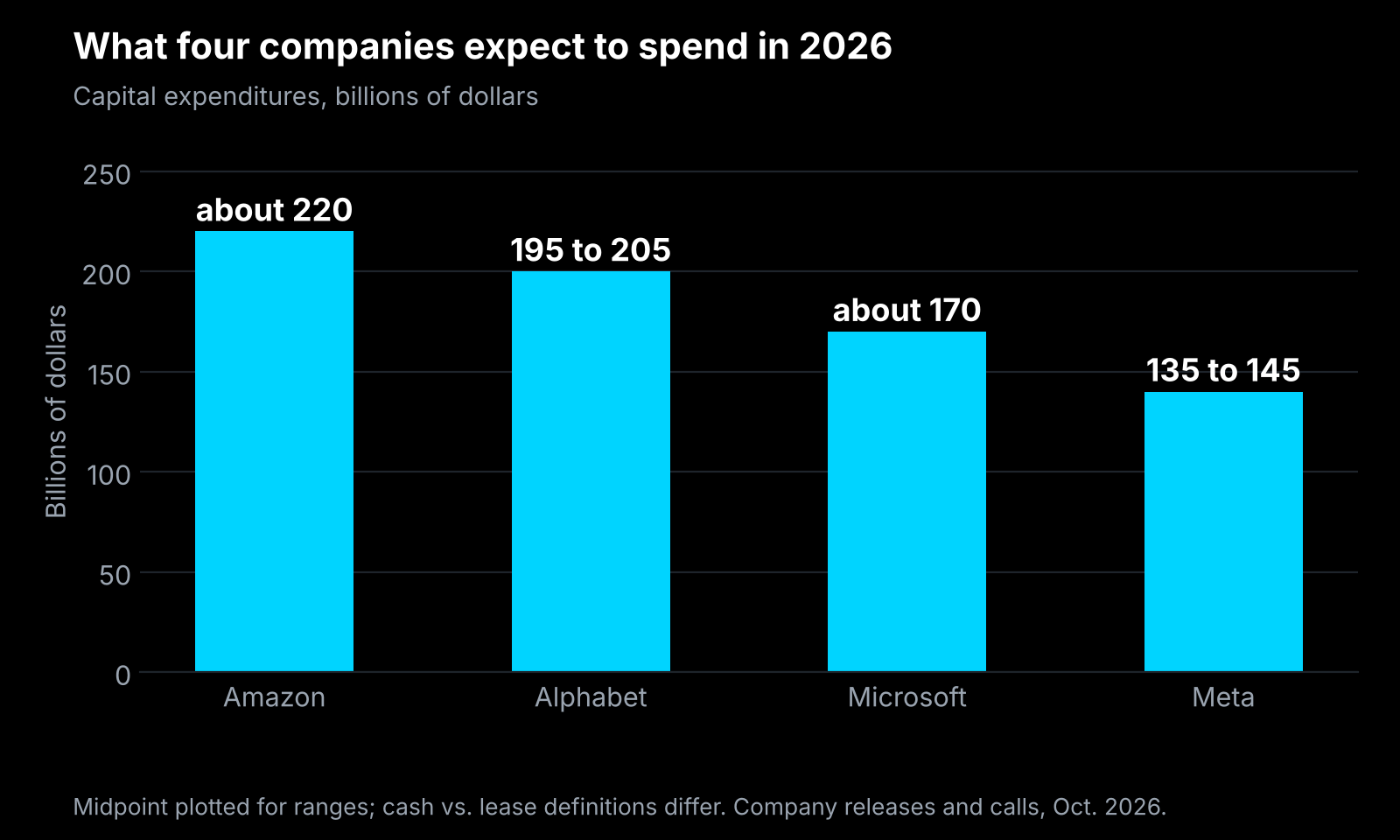
Notice what they said about next year, because it points the same way regardless of what happens with overseas building. Amazon's chief executive said on Thursday, October 29, 2026 that the company expects to "spend meaningfully more in 2027." Alphabet said, according to one summary of its call, that it expects capital expenditures to "increase significantly in 2027."
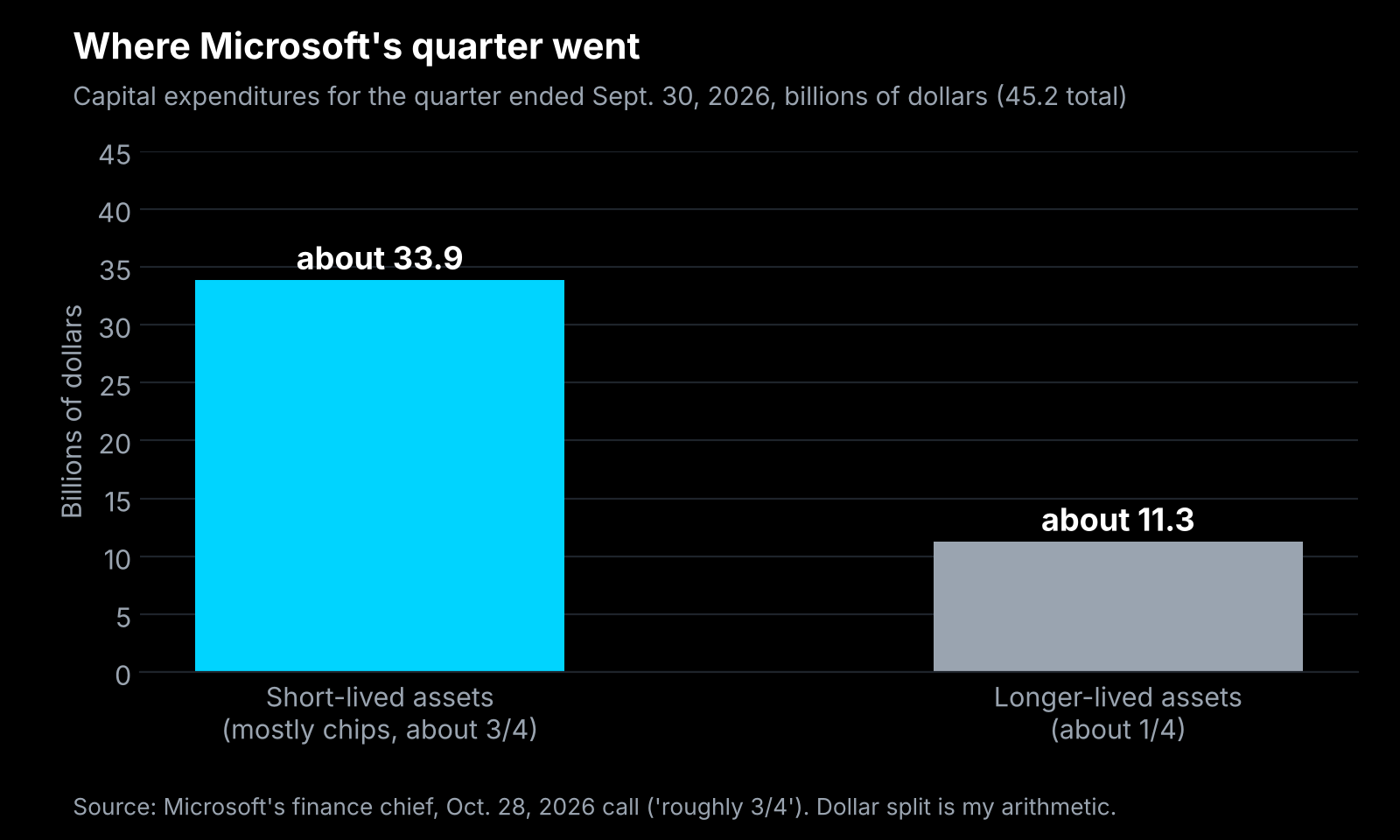
So how much of that depends on where the building sits? Less than you might think. On Wednesday, October 28, 2026, Microsoft's finance chief said "roughly 3/4 of our CapEx was for short-lived assets, primarily CPUs and GPUs." Those are the chips. A chip costs the same wherever the building is. Only the remaining quarter went to longer-lived assets, and the call did not say how much of that was the buildings themselves.
I only have that split from Microsoft. Amazon said most of its spending goes to its cloud business, without a breakdown, and the other two did not give one in the material I read. So I would not assume every company looks like Microsoft. It is the one hard number I found on the question, and it says that a rule about where the building goes touches the smaller part of the bill.
What does the building part cost at home? Two industry guides give different numbers because they count different things. A construction-cost survey dated Thursday, October 22, 2026 puts the US average at 12.08 dollars per watt for a typical 60 megawatt design, and 14 to 16 dollars per watt for the most advanced facilities built for artificial intelligence. A megawatt is a unit of electrical power, so one dollar per watt is a million dollars per megawatt. The same survey says costs in North America and Europe are up 13% from a year earlier, and 81% of respondents say skilled labor is in short supply. A second guide, published Thursday, September 3, 2026, says all-in costs in the United States and Canada average 17.6 million dollars per megawatt, excluding the chips, up 21% since the fourth quarter of 2024. It says land that already has power connected averaged 584,000 dollars per megawatt, 51% higher than a year earlier. It also says Texas is among the cheapest markets.
Building at home was already getting more expensive before any ban. I looked for a like-for-like figure for the same building in the UAE or Finland, and I could not find one that I trust. I also could not confirm that running a data center abroad costs less per year. Those are the comparisons that would show how much a ban or tax changes the math, and they are not in the public material I found.
One more effect that readers rarely see. Money spent on chips and buildings does not hit profit all at once. It is counted over several years as depreciation, which is the accounting rule that spreads the cost of something long-lasting across the years you use it. Alphabet's finance chief said, according to a summary of the call, that more infrastructure spending will raise depreciation and operating costs. So the spending in this story leaves a trace in earnings for years after the money goes out.
What this does not tell you
I do not know what Trump will do next. A statement at a briefing, which he said was a surprise even to his staff, is not a policy, and the headlines have not agreed on whether he "banned" or only "threatened" something. Several of the details above come from a single analyst or law firm summary, which I have said where it applies.
This also does not tell you what any company will do. Capital spending plans are decided by the companies, and I have only reported what they said. And it does not tell you that a tax or a ban would raise or lower anyone's costs, because I could not find a trustworthy cost comparison with the places in question.
Can Trump stop overseas data centers?
Not with a tax he announces alone. Taxes are written by Congress, and as of Saturday, November 21, 2026 I found no bill. Not with a ban either, since nobody has named the authority. What he does control is the chips. The Commerce rule from Monday, November 16, 2026 shows that lever in use, but it is aimed at who rents the computing power, not at where an American company builds, and the same administration has also approved projects in the Gulf.
If he did push the buildings back home, the part of the bill that moves is the smaller part. At least at Microsoft, roughly three quarters of the spending goes to chips that cost the same anywhere.
That brings me back to the podium on Friday, November 20, 2026. He said, "We're not going to allow our companies to build data centers outside of our country." As of now, that sentence is a wish with no document behind it.
Where to look next
Watch for a written order, a bill, or a statement from Commerce that says how a ban or tax would work. Watch the close of the comment period on Monday, January 18, 2027. And watch the next round of company reports, where Amazon and Alphabet have already said they expect to spend more in 2027, to see how much of it is chips and how much is buildings.
If you want to see what any stock you follow is worth, its fair value range, sign up at techdamentals.com. It also shows a company's fundamentals alongside technical analysis of its chart. After each earnings report, it reads the company's own filing and compares the financials with what analysts expected, line by line, so you can see the real reason a stock moved. Try Techdamentals for 3 days, no card needed
This is educational content, not financial advice. Techdamentals is an educational tool and does not recommend any security.