
On Thursday, November 19, 2026, Anthropic's stock made its first trade at 111.50 dollars, two hours and eighteen minutes after the market opened. It closed the day at 97.17 dollars. The night before, the company had priced its shares at 83 dollars. So the stock finished 17% above the offering price and almost 13% below where it first traded.
That same day, the S&P 500 fell 2%, the Nasdaq composite fell 2.3%, and Nvidia, one of the investors in the offering, fell 3.3%. A new stock that jumps while the market sinks is a strange picture, and it leaves one question hanging over everyone who watched it: what happens after Anthropic's IPO? An IPO, or initial public offering, is the first time a company offers its shares to the public.
Most people will tell you the first-day pop is hype and that it fades. Hold that thought.
I will take you through three stops. First, what the 97.17 dollar price is actually made of, because the company's value changes by about half a trillion dollars depending on which shares you count. Second, a calendar that is already written down, with a date when index funds may be required to purchase the stock and dates when insiders can begin cashing out. Third, what two other giant first days did next, and that is where the 2.3% drop comes in.
Why this touches your own money
Many retirement accounts hold index funds. An index is a scoreboard that tracks a list of companies, and an index fund is a fund that holds every company on the list in proportion. One of the most popular lists is the Nasdaq-100, which follows 100 of the biggest companies listed on the Nasdaq exchange. If your 401(k) or IRA holds a fund that follows it, a rule written by the people who run that list may soon require your fund to purchase Anthropic. Nobody at your fund decides that, and neither do you.
There is also a quieter link. Amazon and Alphabet, the parent of Google, are reported to own about 28% of Anthropic between them. Large funds that follow the biggest US companies already hold Amazon and Alphabet, so you may already own a slice of Anthropic without ever having placed an order.
First stop: what is the price made of?
Start with the day itself. When a new stock lists on Nasdaq, the exchange runs a single auction to set the first price, called an opening cross. It matches every order at one price, so nobody gets a different deal from anyone else. According to a live record of the day, this one waited for the lead bank, the bank that organizes the offering, to say it was ready. The first trade printed at 11:48 a.m. Eastern time at 111.50 dollars, which was 34.3% above the 83 dollar offering price.
A minute later the stock touched its high for the day, 114.99 dollars. At 1:18 p.m. Eastern it touched its low, 92.72 dollars. It closed at 4:00 p.m. at 97.17 dollars, after about 832 million shares changed hands. Those open, high, low and volume figures come from a single live record, though the 111.50 first trade and the 97.17 close show up in other reports too.
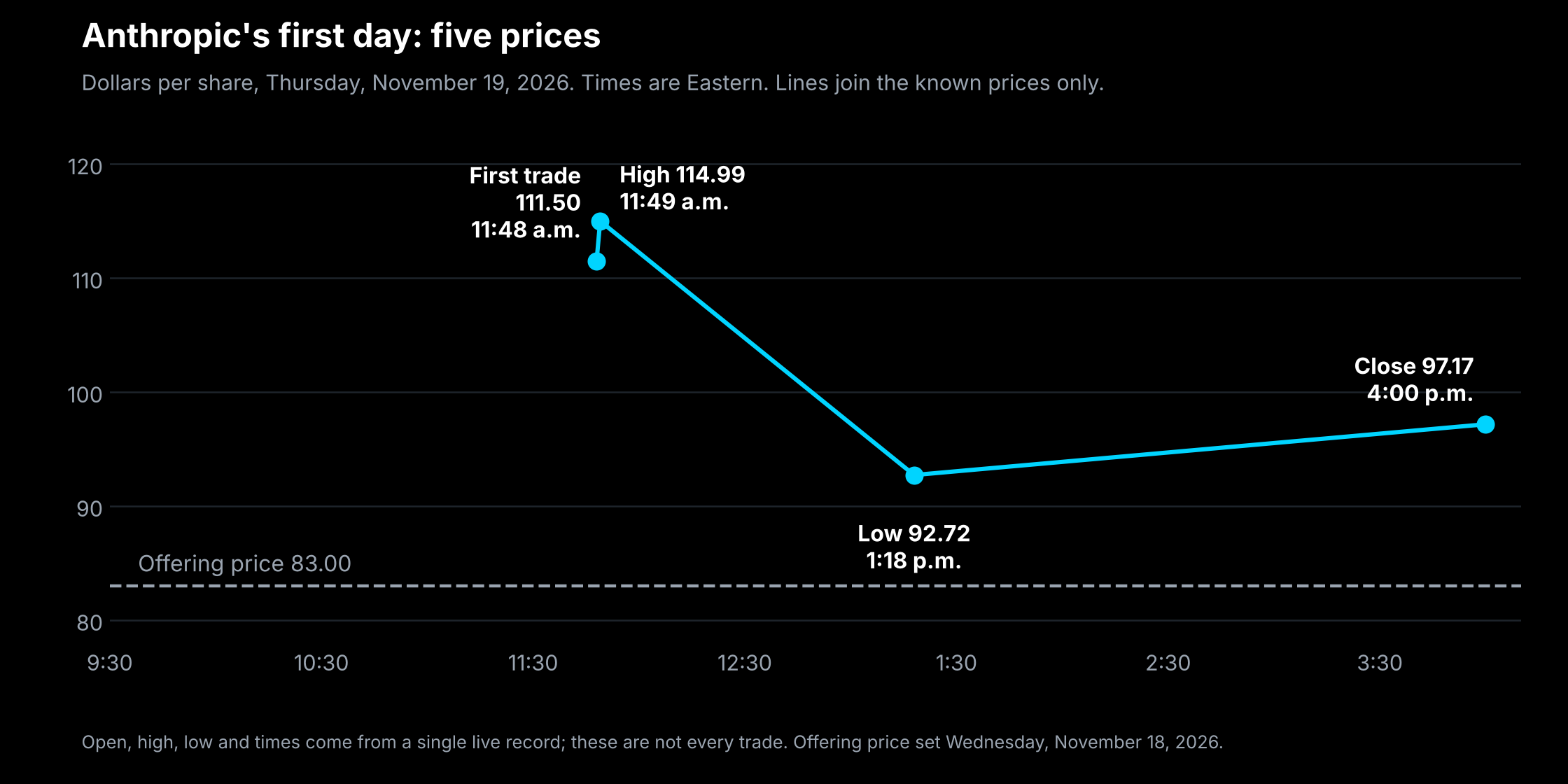
Nobody can tell you why the price slid from 111.50 to 97.17. Several things fit. A first trade can land far above where the stock then settles if the opening orders were lopsided. The whole market was falling that day. And unofficial indications of a price 22% to 26% above the offering price had been reported before the open, so the first trade may have carried some of that excitement. I can list those candidates. I cannot rank them.
Now the number everyone repeated: a company worth 1.76 trillion dollars at the close. A company's market value is the share price multiplied by the number of shares. The catch is that there is more than one count of shares.
The preliminary prospectus, the document a company files with the Securities and Exchange Commission before it lists, showed about 13.1 billion shares outstanding after the offering. Anthropic has several kinds of stock, called classes, and about 7.4 billion of those shares were Class A and about 5.7 billion were Class N. Multiply the 97.17 dollar close by roughly 13.2 billion shares and you get about 1.28 trillion dollars. That is my arithmetic, using a share count from one live record.
The 1.76 trillion figure counts more shares. It is a fully diluted number, which adds shares that do not exist yet but could, such as stock options and stock awards that employees hold. Dividing 1.76 trillion by the closing price implies about 18.1 billion shares, which is again my arithmetic. The same gap showed up the night before the debut. At the 83 dollar offering price, the value was reported as about 1.1 trillion dollars on shares outstanding and about 1.5 trillion fully diluted. Both numbers are right. They answer different questions: what exists today, and what exists if every award turns into stock.
Counting shares tells you the size of the number. It does not tell you whether the number makes sense, and for that I want to compare the price with what the company brings in. The filing has those figures.
The company reported 17.0 billion dollars of revenue for the quarter that ended September 30, 2026, according to the preliminary prospectus. Revenue is the money a company brings in from customers before subtracting its costs. Over the four most recent quarters it was about 35.3 billion dollars, according to a business magazine's report on the company's results. Divide the 1.76 trillion value by 35.3 billion and you get about 50. That is the price-to-sales ratio, meaning how many dollars investors are paying for each dollar of yearly revenue. It is my arithmetic from two sources, so treat it as approximate.
Is 50 a lot? A University of Florida professor who studies IPOs, Jay Ritter, found that only 14 of 4,110 US IPOs from 1980 through 2024 reached a comparable price-to-sales level. Those 14 averaged returns 15.4% below the broader market over holding periods of up to three years, though some did better. That is one researcher's study, reported secondhand.
A different professor, Aswath Damodaran of New York University, estimated Anthropic's equity value at about 1.475 trillion dollars before the debut. His model assumes the company reaches 1 trillion dollars in yearly revenue by 2036 and keeps a 27.5% operating margin, which is profit from operations as a share of revenue. Going from 35.3 billion to 1 trillion in ten years means revenue growing about 40% every year, compounded. That is my arithmetic. At the closing value, the company sat about 19% above his estimate. None of this says what the company is worth. It shows what has to go right for the number to hold.
But the bills are large too
The same filing lists what the company has promised to spend. It has about 900.9 billion dollars in committed spending, substantially all of it for compute, meaning the data centers and chips that run its models. About 451.6 billion dollars of that falls due before December 31, 2030, and about 70.7 billion falls due in the twelve months after September 30, 2026. That one-year bill is close to four times the latest quarter's revenue, since four times 17.0 billion is 68.0 billion. That comparison is my arithmetic. A summary of the filing reported that customers had committed about 13.8 billion dollars in return, and I could not confirm that figure against the document itself.
The profit lines are harder to read. Operating profit is what a company earns from running its business, before things like interest and taxes. A summary of the filing reported that Anthropic had its first operating profit in the second quarter of 2026, about 974 million dollars on 11.6 billion dollars of revenue. The same summary reported a net loss of about 80.7 billion dollars for the first half of 2026, and said most of it came from an accounting adjustment, not from spending. Net loss is the bottom line after everything is counted. I could not read the filing's own explanation of that adjustment [VERIFY: the net loss note in the final prospectus], so I am not going to tell you what it was.
Two more facts from the filing and its summaries shape what a shareholder owns. About 44% of revenue in the first nine months of 2026 came through the cloud marketplaces run by Amazon, Google and Microsoft, which is reported by two separate sources. Those same companies offer competing models and, in two cases, own stakes in Anthropic. And one special share, called Class F, is held by a company owned by the seven co-founders. It carries 50.1% of the total voting power and no economic rights. A shareholder who purchases the stock shares in the company's profits, while the votes on most matters sit with the founders' company.
All of that leaves a stock with a small number of shares available to trade and a very large number of shares held by people who cannot cash out yet. That is the second stop.
Second stop: who has to purchase it, and who can cash out?
The shares that actually trade on the exchange are called the float. In the preliminary prospectus, the company offered 825 million shares, which is about 6.3% of the 13.1 billion outstanding. Market reports say the final offering was upsized to about 980 million shares, which would be about 7.4%. The investors in a separate 26 billion dollar private placement received shares that are restricted for now, so they are not part of the float. Those investors were Google, Nvidia, AMD, Broadcom, Micron, Microsoft and TSMC, and some of them, including Google, Broadcom and Microsoft, also supply Anthropic with computing.
A small float meets a big index rule. Nasdaq changed the rules for the Nasdaq-100 earlier this year, effective May 1, 2026. Under what it calls fast entry, a newly listed company that ranks among the top 40 in market value can join after 15 trading days, instead of waiting three months. I read the rule in Nasdaq's own explanation, which is dated July 2026.
The clock, as that explanation lays it out, runs like this. On the seventh trading day, Nasdaq ranks the company. On the tenth trading day it announces the addition. After the fifteenth trading day it adds the company, effective at the next market open. Counting Thursday, November 19, 2026 as the first trading day and treating Thursday, November 26, 2026 as the Thanksgiving holiday, the seventh day is Monday, November 30, 2026. The announcement day is Thursday, December 3, 2026. The fifteenth trading day is Thursday, December 10, 2026. That count is mine, so check it against Nasdaq's announcement.
One wire service reported a different date, Monday, December 21, 2026. The rule says that when a listing lands close to a regular quarterly review, the addition can wait for that review. I did not find which date Nasdaq will use [VERIFY: Nasdaq's announcement of Thursday, December 3, 2026 or thereabouts]. Whichever it is, the date should be public a couple of weeks after the debut.
When a company joins, every fund that follows the index must hold it. That is what makes an index fund an index fund. But the rule limits how big the company's weight can be. A company's weight is capped at the lesser of its listed market value or three times its float value. Nasdaq's own example is that a company with a 5% float is capped at 15% of its listed market value. Anthropic's float is around 6% to 7%, so at most about 19% to 22% of its value would count. That is my arithmetic from Nasdaq's example, and the exact calculation may differ.
How much would the funds purchase? A research firm called Intropic estimated, before the offering priced, that index-tracking demand could reach about 28% of the IPO shares, or roughly 19 billion dollars. That is a single estimate made at a lower price and a smaller share count, so I would treat it as a rough size, not a forecast.
Now the other side of the calendar. A lockup is an agreement that stops insiders from cashing out their shares for a set time after the listing. In the preliminary prospectus, the lockups cover directors, officers and holders of substantially all of the company's stock, about 15.5 billion Class A shares counting everything that could convert. Most are restricted for up to 180 days. The co-founders and holders of more than 0.5% of the company before the offering are restricted for up to 365 days.
There is an early exit. About 3.7 billion shares under the 180-day lockup may become eligible sooner. That includes up to 10% of the locked shares held by non-founder directors, officers, and current and former employees and consultants, which could be sold beginning on the first day of trading. That day was Thursday, November 19, 2026. I did not find how many shares were actually sold.
Put that 3.7 billion next to the float. It is nearly four times the roughly 980 million shares offered, which is my arithmetic. A summary from one outlet adds a schedule of further releases at 27, 48, 62 and 76 days after the prospectus date, and another 35% after full-year 2026 results. I could not confirm that schedule in the sections of the filing I could read [VERIFY: the "Shares Eligible for Future Sale" section of the final prospectus]. The 180-day mark falls around mid-May 2027, depending on the prospectus date, and the 365-day mark around mid-November 2027.
Put together, the picture looks like this. A small number of shares trade. A required purchase by index funds may arrive in December 2026. A much larger pool of shares becomes eligible for cashing out in stages. That raises the question of what stocks like this have done in the weeks and months after a big first day, and two recent giants give two different answers.
Third stop: what did two other giant first days do next?
SpaceX priced at 135 dollars, opened at 150 dollars on Friday, June 12, 2026, and closed that first day at 160.95 dollars, up 19.2%. It raised about 75 billion dollars, according to reports. On Thursday, November 19, 2026, a quote page showed SpaceX at 138.43 dollars. That is about 2.5% above the offering price, by my arithmetic, five months after a 19% first day.
Cerebras, a maker of chips for artificial intelligence, priced at 185 dollars on Wednesday, May 13, 2026. It closed its first day on Thursday, May 14, 2026 at 311.07 dollars, up 68%. Since then it has fallen below its offering price after an earnings report, according to several headlines, and one report put it about 45% below.
Anthropic closed its first day up 17.1%. That puts it in the same range as SpaceX on day one, and below Cerebras.
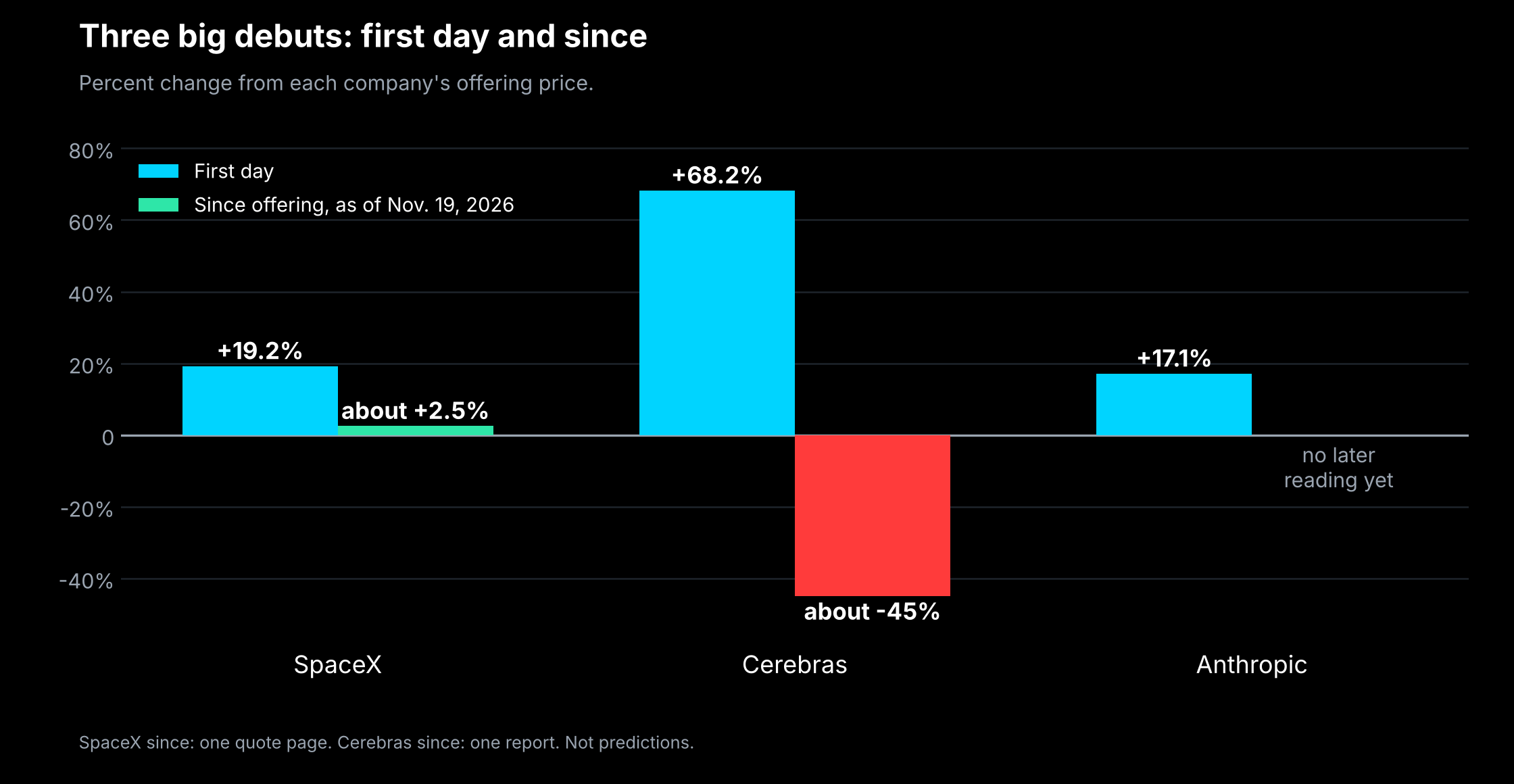
Is that evidence that the pop fades? Two examples cannot settle it. One stock gave back almost all of its first-day gain and the other gave back all of it and more, but they are different businesses listed in different months, and the study of the 14 richly priced IPOs says some of them did better than the market. A first-day jump tells you what people paid that day. It says little about the months after.
That leaves the 2.3% drop. Who owned Anthropic that day, and what happened to them?
Amazon and Alphabet are the two biggest outside owners. According to the same factbox, Amazon put in about 18.0 billion dollars through loans and shares between 2023 and May 2026, and Google about 33.3 billion through loans, shares and a private placement. A wire-service factbox put their stakes at about 271.8 billion and 139 billion dollars at the 78 dollar top of the pricing range, around 411 billion together. At the 97.17 dollar close, that is roughly 25% more, or about 510 billion, by my arithmetic. Yet one quote page showed Amazon down about 3.9% and Alphabet down about 2.9% on Thursday, November 19, 2026. Those two figures come from a single page that does not label them as official closes [VERIFY: official closes for Amazon and Alphabet]. Nvidia, another investor, was up about 4% early and finished down 3.3%, which two sources agree on.
The wider market fell too. The S&P 500 lost 147.80 points to close at 7,175.83. The Dow lost 1,101.11 points, or 2.2%, to 49,097.06. The Nasdaq composite lost 550.69 points, or 2.3%, to 23,879.20. Those are the printed closes.
Several explanations fit. One report tied the drop to valuation worries and fears of more rate increases from the Federal Reserve, the central bank that sets the basic interest rate. One market recap said the retreat in artificial intelligence stocks followed the debut. A reading I cannot show from the data is that investors raised cash to pay for the offering by cutting other holdings. And a few big names fell on their own news that day, such as AMD, after an investment firm disclosed a short position and made claims that AMD disputes, and Williams-Sonoma, after a quarter that was in line but only repeated its guidance. I can list the candidates. I cannot tell you which mattered most, and neither does any source I read.
How to read the filing yourself
Every number in the second stop sits in a document anyone can open for free on the Securities and Exchange Commission's website, under the company's name.
The lockup terms are in the summary near the front, in a box called "The Offering," and in more detail in a later section called "Shares Eligible for Future Sale." Read both. The summary gives the headline and the later section gives the schedule.
The computing commitments are in the management discussion, the part where the company explains its own results, and in the notes to the financial statements. Look for a table that breaks the total into years. That table is where I got the 451.6 billion and 70.7 billion dollar figures.
The voting terms are near the front too, under the description of the different classes of stock. If a company has more than one class, find out which one carries the votes.
And the final prospectus is a separate filing from the preliminary one, so look for the one marked 424(b)(4). Share counts and the size of the offering can change between the two, as they did here.
What this doesn't tell you
The preliminary prospectus is not the final one. It had an offering of 825 million shares and the final offering was larger, so some figures here, including the share counts and the float, shifted. I could not open the final prospectus, so the share counts come from the earlier version and one live record.
I could not confirm the staged lockup schedule, the date Nasdaq will use for the index addition, or the official closes for Amazon and Alphabet. The price-to-sales figures rest on a four-quarter revenue number from a magazine's report, and the study and the valuation model come from that same report. The S&P 500 has its own rules for adding companies, and I did not check them for this issue.
And no source I read says where the stock will trade. A calendar tells you when purchases and cash-outs are allowed. It does not tell you what the price does when they happen.
What happens after Anthropic's IPO?
Three things are already written down. The share count is large and uneven: about 1.28 trillion dollars on the shares that exist, about 1.76 trillion counting shares that could exist, and about 6% to 7% of the stock available to trade. The calendar has two kinds of dates. Index funds that follow the Nasdaq-100 may be required to purchase the stock in December 2026, and insiders can begin cashing out in stages, with the first small slice allowed on the debut day and the big releases starting around mid-May 2027. And the history of other giant debuts is mixed, with one near its offering price and one far below it.
What no document tells you is the price. Anyone could see the first-day pop on a screen. The calendar sits in the filing and the index rules, where fewer people look.
Go back to Thursday, November 19, 2026. A stock that first traded at 111.50 dollars and closed at 97.17 dollars is hard to describe with a single price. A person who received shares at the 83 dollar offering price and a person who paid the first-trade price had two different days, and both were in a market that was falling.
Where to look next
Four dates are worth putting on a calendar. Around Thursday, December 3, 2026, Nasdaq is due to announce whether and when Anthropic joins the Nasdaq-100. The Federal Reserve meets on Tuesday, December 8, 2026 and Wednesday, December 9, 2026, and rate expectations have been moving stocks. Thursday, December 10, 2026 is the fifteenth trading day. And the company's first report as a public company will show whether the revenue growth and the compute bills in the filing are moving the way the price assumes. I did not find a date for that report.
If you want to see what any stock you follow is worth, its fair value range, sign up at techdamentals.com. It also shows a company's fundamentals alongside technical analysis of its chart. After each earnings report, it reads the company's own filing and compares the financials with what analysts expected, line by line, so you can see the real reason a stock moved. Try Techdamentals for 3 days, no card needed
This is educational content, not financial advice. Techdamentals is an educational tool and does not recommend any security.