
On Monday, November 16, 2026, after the United States stock market closed at 4 p.m. Eastern time, the federal agency that runs Medicare put a 167-page proposal onto a public reading desk in Washington, and by the closing bell on Thursday, November 19, 2026, UnitedHealth Group, the largest health insurer in America, was worth 19.79% less than it had been when that session on Monday, November 16, 2026 ended.
The agency is the Centers for Medicare and Medicaid Services, which I will call CMS. It writes the rules for Medicare, the federal health insurance program for Americans 65 and older, and it pays the private insurance companies that cover most of those people now. The proposal is called the Comprehensive Regulations To Uncover Suspicious Healthcare rule, shortened by CMS itself to CRUSH, filed under the docket number CMS-6098-P. It was printed in the Federal Register, the government's official daily record of what agencies are doing, on Thursday, November 19, 2026, at pages 74680 to 74846 of volume 91.
The share prices over those three sessions, measured from the closing price on Monday, November 16, 2026 to the closing price on Thursday, November 19, 2026, give the cleanest window available, because the document went public after the close on Monday, November 16, 2026. UnitedHealth Group fell 19.79%, which took its closing price from $412.02 down to $330.48. With 896.02 million shares outstanding, that is roughly $73 billion of market value, by my own arithmetic from the share count and the two closing prices. Humana fell 17.61%, from $461.25 down to $380.00. Elevance Health fell 12.58%. Centene fell 12.29%. CVS Health fell 9.65%. Cigna fell 9.04%. A fund tracking the S&P 500, the index of 500 large American companies that most retirement money sits in, fell 3.25% over the same three days.
Nothing has been decided. A proposed rule is a draft. CMS has to take written comments from the public until January 19, 2027, then read them, then publish a final version, and only then does anything bind anybody. The agency has even asked for comment on when each piece should take effect.
And the strange part, the part that sent me looking: on Monday, November 16, 2026 itself, every one of those insurers except CVS Health closed higher. UnitedHealth rose 1.12%. Humana rose 2.50%. Elevance rose 3.86%. Centene rose 4.91%. That was a day the S&P 500 fund fell 1.91%. Health insurers were the best place in the market to be on Monday, November 16, 2026, and three days later they were the worst.
So why did a proposal nobody has finalized take roughly a fifth off the biggest health insurer in America in three days?
The obvious answer is a fraud crackdown, and CMS did nothing to discourage that reading when it named the thing CRUSH. That answer is partly right and it explains almost none of the arithmetic. What I want to walk you through instead is how Medicare Advantage actually pays an insurer, which comes down to a single number per patient; what a chart audit can and cannot collect, which comes down to one statistics word; and then the thing that genuinely surprised me, which is that CMS already finalized this identical policy once, already lost it in court, and already put a price on it that was nineteen times smaller than the one it published on Monday, November 16, 2026.
Before any of that, why this reaches you even if you have never thought about Medicare once. UnitedHealth Group is one of the thirty companies in the Dow Jones Industrial Average, and the six companies above are all in the S&P 500, which means if you own a broad index fund in a retirement account, you own pieces of all of them. More than that, this is one of the clearest examples I have seen all year of a specific thing: a company's revenue depending on how a government agency words a document, and a draft of that document moving the stock harder than any earnings report did. That pattern is not unique to health insurance.
What actually landed on Monday, November 16, 2026?
CMS posted the proposal to the Federal Register's public inspection desk, the place documents sit for a few days before they are formally published. One account I found puts the filing at 4:15 p.m. Eastern, fifteen minutes after the market closed. I could not confirm the clock time from a primary source, so treat it as reported rather than established, though it fits the price pattern exactly: the session on Monday, November 16, 2026 was unaffected, and Tuesday, November 17, 2026 was the first session that could price any of it.
CRUSH is not one idea. The agency's own fact sheet, dated Monday, November 16, 2026, covers screening and enrollment of health care providers, reporting of overpayments in traditional Medicare, integrity reporting for managed care, ownership transparency, and payment deductions in Medicaid. CMS says the parts of the rule it can put numbers on would produce nearly $90 billion in federal budget savings between 2027 and 2036, against about $378.51 million in costs.
But one section did the damage, and the rule's own summary tells you what CMS thinks is at stake in it. In section I.B.2, the agency describes the Medicare Advantage Risk Adjustment Data Validation program as oversight of something "responsible for $21 billion per year" in overpayments from the improper inflation of patient risk scores. And in that section, CMS proposes three things: that it would not apply a fee-for-service adjuster, that it would determine the sampling methodology itself, and, in its own words, that it would begin extrapolation of audit findings with payment year 2018 audits. CMS says this approach would let it collect an average of approximately $9 billion per payment year.
Every one of those phrases needs unpacking, so let me start where the money starts.
How does Medicare Advantage pay an insurer in the first place?
Traditional Medicare works the way most people picture insurance from the government: you see a doctor, the doctor bills Medicare, Medicare pays for that service. It is called fee-for-service because the payment follows each service.
Medicare Advantage is the other option. Instead of paying your doctors one bill at a time, the government hands a private insurer a fixed monthly amount to take care of you entirely, and the insurer keeps what it does not spend. According to published enrollment figures for 2026, 35.2 million people of the 64.2 million eligible are in Medicare Advantage, which is 55% of everyone eligible. It is not a side business any more. It is how the majority of Medicare beneficiaries get their coverage.
Now the part that matters. That fixed monthly amount is not the same for everybody. A 79-year-old with diabetes, heart failure and kidney disease costs far more to look after than a healthy 66-year-old, so if the government paid the same for both, no insurer would want the sick one. To fix that, CMS gives every person a risk score, and the payment scales with it. Higher risk score, bigger monthly check.
The risk score is built out of diagnosis codes: the standardized codes that say this patient has this condition. And those codes come from the insurer. The insurer collects them from the doctors in its network and submits them to CMS, and the payment follows.
Think about what that means for a second. The company being paid is the company that documents how much it should be paid. There is nothing sinister in the design, because somebody has to report the diagnoses and the insurer is the one holding the records, but it is the reason an audit program has to exist at all. The whole system rests on each code being supported by something in the patient's medical chart.
What can a chart audit collect, and what has it collected so far?
That is what Risk Adjustment Data Validation does. CMS picks a Medicare Advantage contract, pulls a sample of enrollees, and asks the insurer to produce the medical records that back up the diagnoses it submitted for those people. If the chart supports the code, fine. If it does not, the payment attached to that code was too high.
The sample is small by design. Under the methods used for the payment year 2020 cycle, it runs in four tiers by contract size, 200 enrollees for the largest contracts down through 100 and 50 to 35 for the smallest. I am taking those tiers from a secondary summary rather than from CMS's own instruction document, which I could not read, so hold that detail loosely. The important shape is right: a few dozen to a couple of hundred charts per contract, out of contracts that can hold hundreds of thousands of people.
Then comes the question the entire story hangs on. CMS has found errors in those sampled charts for years. What has it been allowed to collect?
Only the overpayments on the sampled people themselves. For payment years 2011 through 2017, recoveries were limited to enrollee-level adjustments. Find a bad code in Mrs. Garcia's chart, take back what the bad code paid for Mrs. Garcia, and stop there.
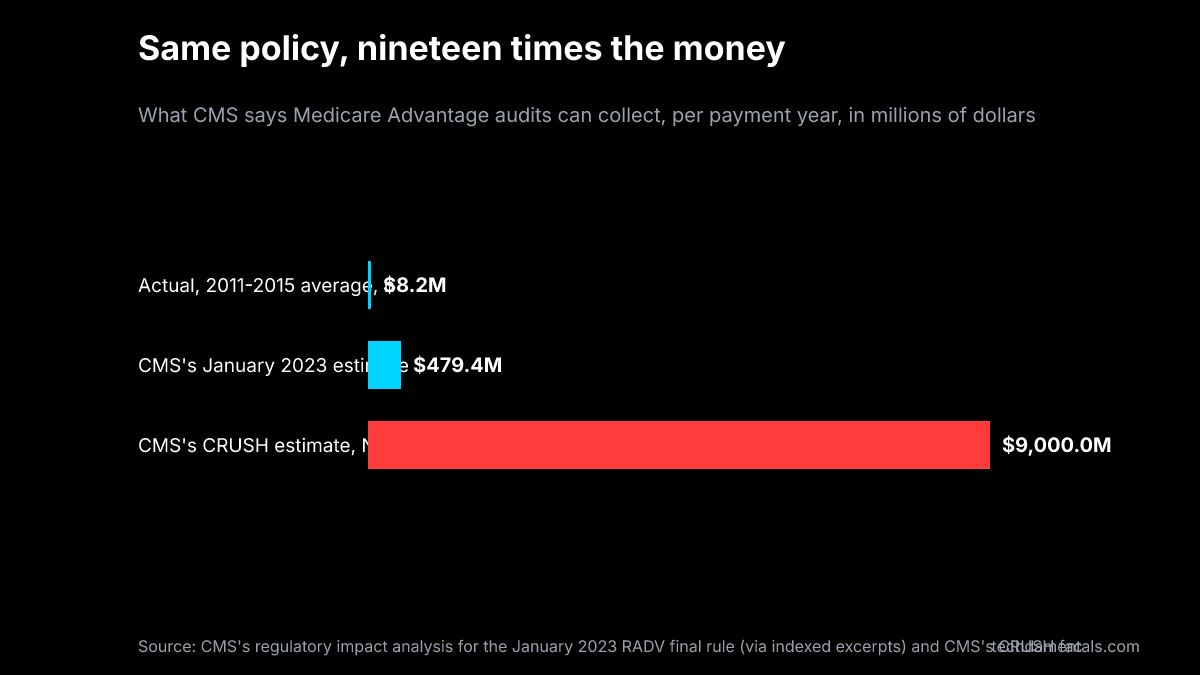
The amounts that produced are, frankly, tiny. In the impact analysis attached to CMS's January 2023 rule, estimated collections across the payment year 2011 through 2015 audits came to $41.1 million in total, about $8.2 million a payment year. Running the audit program cost the agency about $51 million a year. I reached those figures through indexed excerpts of the 2023 document rather than reading the document itself, so I am flagging them, but if they are right, non-extrapolated auditing lost CMS money. That is the cleanest explanation I have for why the agency wants to change the method at all.
What does one word, extrapolate, do to that arithmetic?
Extrapolate means to take what you found in the sample and apply it to everything the sample came from. It is ordinary statistics. If 1,000 out of 200 sampled charts hold an unsupported code, you say the error rate in this contract is that rate, and you bill the whole contract at that rate.
So: finding errors in 200 charts and collecting on 200 charts is an audit. Finding errors in 200 charts and collecting as though every chart in a 300,000-person contract looked like those 200 is a different kind of claim. CMS proposed a contract-level methodology that would do exactly this back in 2012, extrapolating a sample's results across the audited contract's entire risk-adjusted premium for the year under audit. In the years since, it has never actually applied an extrapolated recovery. One specialist tracker states that flatly, and it is consistent with everything in the insurers' filings.
The fee-for-service adjuster is the second half of the same arithmetic. Traditional Medicare's own records contain unsupported diagnosis codes too, because doctors' charts are imperfect everywhere. The adjuster was an offset: before extrapolating, compare the Medicare Advantage audit result against a similar audit of traditional Medicare, and charge the plan only for error above that baseline. Remove the adjuster and there is no offset. The plan is charged for the full measured error rate, including the part that would show up in traditional Medicare's paperwork as well.
That offset is also the legal battleground, and it is where this story stops being about statistics.
Why would a proposal move anything, when CMS has to read comments until January 19, 2027?
Because CMS has done this before.
In January 2023, CMS published a final rule, not a proposal, that eliminated the fee-for-service adjuster and incorporated extrapolation beginning with payment year 2018. Same two pieces. Humana sued. The law that governs how federal agencies write rules, the Administrative Procedure Act, requires an agency to tell the public what it is actually planning before it finalizes, so that comments can address it. On Thursday, September 25, 2025, the United States District Court for the Northern District of Texas granted Humana summary judgment and vacated the rule, which means wiped it off the books. The holding was procedural: there had been no meaningful notice of the agency's ultimate finding that actuarial equivalence, the statutory requirement that Medicare Advantage payments be equivalent to what traditional Medicare would have spent on the same people, does not apply to these audits.
Read that carefully, because this is the hinge. The court did not say extrapolation is unlawful. It expressly declined to reach whether extrapolation itself was arbitrary or contrary to law. It said CMS had not run the process properly.
A procedural defect is the most curable kind. The cure is to propose the policy again, properly, and take comments. That is what CRUSH is.
Meanwhile the first fight is still going. The government appealed on Friday, November 21, 2025, and Humana's quarterly report for the quarter ended September 30, 2026, filed Friday, November 6, 2026, says the appeal "is now pending" at the United States Court of Appeals for the Fifth Circuit, case number 25-11293. That court heard oral argument on Monday, October 5, 2026. One account of that hearing describes the judges as skeptical of the government's position. That is a single reported account of a courtroom's mood and I would not build anything on it, but the date is solid, and the date is the point: six weeks before CRUSH posted, the industry was sitting on an appeal it had reason to think it would win.
THEREFORE the information in the filing of Monday, November 16, 2026 was not "the government is coming for risk adjustment." Everybody knew that. The new information was that winning the court case had become worth a lot less, because CMS can re-adopt the same policy through the front door while still losing the appeal on the old one.
If the policy is identical, why is CMS's number nineteen times bigger?
This is the part I did not expect, and it is the best thing in the story.
When CMS finalized this exact policy in January 2023, its impact analysis estimated recoveries of $479.4 million per audit year starting with payment year 2018, which netted to $428.4 million after the $51 million it costs to run the program. In CRUSH, the same two provisions carry an estimate of about $9 billion per payment year. Roughly nineteen times more money from policy language that did not change.
So what changed? The number of audits.
Through the non-extrapolated era, CMS audited a handful of plans a year. One brokerage analysis published Wednesday, April 1, 2026 puts it at 58 unique Medicare Advantage contracts audited for payment year 2018 and 470 for payment year 2020. Then on Wednesday, May 21, 2025, CMS announced it would audit every eligible Medicare Advantage contract every year, roughly 550 audits per payment year, and that it was adding around 2,000 medical coders to do it. That same analysis counts 60 UnitedHealth contracts under payment year 2020 review, covering about 92% of its more than six million Medicare Advantage members in 2020, and 42 Humana contracts covering 99% of its named-contract membership. Those contract counts come through one intermediary, so they are not gospel, but the direction is corroborated by CMS's own announcement.
Eight times the contracts, bigger samples, and a bigger premium base underneath. Nobody has published the decomposition, so I cannot tell you how much of the jump from $479 million to $9 billion is volume and how much is anything else, and I am not going to pretend otherwise. What I can say is that the word extrapolate was priced at $479.4 million by the same agency three years ago. The audit expansion that makes it worth nineteen times more was announced eighteen months before Monday, November 16, 2026.
What did the tape actually show on each of the three days?
Three sessions, three different stories, and they are worth separating because only one of them is clean evidence.
Tuesday, November 17, 2026 was the first session that could react. UnitedHealth fell 5.42%, Humana 3.88%, Elevance 2.77%, Centene 2.97%, CVS Health 3.14%, Cigna 2.03%. The S&P 500 fund fell 1.01%.
Wednesday, November 18, 2026 was the heavy one, and it is the cleanest reading in the whole week. Humana fell 12.98%, to a close of $385.78. UnitedHealth fell 10.21%, to a close of $349.91. Elevance fell 7.63%, Centene 7.03%, Molina Healthcare 6.62%, CVS Health 5.20%, Cigna 2.96%. The S&P 500 fund that day fell 0.31%, which is as close to flat as a market gets. When insurers drop between 3% and 13% on a day the broad market barely moves, whatever hit them was theirs alone.
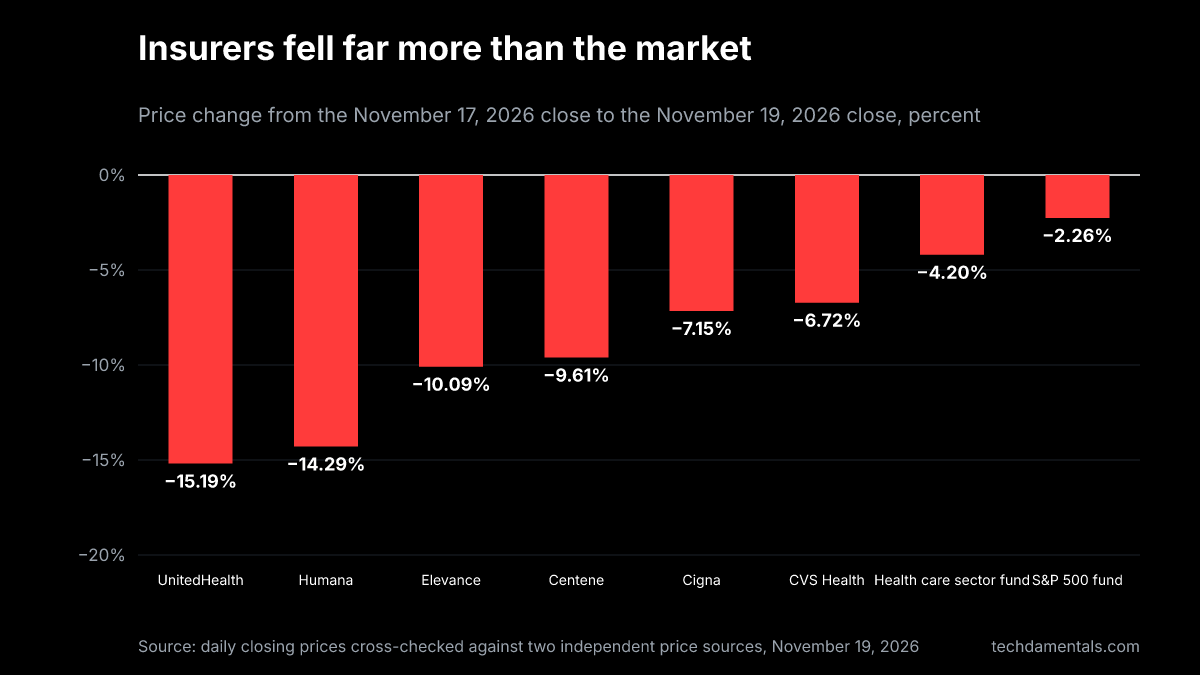
Thursday, November 19, 2026 is contaminated, and I would not use it as evidence of anything about health insurance. The Dow Jones Industrial Average fell 1,101.11 points, or 2.19%, to 49,097.06. The S&P 500 fund fell 1.96% and a health care sector fund fell 2.05%. Market reports put that day on worries about artificial intelligence company valuations and on expectations for Federal Reserve interest rate policy. UnitedHealth fell 5.55%, which means roughly two of those five and a half points look like the market rather than the rule. Humana fell exactly 1.50%. Universal Health Services, a hospital operator rather than an insurer, fell 5.96%, the worst in the group that day, and I have no explanation for that at all.
Two corrections to things circulating about that week, because both are wrong in ways worth knowing.
First, the Dow. On Wednesday, November 18, 2026 the index fell 561.25 points, or 1.11%, to 50,198.17. That 561-point figure has been attached to UnitedHealth as though one company caused all of it. It is the whole index's decline for the day. The Dow is price-weighted, meaning each company moves the index in proportion to its share price rather than its size, and UnitedHealth has one of the highest share prices in it, so it was the single biggest drag. Using a divisor I could only find in secondary sources, UnitedHealth's $39.77 fall works out to about 236 index points, around 42% of the day's drop. Large, and well under half. Contemporaneous reports also attribute that Wednesday, November 18, 2026 to odds of a December interest rate increase running near 92% after the Federal Reserve's minutes, weaker crude oil pulling energy companies down, and Nvidia falling 2.57%. Across the three days, UnitedHealth's $81.54 fall is roughly 485 points of cumulative drag on the index, which is the closest real number to 561 and it is not one day.
Second, measuring from the close on Monday, November 16, 2026 flatters the story for some of these companies. Molina Healthcare rose 11.27% on Monday, November 16, 2026, Centene 4.91% and Elevance 3.86%, and reportedly that was its own event: federal guidance letting states postpone enforcement of Medicaid work requirements through June 30, 2027. The fact of the rally on Monday, November 16, 2026 is solid from two independent price sources. The cause is one reported account. Either way, measure the same companies from Friday, November 13, 2026 instead and Centene is down 7.98% rather than 12.29%, and Molina is down 2.94% rather than 12.76%. For UnitedHealth, which rose just 1.12% on Monday, November 16, 2026, the choice of start date barely matters: 18.89% measured from Friday, November 13, 2026, and 19.79% from Monday, November 16, 2026.
One more data point that says a lot. agilon health, a company that manages care for doctors' groups serving Medicare patients, fell 21.41% in the single session of Wednesday, November 18, 2026, and 23.34% across the three days. It had reported third quarter 2026 results shortly before that beat expectations and raised its guidance, and I could find no company-specific news in that week. That is about as pure a read-through from a policy document to a share price as you will see.
Is a fifth in three days even unusual for this stock?
No. And this is where the framing of the week falls apart.
On Tuesday, January 27, 2026, UnitedHealth Group fell 19.61% in a single session, from $351.64 down to $282.70. One day. More than the entire three-day move from Monday, November 16, 2026 to Thursday, November 19, 2026. The triggers that day were its fourth quarter 2025 results and a different unfinalized CMS Medicare Advantage document, the advance notice for calendar year 2027, which proposed an average payment increase of 0.09% against the 4% to 6% the market had been looking for. In the same results, the share of premium revenue spent on medical care came in at 88.9%, up 3.4 percentage points, and the company forecast its first annual revenue decline in at least a decade. Three things at once, and nobody can tell you how much of that 19.61% belonged to which.
Then look at what happened to the proposal. On Monday, April 6, 2026, CMS finalized the 2027 rates at a net average increase of 2.48%, worth more than $13 billion, against the 0.09% it had floated in January. The final version also tightened risk adjustment in a way that got far less attention: diagnoses from unlinked chart reviews and from audio-only visits can no longer be used.
So in the same calendar year, one unfinalized CMS proposal took a fifth off this stock in a day and was then finalized almost two and a half points better than proposed. That is the honest context for the week of Monday, November 16, 2026. It does not tell you how CRUSH ends. It does tell you that a fifth in three days is, for this particular stock in this particular year, an ordinary magnitude. UnitedHealth also fell about 22% in a single session in April 2025, its largest one-day fall since September 30, 1999, and about 50% across 2025. Anyone calling Wednesday, November 18, 2026 managed care's worst day of the year is simply wrong: 10.21% is about half of January 27.
Who is exposed, and by how much?
This is where the cross-section helps, because exposure is measurable and it is disclosed.
UnitedHealth Group is the largest health insurer in America on both revenue and membership. Its annual report for 2025 shows total revenues of $447,567 million, and states that premium revenues from CMS represented 44% of total consolidated revenues for the year ended December 31, 2025, most of it generated by its Medicare and Retirement business, whose 2025 revenues were $171,285 million, up 22.8%. In its quarter ended September 30, 2026, revenues were $112.694 billion, with $336.447 billion over nine months. On enrollment, it held 26% of Medicare Advantage in 2026 with 9.3 million enrollees, down from 29% in 2025.
Humana is the most concentrated. Its 2025 annual report breaks out individual Medicare Advantage premiums of $90,403 million, which is 70.3% of premiums and services revenue, plus group Medicare Advantage of $9,014 million, or 7.0%. Together that is $99,417 million. Set against total premiums revenue of $122,825 million, Medicare Advantage is 80.9%; against total revenues of about $129.7 billion, it is 76.7%. You see both ratios quoted, so it matters which base you mean. The single cleanest line is Humana's own: "During 2025, 83% of our total premiums and services revenue were derived from contracts with the federal government, including 14% derived from our individual Medicare Advantage contracts in Florida." Humana was second in Medicare Advantage in 2026 at 20% share and 7 million enrollees, up from 17%. Between them, the two companies hold 46% of the program. Humana's revenues in the quarter ended September 30, 2026 were $41,155 million.
The three-day ordering followed exposure at the top: UnitedHealth worst at 19.79%, Humana next at 17.61%, and Cigna, with the smallest Medicare Advantage business of the six, mildest at 9.04%. One brokerage analyst's vulnerability ranking puts UnitedHealth and Humana first, then CVS Health, Elevance, Centene and Molina.
But the middle of the table is messier than a clean exposure story allows. Molina Healthcare, the most Medicaid-focused of the group, fell 6.62% on Wednesday, November 18, 2026, more than CVS Health. Two possible reasons, and I cannot separate them: CRUSH also contains Medicaid and children's health program integrity provisions, so Medicaid-heavy insurers are directly in it, and part of that fall is the Medicaid-driven rally of Monday, November 16, 2026 being handed back.
Has anyone put a number on it?
Not one of these companies, and that absence is doing real work in the price.
UnitedHealth's quarterly filing for the period ended September 30, 2026 says CMS and the HHS Office of Inspector General "have selected certain of the Company's local plans for risk adjustment data validation audits to validate the coding practices of and supporting documentation maintained by health care providers, and such audits may result in retrospective adjustments to payments made to the Company's health plans." On sizing it, the same filing says "the Company is often unable to estimate the losses or ranges of losses for those matters where there is a reasonable possibility or it is probable a loss may be incurred."
Humana's language has been qualitative for years in the same way: it cannot determine whether these audits will have a material adverse effect on its results, financial position or cash flows, and it said the 2023 rule, including the absence of a fee-for-service adjuster, could have such an effect. I could not read Humana's legal proceedings note in the latest filing directly, and I did not read the equivalent sections for Elevance, Centene, CVS Health or Cigna. So the honest version is narrow: no insurer has quantified CRUSH-specific exposure in its filings, and UnitedHealth's most recent quarterly report expressly says it cannot estimate a range. I found no company-specific dollar or per-share estimate from anyone, anywhere. CMS's industry-wide $9 billion is the only number in circulation.
What does exist is a precedent nobody mentioned in the days after Monday, November 16, 2026. In 2026, Elevance Health reportedly transmitted $342,209,085.30 to CMS rather than accept a notice of intermediate sanctions over Medicare Advantage risk adjustment data. The agency's notice, dated Friday, February 27, 2026, alleged substantial and persistent noncompliance: failure to delete diagnosis codes unsupported by medical records, failure to report and return overpayments within 60 days, and failure to submit risk-adjustment data electronically, with corrections for unsupported codes reportedly sent on encrypted USB flash drives from November 2018 until October 2025. CMS threatened to suspend enrollment and marketing for those plans effective March 31, 2026. One trade account puts the company's own estimate of what avoiding the sanctions cost at $935 million. I could not extract the text of CMS's letter, so I am giving you the dollar figures as reported, not as verified.
That matters for the framing question. A nine-figure risk-adjustment recovery from a top-five Medicare Advantage insurer already happened this year, with no extrapolation and no new rule required.
What this does not tell you
I could not read the rule. The Federal Register's own document pages block automated access, the raw text endpoint stops twelve pages into 167, and the PDF would not convert to text on the machine I was working on. So the regulatory impact analysis, the tables where CMS shows its arithmetic, is second-hand throughout this issue.
That leaves the single most important question open. CMS's impact tables reportedly put about $9.2 billion a year of transfers from Medicare Advantage organizations to CMS across calendar years 2027 to 2036, totalling about $90.2 billion. If that is right, the money is a forward collection schedule, not a liability crystallizing on eight years of closed books. Notice too that $9.2 billion times ten is about $90 billion, the same figure the fact sheet gives for the whole rule across three programs, which makes me doubt that the audit provisions are one slice of a bigger total. I cannot resolve it without the tables, and I will not assert either reading.
Nor do I know whether $9 billion is gross or net of appeals, or whether it is a forward annual average or something that could apply to each of payment years 2018 through 2024.
And the audits themselves are nowhere near finished, which cuts against the idea that the three sessions from Monday, November 16, 2026 crystallized old liabilities. From CMS's own audit announcements page: payment year 2020 audits were initiated on March 20, 2026, payment year 2021 on May 29, 2026, payment year 2024 on August 28, 2026, and payment year 2023 on November 13, 2026, three days before the rule posted. Payment year 2022 is not on the list; a tracker puts it in January 2027. Payment year 2018's audit was initiated in November 2024 with findings expected from mid-2026. I found one source claiming some extrapolated audits are complete for 2018 and 2019 and another, better sourced, saying no extrapolated recovery has ever been applied. I cannot settle that.
Finally, I have no statement from any of these companies about CRUSH. No filing, no press release, no named executive. The industry's main trade association said only that it was closely reviewing the proposed rule. So nobody can tell you with a primary source why these stocks fell. The candidates: that CMS put a legally weighty number on an audit expansion everyone already knew about; that a procedural court win became much less valuable six weeks after the appeal was argued; that the market read the reach back to payment year 2018 as retroactive liability, which CMS's own calendar argues with; that Medicaid-focused names handed back the rally of Monday, November 16, 2026; and that Thursday, November 19, 2026 was simply a bad day for everything. They overlap, and nobody can separate them.
So why did a proposal nobody has finalized take roughly a fifth off the biggest health insurer in America?
Because the proposal was not the news. The arithmetic was already loaded, and this document removed the last thing holding it back.
Line the agency's own numbers up. CMS priced identical policy, no fee-for-service adjuster and extrapolation starting with payment year 2018, at $479.4 million per audit year in January 2023. It prices it at about $9 billion per payment year now. The policy language did not change. What changed is that the audit program went from 58 Medicare Advantage contracts in payment year 2018 to 470 in payment year 2020 to roughly 550 a year after the May 21, 2025 announcement, with samples of 35 to 200 charts each and a method that has never once been allowed to multiply any of them out. On top of that sits a court case the industry won on September 25, 2025 purely on procedure, with the judge expressly declining to say whether extrapolation is lawful, and an appeal argued on October 5, 2026 that is still undecided. A procedural win protects you until the agency files the paperwork properly. On Monday, November 16, 2026, at some point after the closing bell, CMS filed the paperwork properly.
So go back to that Monday, November 16, 2026. Every one of these insurers except CVS Health closed higher that afternoon, Molina up 11.27%, on a day the broad market fell almost 2%. The thing that would take a fifth off UnitedHealth by Thursday, November 19, 2026 was already sitting on a reading desk in Washington while that happened, and none of it was new policy. It was a count, a sampling method and a cured technicality.
What to watch
Comments on CMS-6098-P close on January 19, 2027, and CMS has specifically asked for comment on the feasibility of the effective dates, which means the reach back to payment year 2018 is itself on the table. The Fifth Circuit has not ruled on the 2023 rule. Payment year 2022 audits are expected to begin in January 2027. And when these companies file their next quarterly reports, the thing to look for is whether any of them stops saying it cannot estimate.
One last thing for next time. When a company's revenue depends on how an agency words a document, the agency's own impact tables are a primary source available to anybody, and in the days after Monday, November 16, 2026 they were more informative than any of the coverage.
If you want to see what any stock you follow is worth, its fair value range, sign up at techdamentals.com. It works that range out four different ways, then shows the company's fundamentals and explains what each one means. After each earnings report, it reads the company's own filing and shows what the headline left out: the numbers that came in different from what analysts expected. You can also set a value alert, so you hear when a stock moves into the part of its range you pick: undervalued, fair value or overvalued. You decide what that means for your plan; the alert only tells you when it gets there. And on the technical side, you can paste a screenshot of any stock chart, any timeframe, and it reads whether the chart has a bullish or bearish bias. That is 7 days free, with 3 analyses in each app. Try Techdamentals for seven days, no card needed
This is educational content, not financial advice. Techdamentals is an educational tool and does not recommend any security.