
At 7:36 in the morning Eastern time on Thursday, November 19, 2026, shares of Advanced Micro Devices were trading about 2.9% above the previous day's close. AMD is the American company that designs processors, the main calculating chips, that sit inside laptops, game consoles and data center servers. At 10:27 that morning, a publisher called Hunterbrook Media put out a report about AMD, a firmware file and a Chinese server maker that the US government has blacklisted. By 11:00 AM the stock was down about 8% on the day. At 11:12 it was down 6.23%, at 11:42 down 5.12%, at 12:18 down 9.68%. The low of the day was 11.24% below the prior close, and the close on Thursday, November 19, 2026 was $489.19, which is 7.72% below the $530.14 close on Wednesday, November 18, 2026.
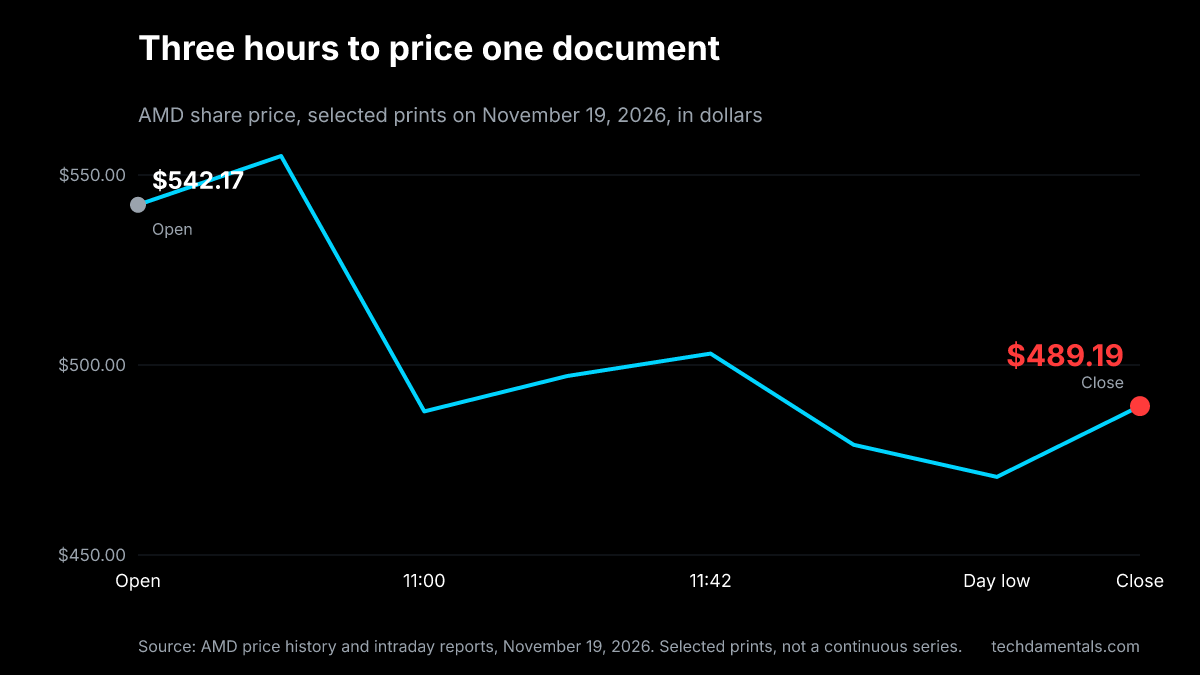
The market took three hours, and a range worth 15.22% of the prior close, to decide what one document was worth, and it changed its mind twice on the way.
So the question is how a report about a firmware file takes 7.72% off a company worth about $810 billion at that close, on a day when no regulator, no court and no company filing said anything about wrongdoing. The obvious answer is that AMD broke US export law. Keep that as a suspect rather than a conclusion, because the report that moved the stock says, in its own words, that the records it found "don't establish on their own a violation of export laws."
The story runs through three stops. First, who published this and the one line in its own disclosure that tells you how to read the rest. Second, how servers built around a blacklisted Chinese company's startup software reach customers under three other brand names, and the dated line in the American rulebook that decides whether that matters right now. Third, what a committee in Congress published hours later the same day, which changes what anyone can honestly claim to know. I will not answer that third one until the end, because it broke my own first draft.
Why it matters even if you have never held a single AMD share: a company that size sits inside most broad index funds, which hold hundreds of companies at once and are the default in a lot of retirement accounts. And the shape of this day repeats constantly: a document arrives, a price moves, a denial follows, and nothing gets adjudicated for months or ever.
What actually moved, to the minute
Close-to-close, the move is 7.72%, and that is the figure I trust. The snapshots that circulated, including one at 10:50 AM Eastern showing 9.72% down, are real prints but not the day's result. Nothing closed at 9%. Volume was about 72 million shares, roughly 116% above AMD's average by one tracking service's count.
Over the 36 trading sessions from October 1 to November 19, 2026, AMD's average daily move, ignoring direction, was 4.62%, and 15 of those sessions moved at least 5%. That is Techdamentals' own math from daily closes. So a 7.72% decline is about 1.67 times an ordinary day for this stock, and four sessions in the same window fell further, including November 5 at 17.26% and October 30 at 10.88%. The day before the report AMD rose 5.31%, and the November 19 close sat 24.7% below the October 6 close, the highest in that window.
Was it the report, or was it the day?
Thursday, November 19, 2026 was ugly for almost everything. The S&P 500, an index tracking 500 large US companies, closed down 2.02%, the Nasdaq Composite down 2.25% and the Dow Jones Industrial Average down 2.19%, with all 11 sectors of the S&P 500 lower. Chip stocks took it too: Nvidia fell 3.30%, Micron fell 2.10%, and a widely tracked basket of semiconductor stocks fell 2.75%. So AMD finished roughly 4.98 percentage points worse than the chip basket and 4.43 points worse than Nvidia, which is Techdamentals' own math from those closes.
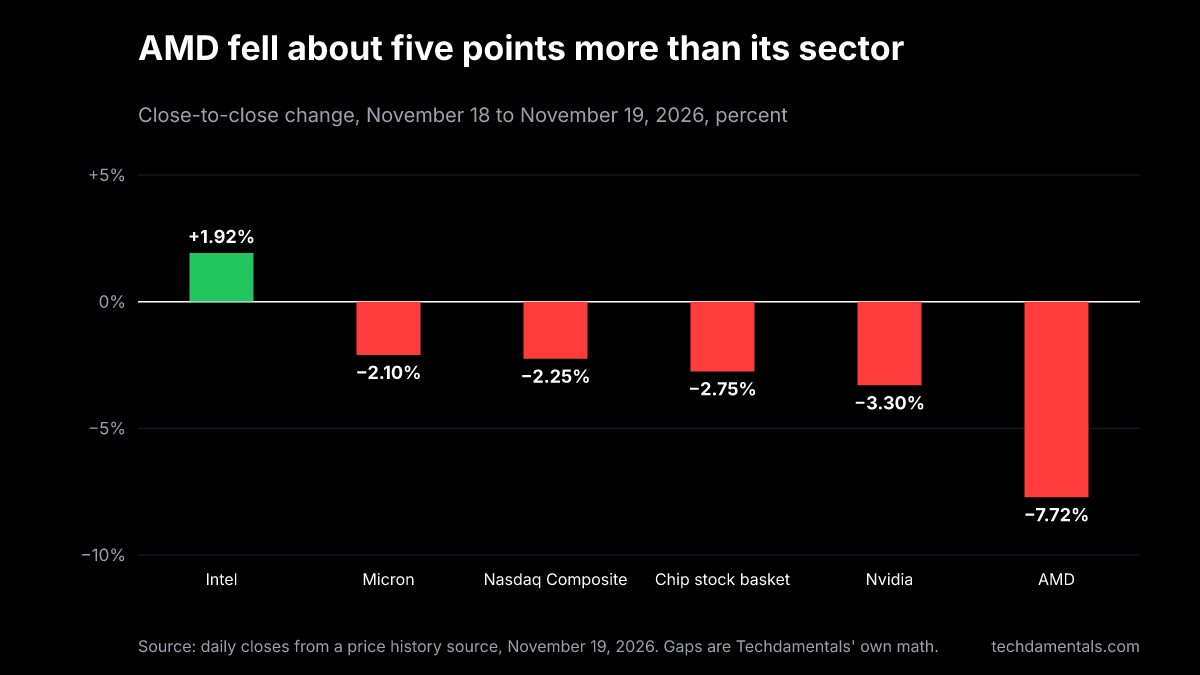
What I have to resist is a tidy subtraction. It would be easy to say two of AMD's 7.72 points were simply the market and the rest was the report, and the timestamps do not allow it. At 11:00 AM Eastern, AMD was already down about 8%, while Nvidia was up 1.6%, Intel was up about 5% and the Nasdaq was still higher on the day. The index decline arrived in the afternoon, and during that afternoon AMD went from down 8% to down 7.72%. You cannot subtract a market fall that had not happened yet. Intel closed up 1.92%, and one account says it had its own news that day about a manufacturing customer, so its green close proves nothing about the sector.
So what can be said about cause? These are the candidates, and nobody can separate them, because no filing, no agency statement and no company disclosure attributes the move to anything: the Hunterbrook report, the only new AMD-specific claim with a timestamp that fits the slide; a market-wide fall with every sector lower and the indexes closing at their lows; chip and artificial-intelligence stocks giving back a morning rally; a new Commerce Department export rule effective the same day; and momentum unwinding in a stock already a quarter below its early-October high.
Who wrote this, and what does its own disclosure admit?
Hunterbrook Media is a newsroom that began publishing in 2023, paired with an affiliated investment fund. Its disclosure on this report says that, based on its reporting, at the time of publication Hunterbrook Capital was short AMD and "long a basket of comparable securities."
A short position is a bet that a price will fall. You borrow shares you do not own, dispose of them at the going price, and later repurchase them to hand back to the lender; if the price fell in between, you keep the difference. So the publisher's affiliated fund profits if people believe the report. That does not make the report wrong, but it does mean the disclosure is the first thing to read, not the last.
The second half of that sentence is the sharper part, and most coverage dropped it. "Long a basket of comparable securities" means the fund also held similar stocks the ordinary way, profiting if they rise. A position shaped like that pays off on the difference between AMD and its peers, not on AMD alone. That is what the tape delivered: AMD down 7.72% against a chip basket down 2.75%.
Hunterbrook's own language also calls Hunterbrook Media an affiliate of Hunterbrook Capital, "an exempt reporting adviser." Such an adviser advises only private funds and, under the rule it relies on, holds under $150 million managed for US investors, and the registration form's instructions mean it does not have to report its managed assets at all. So the disclosure tells you the direction of the bet; no rule requires it to tell you the size, when it was opened, or whether it still exists by the time you read the report.
What does the report actually claim?
Firmware is the small program stored inside a machine that wakes the hardware up before the operating system loads. AMD publishes startup firmware for its server processors, called Platform Initialization code. The report alleges that newer versions of that code appear in the products of IEIT Systems, a Chinese server maker.
IEIT matters because of a list. On March 28, 2025, the Commerce Department's Bureau of Industry and Security added six Inspur companies to the Entity List, a register of companies you need a government license to export to, effective March 25, 2025. The entry is for "Inspur Electronic Information Industry Co., Ltd.," with eight named aliases, one of which is "IEIT Systems Co. Ltd." The license requirement covers "all items subject to the EAR," the US export rulebook, which reaches software and code and not only physical goods, and the review policy is "policy of denial," for contributions to "Inspur's development of supercomputers for military end use."
The report says IEIT has incorporated at least six newer versions of AMD's firmware since that listing, identifies the code as a version called TurinPI 1.0.0.B, says the package is dated August 25, 2026, and says IEIT's site shows a posting date of October 19. Every one of those specifics comes from the report alone, and I could not verify any of them independently.
Then the brand names. The report names three closely tied companies that ship AMD-based servers under their own labels: Maginfra in China, Kaytus in Singapore and Aivres in California. It says their firmware is "99.94% identical to IEIT's," which is easy to misread. It compares the three brands against IEIT, so it supports the claim that three differently branded companies ship one company's firmware. Whether AMD's newer code is inside that firmware is a separate allegation resting on separate evidence.
I did check one thing myself. Aivres's own website describes it as a data center servers and storage provider "Based in Silicon Valley," with no mention of Inspur or IEIT, and the Federal Register document that added the Inspur entities in March 2025 does not contain the names Aivres, Kaytus or Maginfra at all.
If a blacklisted company owns the brands, why is that not automatically illegal?
In September 2025 the Bureau of Industry and Security published what is known as the Affiliates Rule. It would automatically extend an Entity List company's license requirements to any business owned 50% or more, directly or indirectly, by that company. If it were in force, ownership alone would close the loop.
It is not in force. A rule published and effective November 9, 2026, ten days before the report, says the September 30, 2025 amendments, already stayed on November 10, 2025, "are further stayed until January 10, 2027." The rule text gives no reason. Commentary ties the pause to trade negotiations, but the government's own document does not say that, so I will not either.
What that means as of Thursday, November 19, 2026 is specific. A majority ownership link from a listed parent to a subsidiary does not, by itself, trigger the license requirement. What still applies is the agency's long-standing position that subsidiaries acting as agents, fronts or shell companies for a listed parent violate the controls regardless of ownership percentages. So the live question is whose brand is on the box and what that brand is doing, and the ownership gate reopens on January 10, 2027 unless something changes.
Outside the report, the strongest ownership material is a 2024 federal patent lawsuit from Hewlett Packard Enterprise alleging IEIT wholly owns Aivres, Kaytus and a third entity as indirect subsidiaries, which I read through a secondary summary rather than from the court docket.
Separately, a rule called "Addressing Remote Access to Advanced Semiconductors" took effect the same day. It requires licenses for exports and transfers within Indonesia, Malaysia, Singapore, Brazil and Thailand, with comments due January 19, 2027, and it does not apply where the end user's ultimate parent is headquartered in the United States. It was released on November 16, so it is context for the day, not a surprise.
How much of AMD's money is even involved?
AMD's annual report for the fiscal year ended December 27, 2025, filed February 4, 2026, breaks revenue out by region: total revenue of $34,639 million, of which China accounted for $7,751 million, or 22.38%. That confirms the report's "over 20%" framing.
Two caveats change how much weight it carries. AMD's own language says the table shows sales "based on billing location of the customer," which is where the invoice went, not where the hardware ended up. Taiwan at 14.97% and Singapore at 12.37% of revenue are billing hubs for distributors and contract manufacturers.
The second caveat is vintage. That fiscal year ended eleven months before the report. AMD's third quarter of fiscal 2026, ended September 26, 2026, brought in revenue of $13.4 billion, up 45% from a year earlier. On November 3, 2026 the company guided the following quarter to about $17.0 billion plus or minus 3%, which annualises near $68 billion, roughly double the base the 22.38% was measured against. As an illustration and not a fact, if China billings merely held flat in dollars at the fiscal 2025 level, the share would be near 11%. AMD does not disclose the regional split quarterly, so the current China share is not publicly knowable.
What did AMD say, and what did it not say?
By early afternoon, a company spokesperson, unnamed, had given this statement: "The claims misrepresent AMD's business practices and relationships. AMD complies with applicable US export control laws and regulations and maintains rigorous processes to ensure compliance across our global operations. We remain focused on serving our customers and upholding the highest standards of integrity."
Notice its shape. It asserts compliance and calls the claims a misrepresentation. It does not address the specific factual allegation, which is whether AMD's post-March-2025 startup firmware appears in IEIT update packages, and it does not say whether AMD holds any license covering such a thing. A denial of a characterization is not a denial of a fact.
What this does not tell you
Nothing here has been adjudicated. I found no Commerce Department or Bureau of Industry and Security statement about the report, no enforcement action, no investigation and no AMD filing responding to it; AMD's most recent current report filed with the SEC is from November 3, 2026, covering quarterly results. Nobody publicly knows how IEIT obtained AMD's code, and the report says so plainly: it "does not know how IEIT obtained AMD's code, or whether AMD or anyone else held a license to supply it." I also cannot verify the firmware specifics or the method behind the 99.94% figure.
So why did AMD stock drop on China claims?
Because a document put a number on a kind of exposure nobody can measure from the outside, and the market marked that exposure to an opinion for a day.
The part that undid my own first answer came the same afternoon, when I had been planning to write that nobody outside the Commerce Department knows any of this. On November 19, 2026, the chairman of the House Foreign Affairs Committee, Brian Mast, used his authority under the Export Control Reform Act to release export-license application records for AI chips bound for China: about 3.4 million chips requested, and more than 879,000 approved. In coverage of that release, two companies named in Nvidia license applications were described by the chairman as suspected fronts, and one of those names, Maginfra, is the same name the short report had flagged that morning. Reporters who went to the two addresses in November 2026 found empty offices. The committee's own press release does not name the companies, so that part rests on one account.
AMD's licensing position is not hypothetical either. In August 2025, AMD and Nvidia agreed to remit 15% of revenue from certain China chip sales to the US government in exchange for export licenses, and AMD said its initial applications for one of its China accelerators had been approved. I found no 2026 update on whether that arrangement still operates.
So licenses exist, approvals exist, and part of the record is now public. What is still not public, and what the entire report turns on, is whether anyone ever licensed the supply of AMD's startup firmware to a company sitting on the Entity List under a policy of denial. Individual license determinations are not published. That question cannot be answered by anyone outside the agency and the company as of Thursday, November 19, 2026, and the honest answer to the title is that the stock fell because an estimate changed, not because a fact was established.
Go back to that three-hour window, in percentages from the November 18 close: up about 2.9% before the open, down about 8% by 11:00 AM Eastern, back to down 5.12% at 11:42, down 9.68% at 12:18, down 11.24% at the low, and 7.72% lower at the closing bell. The 11:00 AM print, $487.80, sat about a dollar and a half from where the stock finished three hours and a 15.22% range later. All that motion ended up where the first reaction already was. That is what repricing an unverifiable claim looks like in real time, on a stock whose average day in the preceding seven weeks already moved 4.62%.
Two dates are now on the calendar: January 10, 2027, when the stay on the ownership rule expires, and January 19, 2027, the comment deadline on the new export rule. AMD's next annual report is the first place the regional revenue table gets updated.
If you want to see what AMD is worth, its fair value range, sign up at techdamentals.com. It works that range out four different ways, then shows the company's fundamentals and explains what each one means. After each earnings report, it reads the company's own filing and shows what the headline left out: the numbers that came in different from what analysts expected. You can also set a value alert, so you hear when a stock moves into the part of its range you pick: undervalued, fair value or overvalued. You decide what that means for your plan; the alert only tells you when it gets there. And on the technical side, you can paste a screenshot of any stock chart, any timeframe, and it reads whether the chart has a bullish or bearish bias. That is 7 days free, with 3 analyses in each app. Try Techdamentals for seven days, no card needed
This is educational content, not financial advice. Techdamentals is an educational tool and does not recommend any security.