
On Thursday, November 19, 2026, the S&P 500 fell 2.02% and closed lower for the sixth day in a row. The S&P 500 is an index, which just means a scoreboard that tracks the combined value of 500 of the biggest companies in the United States, and many retirement funds track it. Since Wednesday, November 11, 2026, that scoreboard is down 5.82%.
A lot of the coverage blames the Federal Reserve, the US central bank, the institution that sets the basic interest rate for the whole country. The Fed published notes on Wednesday, November 18, 2026 showing that almost all of its officials expect to raise interest rates again. That sounds like a clean explanation, but on Monday, November 16, 2026, when the index fell 1.92%, the interest rate the government pays to borrow money for ten years actually slipped, from 5.15% to 5.12%. If the Fed were scaring everyone, I would expect that rate to jump.
So I want to answer one question: are Fed hike fears sinking stocks? I will take you through three stops. First, what the Fed's notes actually said, and how few officials want the big move you may have heard about. Second, what the bond market has been expecting, and since when. Third, the two worst days of the slide, and that is where the story turns. Most people will tell you it is the Fed. Hold that thought.
Why this touches your own money
If you have a 401(k) or an IRA that holds an index fund tracking the S&P 500, that 5.82% drop comes straight out of your balance. On a $100,000 account that tracked the index exactly, it is about $5,820 gone in six trading days. It is a paper loss until you cash out, but it is the number on your statement.
The Fed's rate also reaches you in a quieter way. It influences what you pay on a credit card, on a loan whose rate resets every so often, and on a home equity line of credit, which is a credit line you borrow against the value of your house. It influences what a savings account pays you too.
First stop: what the Fed's notes said
The Fed makes its rate decisions through a group called the Federal Open Market Committee, or FOMC. The main thing the FOMC controls is the federal funds rate, which is the rate banks charge each other for overnight loans. Banks build their own prices off that rate. The committee does not pick a single number. It picks a range, and on Wednesday, October 28, 2026 it left that range at 3.75% to 4.00%. The last change before that was a quarter-point increase on Wednesday, September 16, 2026, which was the first increase since 2023.
A quarter of a percentage point is 25 basis points. A basis point is one hundredth of a percentage point, so a half-point increase is 50 basis points, double the usual step. That is the move people have been asking about.
After every meeting the Fed publishes minutes, a written record of what was said, about three weeks later. The ones for the meeting held on Tuesday, October 27, 2026 and Wednesday, October 28, 2026 came out at 2:00 p.m. Eastern on Wednesday, November 18, 2026. The Fed does not put head counts in the minutes. It uses a fixed set of words instead: "a couple" is the smallest group, then "a few," "some," "several," "many," "most," and "almost all." It is like a meeting summary that says "a couple of people raised their hands" without telling you how many.
This is what the document said. "Most" participants supported holding the range where it was. "Some" wanted a quarter-point increase right then, saying inflation was too high and they saw few signs of it easing. Inflation, by the way, is just the rate at which prices across the economy rise, and the Fed's goal is for it to run at 2% a year. "Almost all" said that further increases in the range would likely be appropriate if inflation and the job market followed their baseline expectations. And "a couple" said an increase of more than a quarter point could deserve consideration at the next meeting if the incoming inflation data looked bad.
That is where the half-point talk comes from, and notice how small it is. The group that raised the idea is the smallest one in the Fed's vocabulary, and it attached a condition. The vote on Wednesday, October 28, 2026 backs that up. The Fed held the range by 10 votes to 2, and the two who voted against, Lisa Cook and Beth Hammack, wanted a quarter-point increase, which is half the size of the move in the headlines.
So why would anyone at the Fed want to raise rates at all, when most of them held? Look at the prices. The government's consumer price index, or CPI, measures what households pay for a basket of everyday goods and services. It rose 0.4% in October 2026, after rising 0.6% in September, according to the report released on Tuesday, November 10, 2026. Core CPI leaves out food and energy, which jump around a lot, and keeps everything else in the basket. It rose 0.3% in October, the same as in September and August. That sounds small, but 0.3% every month adds up to about 3.7% over a year, and a 2% year works out to about 0.17% a month. So the recent pace is close to double the Fed's goal. The Fed's own favorite gauge, a different index called the personal consumption expenditures price index, or PCE, was at 3.6% for September 2026, and 3.1% once you remove food and energy. The goal, again, is 2%.
The government also published no 12-month figure for October, because it never collected October 2025 prices during a lapse in government funding, so monthly numbers are what the Fed has.
That raises the next question. If the Fed just held rates, and only a couple of officials want a bigger move, why does the market behave as if more increases are coming?
Second stop: what the bond market expects
To answer that, I need to explain a Treasury. A Treasury is a loan you make to the US government. You hand over money, and the government pays you interest and gives your money back at the end. The yield is the yearly return you earn on that loan at its current price. A 10-year Treasury runs ten years, and a 2-year Treasury runs two.
The 2-year yield is the one that tends to follow where investors think the Fed's rate is headed over the next couple of years. If investors believed the Fed would leave its rate alone, the 2-year yield would sit close to the Fed's range of 3.75% to 4.00%. On Wednesday, November 18, 2026, the 2-year yield was 4.80%. That is 0.8 points above the top of the range. One reading is that investors expect increases. It is a reading, since other things can also push yields around, but it lines up with what the minutes say. A staff survey cited in the minutes had the median person expecting one increase in December and another in March 2027, and futures markets gave high odds to a quarter-point increase by the end of 2026 and two more by the summer of 2027.
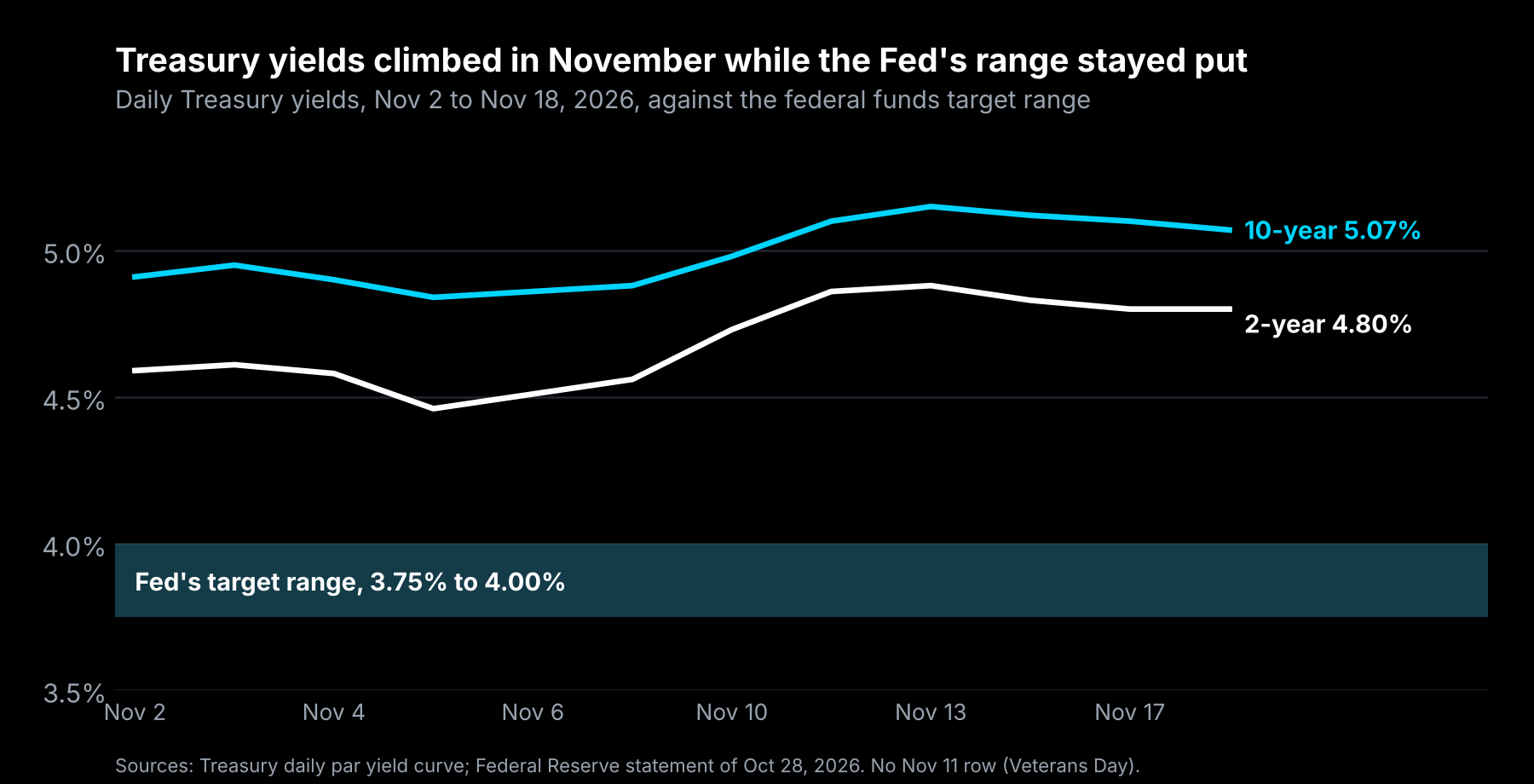
The important part is when this happened. The 2-year yield was 4.46% on Thursday, November 5, 2026 and 4.88% on Friday, November 13, 2026. That is a jump of 0.42 points in eight days, and 0.30 of it came between Monday, November 9, 2026 and Thursday, November 12, 2026, right around the inflation report on Tuesday, November 10, 2026. All of that happened before the minutes came out. On the day of the minutes, Wednesday, November 18, 2026, the 2-year yield did not move at all. It was 4.80% the day before and 4.80% that day.
Now put that next to the stock market. If rate fear was what hurt stocks, the days of that jump should have been the worst ones. They were not. The index fell only 0.35% on Thursday, November 12, 2026 and 0.40% on Friday, November 13, 2026. And that raises the next question: if those weren't the bad days, which days did the damage?
Third stop: the two worst days
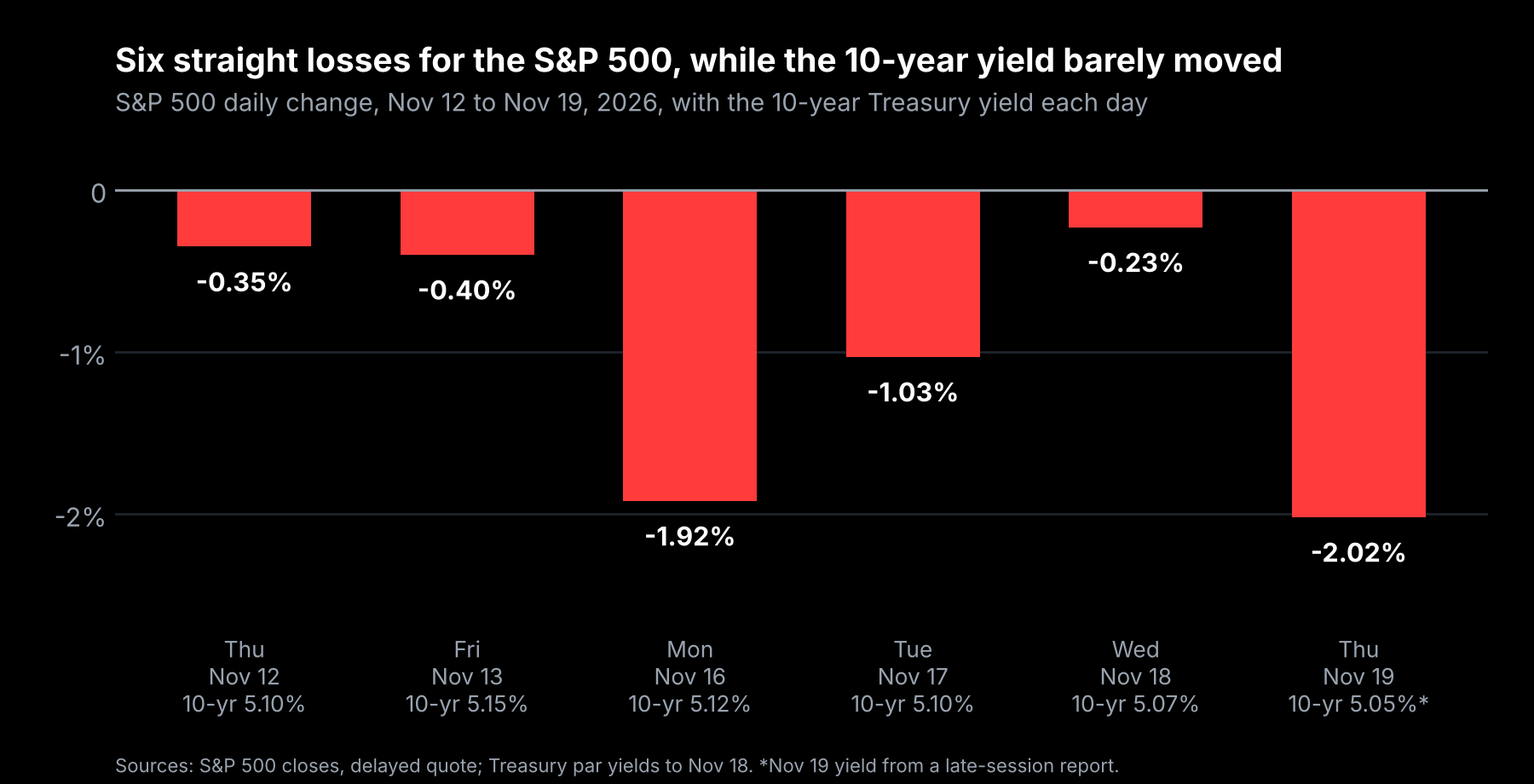
The two worst days of the slide were Monday, November 16, 2026, when the index fell 1.92%, and Thursday, November 19, 2026, when it fell 2.02%. On both of those days, the 10-year yield eased. On Monday, November 16, 2026 it went from 5.15% to 5.12%. On Thursday, November 19, 2026 it was about 5.05%, down from 5.07% the day before [VERIFY: the Treasury's official November 19, 2026 close, since that figure was not yet posted when I checked].
So on the two days stocks fell the most, the number that is supposed to show rate fear went the other way. That does not fit the simple story, though it does not make the Fed irrelevant either. The Fed's rate path just cannot explain those two days by itself.
Something else was going on on Thursday, November 19, 2026. Anthropic, the artificial intelligence company, began trading on the stock market that day, after pricing its shares at $83 and raising about $81 billion, according to market reports. When a company that size offers its shares, investors have to raise cash to pay for them, and one possible reading is that some of that cash came from reducing other holdings. I cannot show that from the data I have, and nothing I read ranks it against the other candidates. More than 90% of the 500 companies in the index fell that day, so the drop was broad. A stronger dollar and worries about technology valuations, meaning fear that tech share prices have climbed past what profits justify, were also in the news. I can list the candidates. I cannot tell you which one mattered most.
There is also a reason a yield can fall on a day stocks fall. When investors get nervous, many move their money into government debt because it is considered safe. More demand pushes the price of that debt up and its yield down. That is one reading of why the 10-year yield eased on those two days, and these data cannot confirm it.
What this doesn't tell you
The minutes describe a meeting held before the October inflation report came out, so they say nothing about how the Fed read it. "Some" and "a couple" are labels with no head counts behind them.
I also could not find a current market estimate of the odds of a December increase. The ones I came across predate the inflation report, and numbers like that swing fast, so I am not giving one. And I cannot rule out that rate fear played a part in the two worst days without showing up in the yields, since a market can be nervous about rates while the 10-year yield sits still.
The limit on all of this is that I have the closes and the yields but not what the people trading were thinking.
Are Fed hike fears sinking stocks?
That is where the evidence leaves me. Rate expectations clearly moved in the first half of November 2026, and the inflation report on Tuesday, November 10, 2026 is the likeliest trigger. But the stock market barely flinched on those days, and it fell hardest on Monday, November 16, 2026 and Thursday, November 19, 2026, when yields were flat to lower. So the evidence ties rate expectations to the early days of the slide, and it cannot show they caused the two worst days. A half-point increase is also a minority view, held by a couple of officials in the minutes.
Go back to Thursday, November 19, 2026. The S&P 500 fell 2.02% on a day yields eased and a giant new company started trading. That fits a market reacting to more than the Fed.
What happens next is on the calendar. The Fed meets on Tuesday, December 8, 2026 and Wednesday, December 9, 2026. The next inflation report comes out on Thursday, December 10, 2026, one day after the decision. That means the committee decides without seeing it, so the rate-fear story gets tested again.
If you want to see what any stock you follow is worth, its fair value range, sign up at techdamentals.com. It also shows a company's fundamentals alongside technical analysis of its chart. After each earnings report, it reads the company's own filing and compares the financials with what analysts expected, line by line, so you can see the real reason a stock moved. Try Techdamentals for 3 days, no card needed