
On Wednesday, November 18, 2026, Target reported results for the third quarter of its fiscal 2026, the three months that ended October 31, 2026. Profit per share was 2.65 dollars. Analysts had expected about 2.07 dollars. The stock rose roughly 5% to 8% during the day, depending on the outlet and the hour.
That is a big beat. Sitting inside it is a smaller number, 50 cents, which comes from a government refund of tariffs that Target paid in earlier years. This issue separates the two, shows what the company's results look like with and without the refund, and says where we cannot be sure. Everything about the company's figures comes from its earnings release on the Securities and Exchange Commission's website. The stock moves are intraday readings, not closing prices.
What the refund is
A tariff is a tax on imported goods, paid by the company that brings them in. Many of the tariffs imposed in 2025 were based on a law called the International Emergency Economic Powers Act, usually shortened to IEEPA. According to the National Retail Federation, the Supreme Court ruled 6 to 3 on February 20, 2026, in Learning Resources v. Trump, that the law does not give the president authority to impose tariffs. The Court did not decide whether the money would be returned. A trade court then ordered U.S. Customs and Border Protection to issue refunds to the companies that paid, and law-firm summaries say the first phase of a refund system opened on April 20, 2026. The Federation says refunds can take 60 to 90 days after a claim is accepted. We did not read the ruling itself.
Target says it received refunds in two quarters. In the second quarter, reported on August 19, 2026, it recognized 994 million dollars before tax, worth 1.65 dollars per share. In the third quarter it recognized 301 million dollars before tax, which is 228 million after tax, or 0.50 dollars per share. The company recorded the money as a reduction in cost of sales, the line that holds what it pays for the goods it puts on shelves. That is why the refund shows up in gross margin, which is the share of each sales dollar left after those costs.
The release states it directly: "Third quarter 2026 results include $301 million of pretax tariff refund benefits within gross margin and operating income."
The beat, with and without it
Subtract the 50 cents from 2.65 and you get about 2.15 dollars. That is our arithmetic, and it matches the release, which says adjusted earnings per share would have grown about 21% from last year's 1.78 dollars without the refund. With the refund, the growth was 49%.
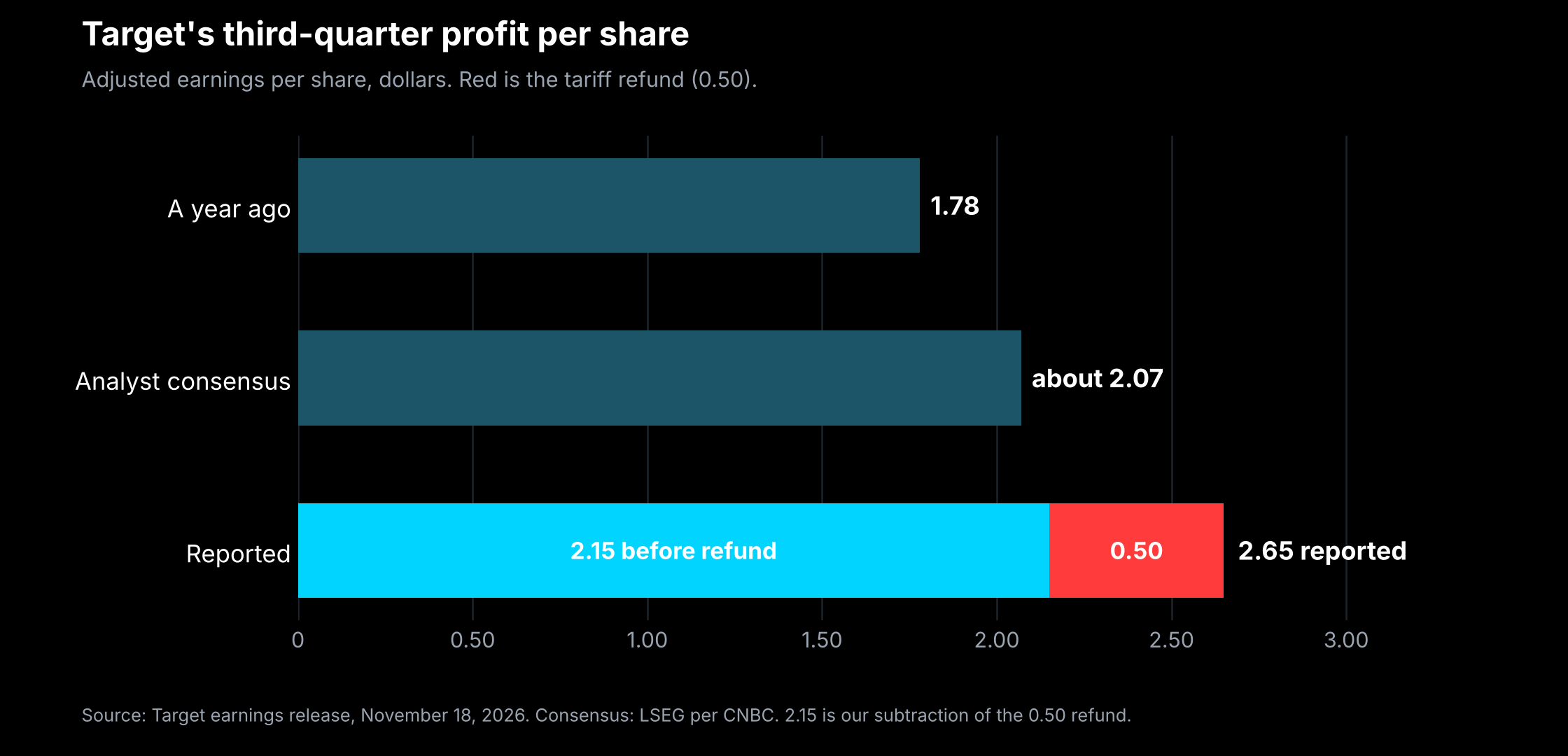
Set that against the 2.07 dollars analysts expected, a figure CNBC attributed to LSEG, a data provider. Other outlets had 2.07 or 2.08. The beat was 58 cents. The refund was 50 cents of it, about 86%. If analysts left the refund out of their estimates, the beat without it was about 8 cents, or around 4%. If some analysts had already counted on a refund, the real beat was larger. The sources we found do not say which. One note published on November 10 put analysts' full-year profit estimate near 8.43 dollars, close to the company's without-refund range, which hints that analysts left refunds out. That is indirect, so treat the exact gap as approximate.
Operating margin, operating profit as a share of sales, was 6.2% against 4.4% a year ago on the adjusted basis. The release says the refund added about 1.1 points to that. That leaves about 5.1% without it, still higher than 4.4%.
What the business did
The refund is one part of the quarter. The rest is the sales side, and it was strong.
Net sales rose 7.1% to 27.07 billion dollars, against about 26.56 billion expected by LSEG's count. Comparable sales, which measure sales at stores open at least a year plus digital orders, so that new stores do not flatter the figure, rose 5.6%, against about 3.8% expected, according to a repost of CNBC's report that cites StreetAccount. A year ago they fell 2.7%, and last quarter they rose 3.8%. Store comparable sales rose 4.6% and digital rose 9.8%.
Customers came back. The number of transactions, which the company calls traffic, rose 5.0%, and the average amount spent per transaction rose just 0.6%. So this growth came from more visits, not from higher prices or a bigger basket. Last year at this time, traffic fell 2.2%.
Two other readings. The company's other revenue, mostly advertising and credit card profit sharing, rose 19.3% to 618 million dollars. And one summary of the call says toys and games, which Target calls Fun 101, rose 27% in the quarter, with about 40% of the year's growth in that category from trading cards. That is a single secondhand source.
Gross margin was 30.5% against 28.2%, a gain of 2.3 points. The refund explains about 1.1 points of it, so the underlying gain was about 1.2 points. The summary of the call credits lapping last year's markdowns and tariff costs, growth in advertising and membership businesses, and supply chain savings, and lists price investments, higher freight and fuel costs and product mix as pulling the other way. Operating expenses rose about 10%, which the summary ties to store hours, new stores and remodels, and incentive pay. We did not find a full transcript.
The same pattern showed up last quarter. In the second quarter, adjusted earnings per share were 4.11 dollars against 2.05 a year earlier, a doubling. Without the 1.65 dollar refund the company says growth was 20%. This quarter, without the refund, it was about 21%. So underlying profit growth has run near 20% in both quarters, and the headline growth rates of 100% and 49% were made larger by money that was one-time.
Inventory, the goods on hand, was 16.1 billion dollars at the end of the quarter against 14.9 billion a year earlier, up about 8%. That is slightly faster than the 7.1% growth in sales. It is not a warning on its own, since stores stock up before the holidays, but it is worth checking in the next report.
The guidance
Guidance is the company's own forecast for the rest of the year. Target raised its net sales growth forecast for the full year from about 5% to about 6%.
Its profit forecast needs a closer look. The new range is 10.65 to 11.40 dollars per share. The release says that includes about 2.14 dollars of refunds received so far, which is the 1.65 from the second quarter plus the 0.50 from the third, give or take rounding. It also says the forecast leaves out any refunds Target might receive later.
In August the range was 9.90 to 10.90 dollars, including 1.65 of refunds.
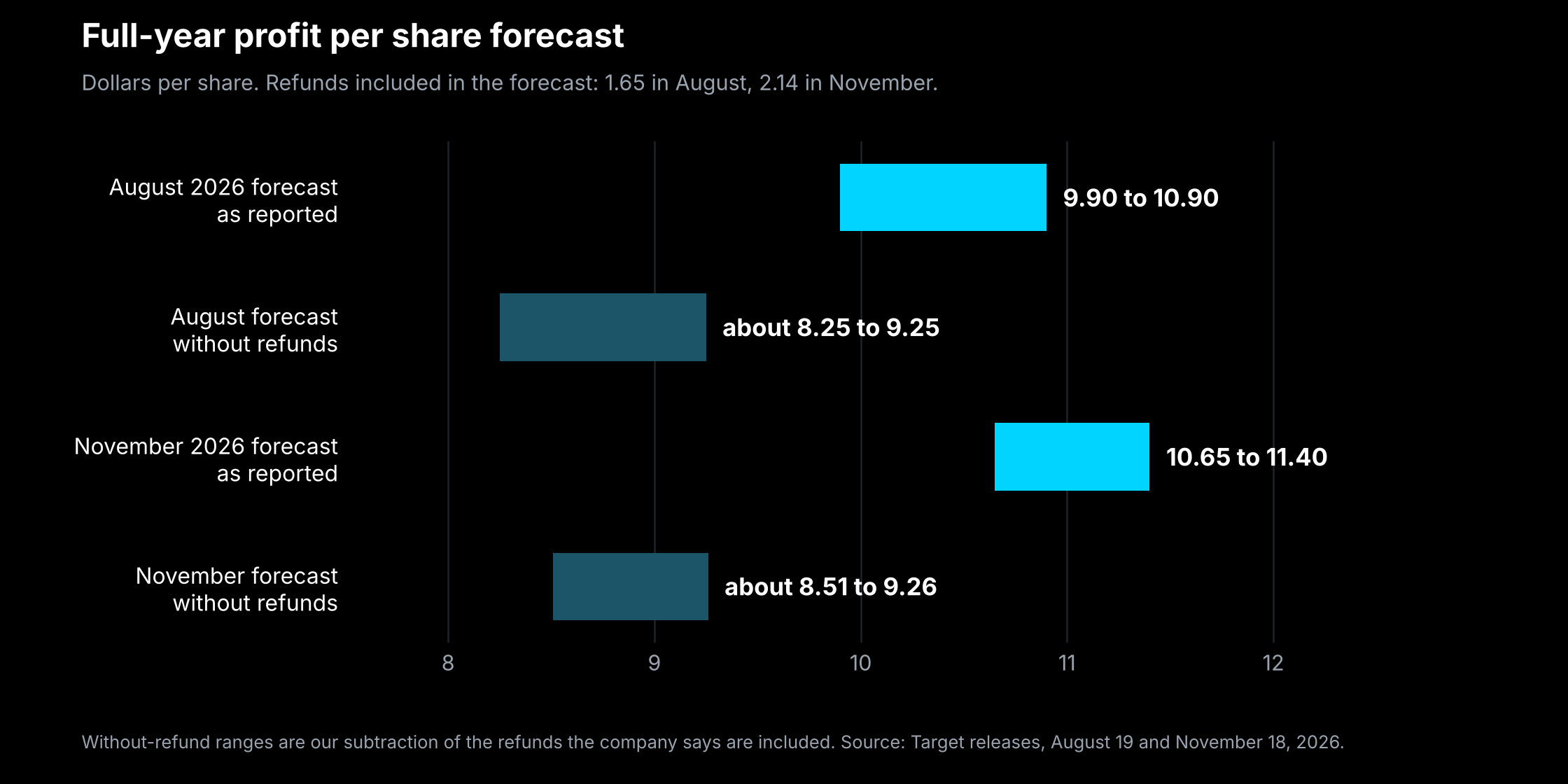
Subtract the refunds and the picture changes. In August, without refunds, the range was about 8.25 to 9.25. Now it is about 8.51 to 9.26. These are our calculations, using the company's stated amounts. The midpoint of the reported range rose about 63 cents, from 10.40 to 11.03. Fifty cents of that is the refund recognized this quarter. The rest, about 13 cents, is the underlying increase, a bit under 2%.
The raised sales forecast and a month-to-date sales trend that the release says accelerated in November are real signals of a better business. The profit increase is mostly the refund.
Why the stock rose, and what we cannot say
Several explanations fit. Sales growth was the fastest in some time, and CNBC's report, which we read only through a repost, calls it the best in more than five years. Traffic turned positive after falling last year. The sales outlook went up. Profit beat estimates by a wide margin, even though most of the beat came from the refund.
The stock also had room to move either way. One headline described the shares as up 70% this year going into the report, and one outlet put the options market's implied move at about 9%. Both are single sources, and the options figure is a market estimate, not a result. A stock that has already risen a lot can fall on good news, and this one rose.
Early reports of the premarket reaction were mixed. One page said shares fell before the open, though its own price data showed a gain, and another said they were marginally higher. By the morning session the readings were up about 5.5% to 7.7%, and we did not find a closing price. None of the sources we read separates the reasons for the rise, and the analysts and outlets who offered reasons gave their own readings. We can say what the release contains. We cannot say what moved the price.
How to find a one-time item yourself
Most companies report two profit figures. The first follows standard accounting rules. The second, called adjusted or non-GAAP, removes items the company calls unusual. Target is unusual this quarter because it did not remove the refund, so its standard and adjusted figures are both 2.65 dollars. A refund that a company counts as part of normal results is worth a second look, because the company's own adjusted number then includes it.
Three places show you what is inside a number. The earnings release has footnotes under the results table, and the refund appears in one of them. The reconciliation table, which lists every adjustment between the two profit figures, shows what the company took out. The quarterly report has a section where management explains changes in gross margin, which is where a refund like this one has to be described.
What to watch
Three things to read for yourself.
Read the quarterly report when it is filed for the refund details. Whether more refunds are coming, and how much, is the largest open item. The release says the guidance excludes them, and that does not say whether Target expects any.
Watch the fourth quarter, which includes the holiday season. The release gives no fourth-quarter number, only that November sales are in line with the company's expectations and accelerating from October.
Compare the next report with this one without the refund. A company that earns 2.15 dollars in a quarter where it used to earn 1.78 is a different story from one that earns 2.65, and the next report will not include 50 cents of refund unless another one arrives.
What this does not tell you
It does not tell you the refund was the only reason for the beat. Sales and margin improved apart from the refund, and the beat size depends on whether analysts counted it.
It does not tell you why the stock rose. The sources do not separate the explanations.
It does not tell you whether more refunds will come. The company excludes them from its forecast, and we found no estimate.
It does not tell you what Target is worth, or where the stock goes next. Nothing here is a forecast.
The next time a company beats estimates by a wide margin, look for a one-time item in the footnotes before you read anything into the size of the beat.
Techdamentals shows the inputs behind every fair value rather than a single number, puts the fundamentals and the chart in one place, and reads the SEC filing to find the real reason a stock moved after earnings.
Try Techdamentals for 3 days, no card needed
This is educational content, not financial advice. Techdamentals is an educational tool and does not recommend any security.