
On Tuesday, November 17, 2026, at about 1:20 p.m. Pacific time, Nvidia reported results for the third quarter of its fiscal 2027, the three months that ended October 25, 2026. It was the company's first report since founder Jensen Huang resigned as chief executive on Thursday, November 12, 2026, and Colette Kress, the chief financial officer, became interim CEO.
The numbers were large. Revenue was 115.8 billion dollars, up 103% from a year earlier, and the company guided to about 130 billion dollars for the next quarter. The stock had closed the regular session at 155.46 dollars, down 0.44%, and traded higher after hours. Reports put the gain at anywhere from about 1% to nearly 4%. TheStreet described about 3% right after the release that eased to about 1%, so these look like snapshots from different minutes. Those are early readings, not closing prices.
A word on sourcing. We read Nvidia's earnings release as filed with the Securities and Exchange Commission, which is the primary source for every company figure below. The longer quarterly report, called a 10-Q, had not been filed when we wrote this. Details of the conference call come from news summaries, and one of them was machine generated with visible transcription errors, so we mark anything that rests on it. We are not repeating any report about why Mr. Huang resigned. Nvidia's own documents give no reason, and that is where we stop.
How big was the beat
Before each report, analysts publish estimates, and the average is called the consensus. A beat means the company came in above it. Nvidia's own forecast for the quarter, its guidance, was 108.0 billion dollars of revenue, plus or minus 2%.
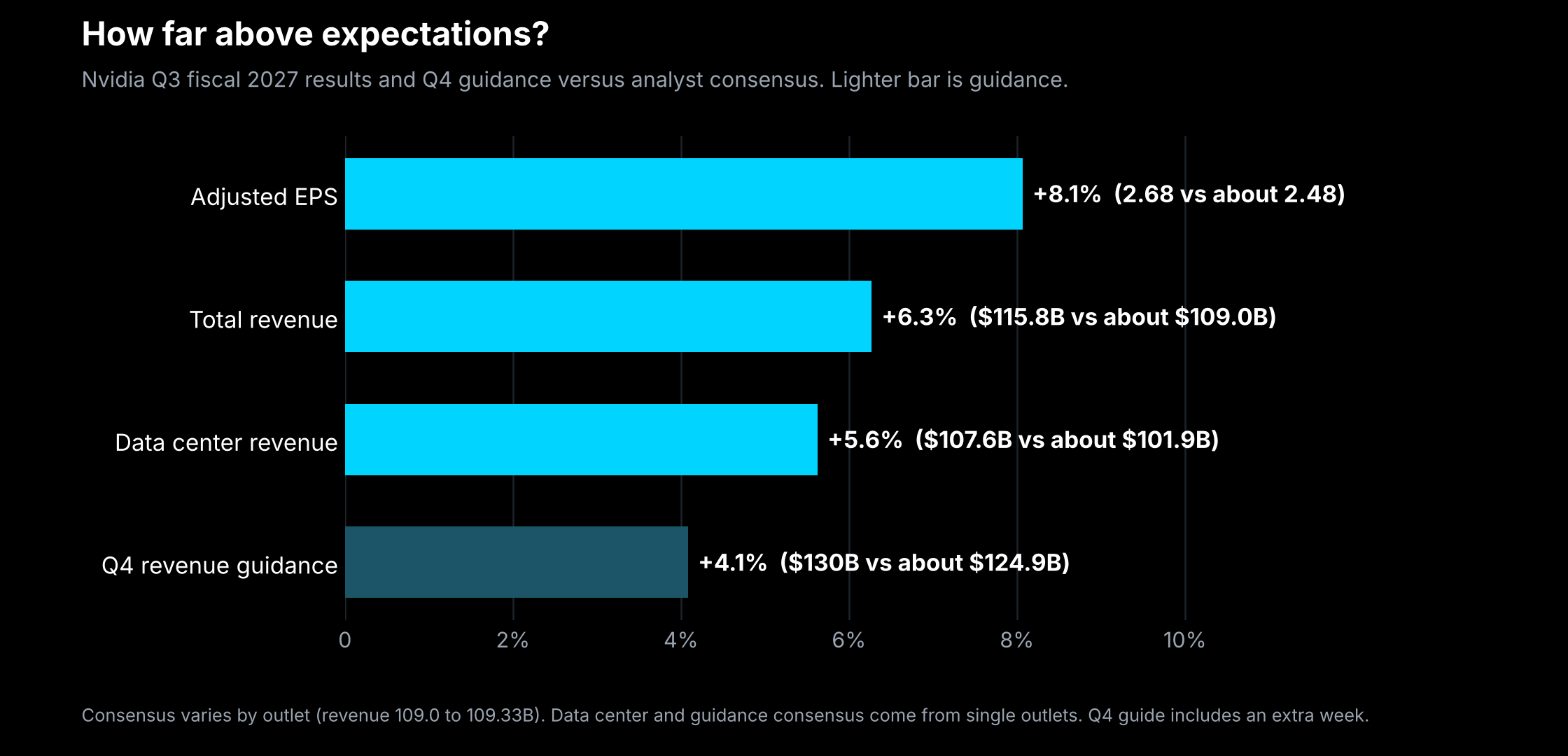
Revenue of 115.8 billion dollars was about 6% above a consensus of roughly 109 billion, and about 7% above the middle of the company's own guidance. Adjusted earnings per share, which excludes items the company treats as one-time, were 2.68 dollars against about 2.48 expected, a beat of about 8%. Data center revenue, the segment for chips and systems sent to cloud companies and other large customers, was 107.6 billion dollars, up 110% from a year earlier and about 93% of the total. One outlet had expected about 101.9 billion for that line.
The consensus figures differ a little by outlet. Kiplinger cited FactSet at 109.0 billion for revenue and 2.48 dollars for earnings per share. Others had 109.1 to 109.33 billion and 2.47 dollars, and none of those named a provider. TheStreet also cited a 112.6 billion dollar survey figure from JPMorgan, so the size of the beat depends on which expectation you use. The next quarter's guidance of 130 billion dollars, plus or minus 3%, compares with a consensus of roughly 124 to 125 billion at three outlets (TheStreet had 124.9).
The extra week
The release says the fourth-quarter outlook "includes an additional week." Nvidia's fiscal year normally has 52 weeks, with 13 in each quarter. An additional week makes the quarter 14 weeks long. The release does not say which fiscal year has 53 weeks, and we did not check it.
That changes how to read 130 billion dollars. Divided by 14 weeks it is about 9.3 billion dollars a week. This quarter's 115.8 billion over 13 weeks was about 8.9 billion a week. On a per-week basis, the guide is about 4% higher than this quarter, which is still growth, and a smaller step than the headline gap suggests. These are our own calculations from rounded figures. We could not tell whether the published consensus of about 125 billion already counted the extra week, so we cannot say how much of the guidance beat comes from the calendar.
The margin guide
Gross margin is the share of each sales dollar left after the direct costs of making the product. Nvidia reported 74.8% on the standard accounting basis and 74.9% adjusted, against 75.0% in the prior quarter. For the fourth quarter it guided to 71.0% to 72.0%, roughly three points lower.
At 130 billion dollars of revenue, each point of gross margin is about 1.3 billion dollars of gross profit. The release does not say why the margin is expected to fall. One call summary attributes this quarter's margin to "better product mix." We found no reliable account of the reason for the lower forecast. Motley Fool wrote that the company does not say why, and TheStreet's live blog ties the decline to the ramp of the new Vera Rubin product. That is blog-level sourcing, not a quote from management, so we treat it as a question to put to the call transcript.
What changed on the balance sheet
The release includes a balance sheet, and the changes since the end of January are large. All figures are in billions of dollars.
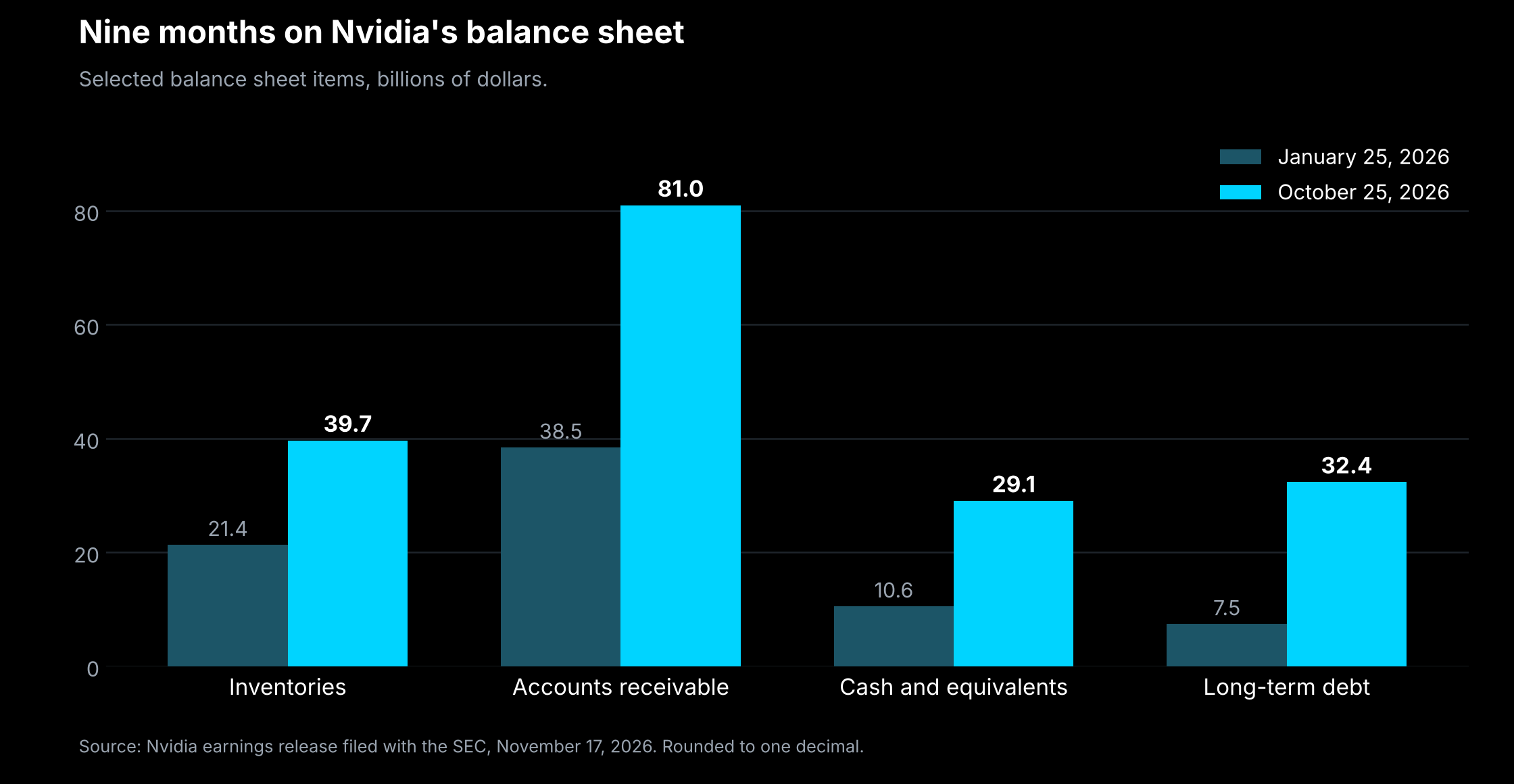
Inventories, the chips and parts Nvidia holds, rose from 21.4 to 39.7. Accounts receivable, which is what customers owe the company for products already delivered, rose from 38.5 to 81.0. Cash and equivalents rose from 10.6 to 29.1. Long-term debt rose from 7.5 to 32.4, and short-term debt went from 1.0 to zero. The release does not say when or how the new debt was issued. TechRepublic reported in June 2026 that Nvidia sold about 25 billion dollars of senior notes, its first bond sale since 2021. That is one outlet, and we did not match it to the balance sheet.
Rising receivables and inventory are normal when sales double, so none of these figures is a warning on its own. The test is whether they grew faster than sales, and that needs prior-quarter figures that the release does not include. The 10-Q will also show which customers owe the money. In August it showed five direct customers owing 22%, 14%, 13%, 11% and 10% of the total, which we covered in our earlier issue on the leadership change.
The company also generated 48.3 billion dollars of cash from operations in the quarter and spent 4.4 billion on capital equipment. It returned 28.1 billion dollars to shareholders through repurchases and dividends, and the board added 150 billion dollars to its repurchase authorization, which has no expiration. About 227.3 billion dollars remains.
China, and a new committee
The release repeats a line from earlier quarters: "NVIDIA is not assuming any Data Center compute revenue from China in its outlook." So the guidance does not depend on the export rules the Commerce Department published on Monday, November 16, 2026, which we covered in our issue on the chip rule. The release also lists, as a headline, that the board has established a National Security and Export Control Oversight Committee. It gives no description of what the committee does, and we found none.
A machine-generated call summary says Nvidia booked 2.4 billion dollars of licensed Hopper chip sales to China this quarter and no longer ships those products there. TheStreet's live blog repeats the 2.4 billion figure. That summary also contained clear errors, and we found no transcript, so we are not treating either claim as established. The 10-Q should show Nvidia's revenue by region.
What the company said about leadership
Ms. Kress said, in the release, "Our momentum is real. NVIDIA is an exceptional technology leader, powered by the relentless innovation of our people." About the new product, she said, "Vera Rubin is off to an explosive start, our roadmap is on track and our ambition has never been greater."
The release's list of risks, in its forward-looking statements, still names the search for a new chief executive and "the ongoing investigation by an independent committee of NVIDIA's board of directors." That investigation is the one the board announced on Sunday, November 8, 2026, which we covered in our earlier issue. The release does not describe its scope.
Two outlets reported things about the call itself. TheStreet attributes to Bloomberg a report that the board is not considering bringing Mr. Huang back, and the release itself says nothing about it, so we do not treat it as a company statement. The machine-generated summary quotes the company as saying it "will not be addressing or taking questions on today's call regarding the circumstances of Jensen's resignation." We could not check either against a transcript.
Why the stock moved, and what we cannot say
A rise after a report like this has several candidate explanations. Revenue and earnings above estimates are one. A guide well above estimates is another, and the Motley Fool and XTB wrote that the report and guidance drove the move. A large repurchase authorization is a third. The fact that investors had been bracing for the first report without a founder CEO is a fourth. None of those outlets showed evidence that separates one reason from another, and neither can we.
The numbers do show this much. Nvidia's record close of the past year was 239.24 dollars on Tuesday, October 6, 2026. The November 17 close of 155.46 dollars is about 35% below that. Even the biggest early after-hours reading, near 4%, would leave the stock about a third below its record. The report answered a question about demand. It did not claim to answer questions about the board's investigation or the permanent CEO.
What to watch
Read the 10-Q when it is filed. It will show revenue by region, the customers behind the receivables, and the commitments Nvidia has signed to suppliers. At the end of July those commitments were 279 billion dollars for supply and capacity. The machine-generated call summary lists a figure that appears to be near 390 billion dollars, and pledges near 118 billion, but it contains transcription errors and we do not use it.
Read the full call transcript for what management said about the margin guide and the supply side.
Read the closing price on Wednesday, November 18, 2026 against the early readings in this issue. After-hours moves on a report day often change by the open.
What this does not tell you
It does not tell you why the stock rose after hours. Several explanations fit and the sources do not separate them.
It does not tell you why Mr. Huang resigned, or who will lead the company permanently. Nvidia's documents give no reason, and the board has said only that a search is underway.
It does not tell you what the fourth quarter will be. The guide includes an extra week, and the company has missed and beaten its own forecasts before.
It does not tell you what Nvidia is worth, or where the stock goes next. Nothing here is a forecast.
The next time a company reports a big beat, check three things before you read the headline: how large the beat is against the company's own guidance, how much of the guide comes from the calendar, and whether the balance sheet grew in line with sales.
Techdamentals shows the inputs behind every fair value rather than a single number, puts the fundamentals and the chart in one place, and reads the SEC filing to find the real reason a stock moved after earnings.
Try Techdamentals for 3 days, no card needed
This is educational content, not financial advice. Techdamentals is an educational tool and does not recommend any security.