
On Tuesday, November 17, 2026, Home Depot reported results for the third quarter of its fiscal 2026, the three months that ended November 1, 2026. Profit per share came in above what analysts expected. Sales came in above what analysts expected. The stock slipped anyway, down roughly 1% to 3% in early trading, depending on which outlet and which hour you read.
A stock falling on good news looks backwards, so this issue goes through it with the company's own numbers. It also covers the part that is easy to skip: nobody knows exactly why a stock moves on a given morning, and we will say where the evidence runs out.
These are early readings from the morning of the report, not closing prices. We read the company's earnings release on the Securities and Exchange Commission's website. Analyst expectations and the details of the conference call come from news summaries, and we flag the ones that rest on a single source.
What a "beat" means
Before an earnings report, analysts publish estimates for profit per share and for sales. The average of those estimates is called the consensus. When the company reports a number above the consensus, headlines call it a beat. When it reports below, they call it a miss.
The size of the beat matters as much as the direction. This quarter Home Depot reported adjusted earnings of 3.86 dollars per share against a consensus of 3.84 dollars. "Adjusted" means the company removed certain items it considers one-time, such as costs tied to acquisitions. The beat is two cents, or about 0.5%.
Sales were 43.4 billion dollars against about 42.81 billion expected, a beat of about 1.4%. Comparable sales, which measure sales at stores open at least a year so that new stores do not flatter the figure, rose 2.2% against an expectation of roughly 1.8%. The two consensus figures that go beyond earnings come from a single news summary that did not name its data provider, so treat them as approximate.
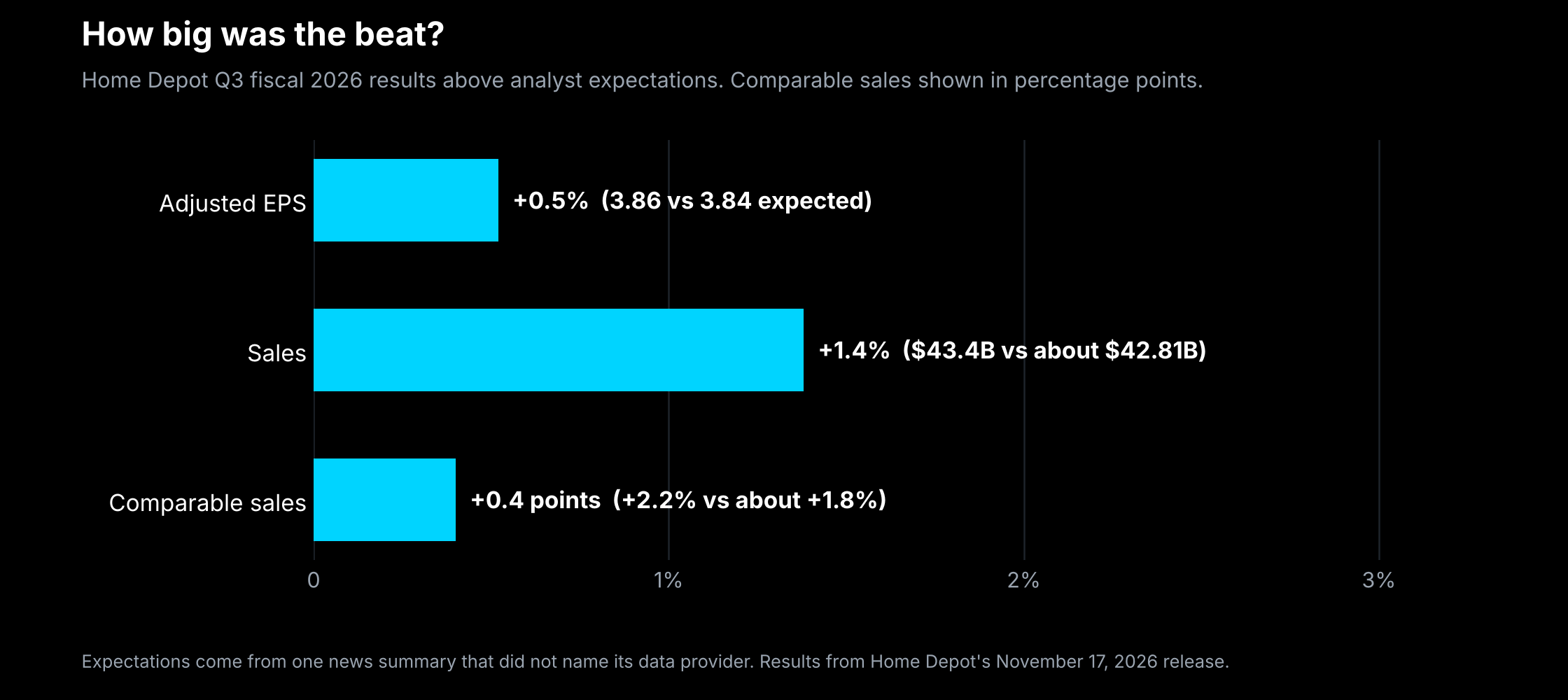
So it was a beat, and a thin one. A two-cent margin on a company that earns nearly four dollars a share in a quarter is the kind of beat that analysts expect most quarters.
What the quarter showed
The release gives the following for the third quarter, compared with the same quarter a year earlier.
Net sales rose 4.9% to 43.4 billion dollars. Comparable sales rose 2.2%, and comparable sales in the United States also rose 2.2%. Reported earnings were 3.72 dollars per share, up from 3.62. The operating margin, which is operating profit as a share of sales, was 12.6%, down from 12.9%. On the adjusted basis it was 13.0%, down from 13.3%.
Two details sit under the headline. First, customers made fewer trips. Total customer transactions fell 0.2% to 392.7 million, and the comparable count fell 0.5%. Sales grew because the average ticket, the amount spent per transaction, rose 3.0% to 93.09 dollars. One news summary of the call said roughly half of that ticket growth came from inflation. That is a single source.
Second, gross margin, the share of each sales dollar left after the cost of the goods, slipped. The release does not state it, so we calculated it from the reported figures: about 32.8%, against about 33.4% a year earlier. One summary of the call puts the decline at about 60 basis points, which agrees. A basis point is one hundredth of a percentage point, so 60 of them is 0.6 points. The same summary said management pointed to cost pressures in fuel, energy, freight, resin and metals, and to the mix of businesses after acquisitions. We did not find a full transcript.
Monthly comparable sales, from the same summary, were up 1.1% in August, 3.8% in September and 1.8% in October. Online comparable sales rose about 13%, and 13 of 16 merchandising departments posted positive comparable sales. All of these are single-source.
What the new outlook says
Every quarter, Home Depot publishes guidance, its own forecast for the full fiscal year. Investors often care more about this than about the quarter just reported, because stocks are priced on what comes next.
Compare the guidance in the August release with the one published this morning. The release says guidance was updated, but it does not show the old ranges, so we took them from the August 18 release.
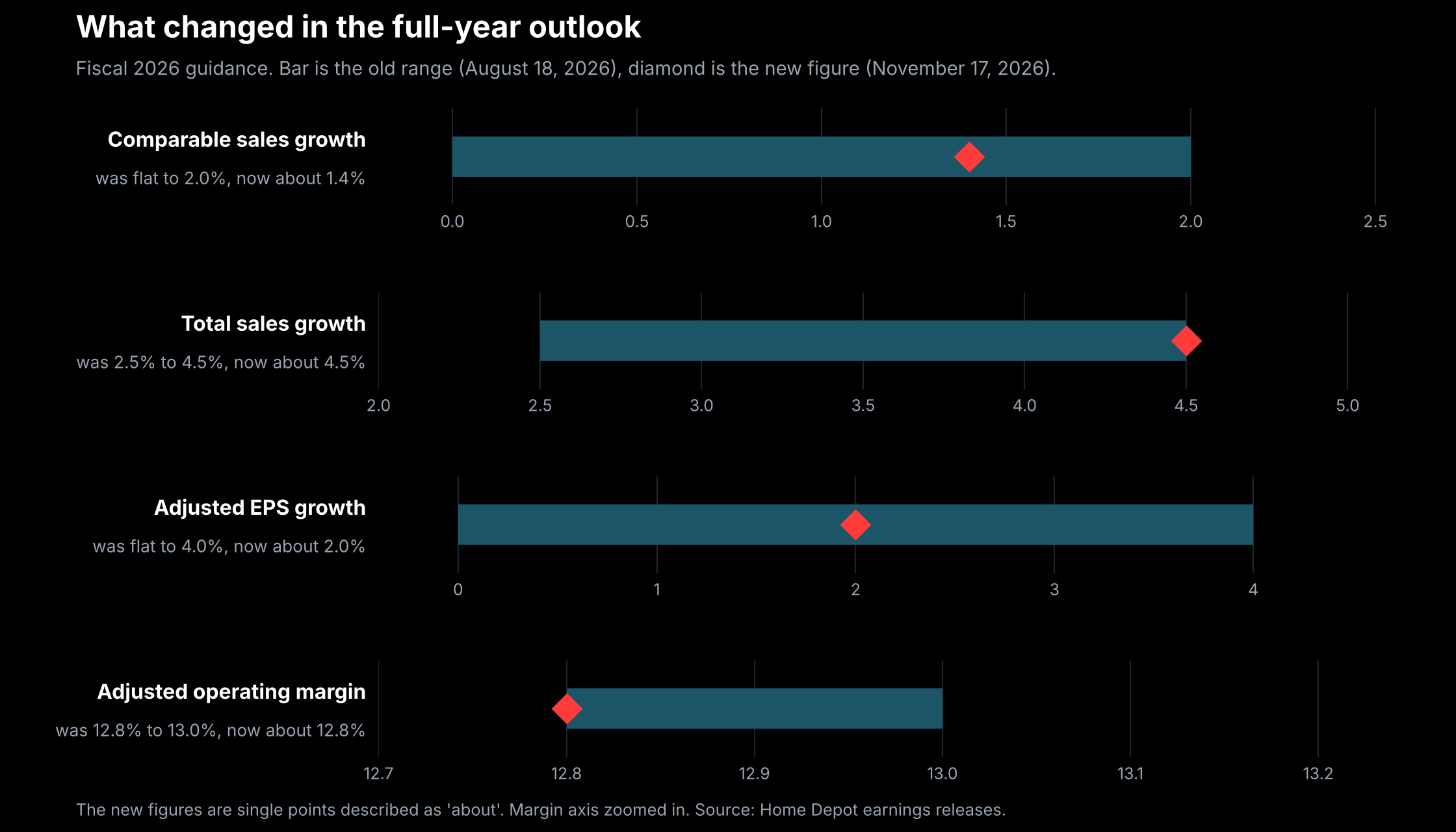
Two things stand out.
The range got narrower, and in most cases it landed in the middle or the bottom. Adjusted profit growth moved from "flat to 4%" to about 2%, which is the middle of the old range. Comparable sales growth moved from "flat to 2%" to about 1.4%, a bit above the middle. Total sales growth moved to about 4.5%, the top of the old range. The adjusted operating margin moved to about 12.8%, the bottom of its old range of 12.8% to 13.0%. Gross margin guidance edged from about 33.1% to about 33.0%.
So the outlook did not collapse, and it did not rise. One news account described the sales guidance as "raised." That is true only in a narrow sense, because the top of a range is a smaller change than it sounds, and our reading of the release is that the company did not lift the whole forecast.
The second point comes from arithmetic. Adjusted profit of 14.69 dollars per share in fiscal 2025, growing about 2%, gives roughly 14.98 dollars for this fiscal year. Adjusted profit for the first three quarters was 3.43, 4.92 and 3.86 dollars, a total of 12.21. That leaves roughly 2.77 dollars for the fourth quarter, against about 2.71 in the same quarter last year. By the same method, a full-year comparable sales figure near 1.4% implies fourth-quarter comparable sales growth of about 1%. These are our calculations from rounded guidance, so they carry some error. They suggest that the company is guiding to a slower final quarter than the third.
One news account said the guidance implies about 14.98 dollars against analyst expectations of about 15.05. That gap would be about 0.5%, and it matches the size of the earnings beat in the other direction. It also rests on one source.
What management said about the business
The call summary we read gives several comments that help explain the numbers.
On housing, the new chief executive said "Housing turnover hasn't moved in four years now." Management said its growth was coming from gaining market share rather than from a stronger housing market, and acknowledged that higher interest rates weigh on its customers. Customers favored smaller repair and maintenance projects over large renovations.
On roofing, the company said "We've had two years in a row with really very little storm seasons." The same summary says the company's SRS roofing and building materials business now expects low single-digit organic sales growth, down from its earlier view. Organic growth excludes acquisitions.
On the fourth quarter, management said gross margin will be a bit lower than last year because of product mix and seasonality. The first few weeks of November were consistent with guidance, and promotional activity was lower than in prior years.
All of this is a news summary of the call, not a transcript. We did not find one.
A change at the top
The same release announced a leadership change. Richard McPhail, the chief financial officer, becomes chief executive on November 23, 2026. The release calls him "incoming chief executive officer." One news account reports that Ted Decker, the current chief executive, remains chairman of the board, that Ann-Marie Campbell becomes president and chief operating officer, and that Jordan Broggi becomes chief financial officer, all on the same date. The release itself, as far as we could read, gave no further detail, and we did not find an explanation of the timing.
A leadership change alongside a quarterly report gives investors a second thing to weigh. No source we found says how much it mattered to the stock.
What had already happened to the stock
A stock does not start from zero on the morning of a report. Home Depot rose about 7% on November 4, 2026, the day after the midterm elections, as housing-related stocks rallied and Treasury yields dipped, according to one financial site. It said investors expected Congress to act on housing affordability and lower mortgage rates, that neither had happened yet, and that analysts at TD Cowen "remain dubious it will become law." The same site said the stock traded at about 22 times forward earnings before that jump and about 24 times after it.
Forward earnings are the profit analysts expect over the next twelve months, and "22 times" means the stock price was 22 times that profit. A higher multiple means investors are paying more for each dollar of expected profit, so they need more from the results to feel the price is justified.
The stock closed at 347.51 dollars before the report, within a 52-week range of 277.15 to 397.63 dollars, according to the data on one summary page. A stock sitting well above its low point, after a recent jump, has more room to fall on a report that is only slightly better than expected.
Why it fell, and what we cannot say
Several explanations fit the facts, and nobody can rank them.
One candidate is the thin beat. A two-cent beat is small, and a stock that has risen can need more.
A second is the outlook. Profit guidance landing at the midpoint of its old range, and margin guidance at the bottom, is less than some investors hoped for, particularly with an expected profit figure above the guidance in one account.
A third is margin. Gross margin fell about 0.6 points from a year earlier, and management said the fourth quarter will be lower again.
A fourth is the roofing business and the storm comments.
A fifth is the leadership change. A sixth is housing, since turnover has been flat for four years and the Congress-related hopes behind the November 4 jump had not become law.
Several outlets wrote that the stock fell because of the weaker profit outlook and the housing market. That is their reading, and none of them showed evidence that separates one reason from another. A stock price is the result of thousands of trades by people who each have their own reason. We can say what the report contained. We cannot say which part moved the stock.
What to watch
Three things to read for yourself.
Read the full conference call transcript when it is available, in particular what management says about the fourth quarter and about the roofing business.
Read the company's quarterly filing with the Securities and Exchange Commission when it appears, for the segment detail the release leaves out.
Watch the closing price tonight, and compare it with the early readings in this issue. Early moves on report days often change by the close.
What this does not tell you
It does not tell you why the stock fell. Several reasonable explanations fit the data, and the sources do not separate them.
It does not tell you what the fourth quarter will be. Our implied figures come from rounded guidance and carry error. Companies can miss or beat their own forecasts.
It does not tell you whether the closing price confirmed the early move. We used early readings from the morning of November 17.
It does not tell you where the stock goes from here, or what it is worth. Nothing here is a forecast.
The next time a stock falls after a beat, look at three things before you form an opinion: how big the beat was, what the new guidance says compared with the old, and how far the stock had risen going in.
Techdamentals shows the inputs behind every fair value rather than a single number, puts the fundamentals and the chart in one place, and reads the SEC filing to find the real reason a stock moved after earnings.
Try Techdamentals for 3 days, no card needed
This is educational content, not financial advice. Techdamentals is an educational tool and does not recommend any security.