On Monday, November 16, 2026, the US Commerce Department published a rule about a question that sounds like a riddle: if a country is barred from purchasing the most advanced artificial intelligence chips, can it still use them?
For years the answer was a gray yes. A company in China could not import the chips, but it could rent computing time on those same chips in a data center in Malaysia, Singapore or Indonesia and use them over the internet. The new rule tries to close that route. This issue explains what the rule says, what it leaves open, and what it does and does not tell you about Nvidia, which reports earnings on Tuesday, November 17, 2026 after the market closes.
One note on sources. We could not open the rule itself, because the Federal Register and the Commerce Department's own pages were not reachable for us. What follows comes from news coverage and from a draft of the rule that circulated, and we say where outlets disagree. We also decline to say the rule caused any move in a stock. We will show you why.
What the rule says
Here is what the coverage agrees on. The Bureau of Industry and Security, the part of Commerce that writes export rules, issued what is called an interim final rule. That means it takes effect without waiting for public comment first, and the public can comment afterward. Outlets report a 60-day comment period, though two of the sources for that appear to be copying each other.
It does three things.
It adds a license requirement for certain data centers. A license is required to ship advanced chips to a data center that provides a large amount of computing power to companies headquartered in China, Macau or the other countries on a US restricted list. "Large" is defined by a score. Export rules measure a chip's computing power with a number called total processing performance, or TPP. The rule's threshold is 12 million TPP of access, counting linked facilities together. One outlet estimates that is roughly the power of 750 of Nvidia's H100 or H200 chips. That conversion comes from one source, so treat it as a rough guide.
It requires licenses for exports to five countries. Shipping advanced chips to companies headquartered in Indonesia, Malaysia, Singapore, Thailand or Brazil will need a license, reviewed case by case. The stated reason is a higher than normal risk that chips get passed along to places they are not allowed to go. Companies headquartered in the United States are exempt if they file regular reports.
It tells data centers to know their customers. Operators have to check who owns and controls the companies renting their computing power, directly and indirectly. Existing data centers get 90 days to apply for a license.
Two points where reports disagree. Euronews says the license requirement "takes effect in 90 days." Other outlets say the rule takes effect when it is published in the Federal Register, with the 90 days applying to data centers that already serve covered customers. The second reading looks right, but we have not seen the final text. Reports also disagree on how to name the restricted countries. Some say China, Russia and Iran. The better-supported reading is Macau plus a list the government already maintains, which includes those three and others.
Three addresses for one chip
To see why this is hard, think about every address a chip has. We count three.
The first is where the bill goes. The second is where the chip physically sits and runs. The third is who is actually using it.
Those can all be different. Nvidia used to report revenue by where customers were billed. In its second quarter of fiscal 2026, the quarter that ended in July 2025, about 22% of its revenue was billed to Singapore, roughly 10 billion dollars on our arithmetic. Nvidia said over 99% of the data center computing billed there was for customers in the United States, and that companies use Singapore to centralize invoices while the products ship elsewhere. Those figures come from secondary summaries of the filing, not the filing itself.
Nvidia has since changed how it reports. It now assigns revenue by where the customer is headquartered, and it includes this warning in its most recent quarterly filing: "The end customer and shipping location may be different from our direct customers' headquarters location." In other words, even Nvidia's own table cannot tell you where a chip runs or who uses it.
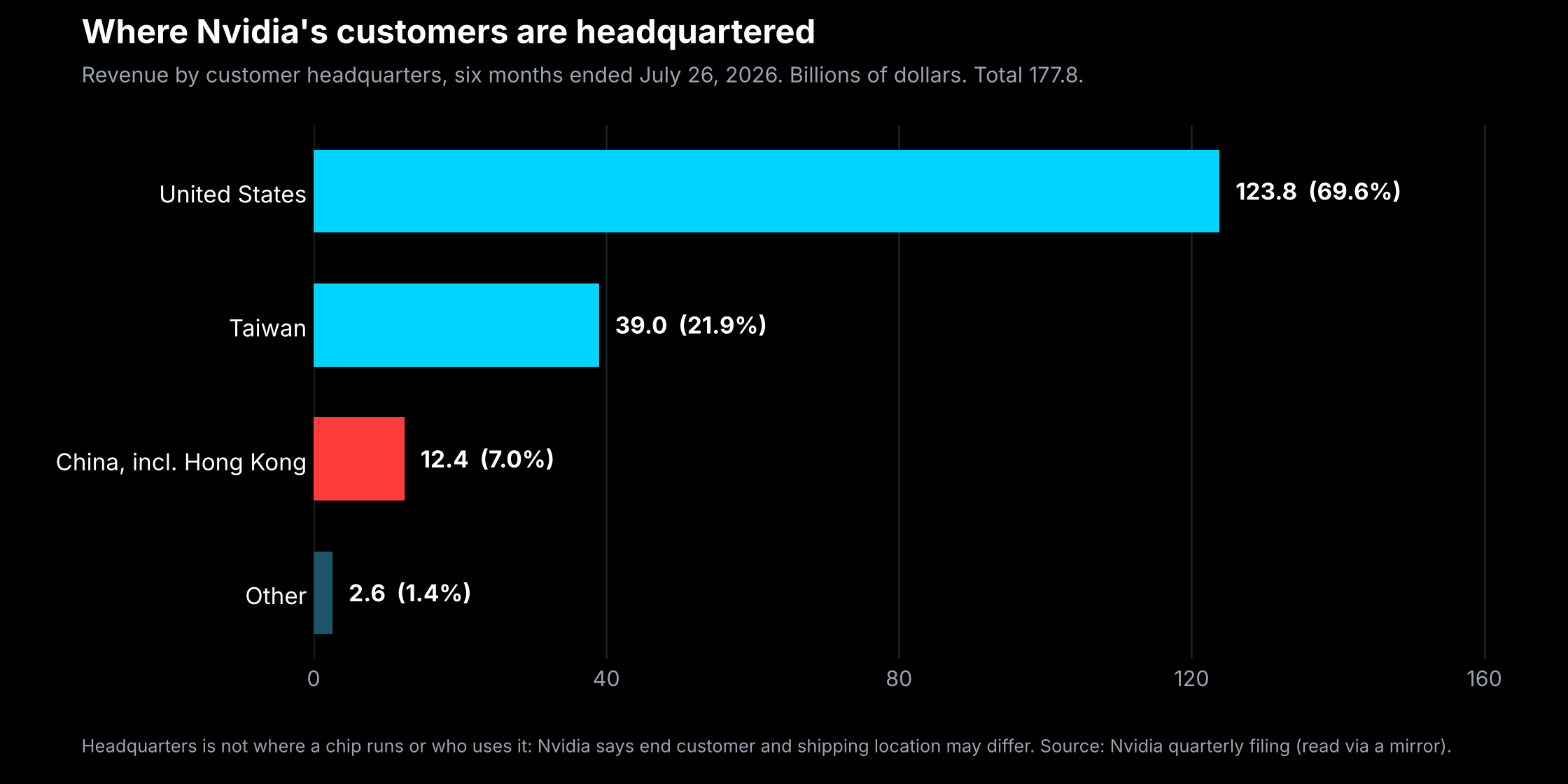
The new rule is aimed at the third address. It asks who ultimately benefits from the computing, using the headquarters of the user company or its ultimate parent as the test. That is a real shift. It is also the address that is hardest to check.
Was this legal before?
The short answer is that it sat in a gray area, and the sources disagree on how gray.
A May 2026 analysis from the Carnegie Endowment called these rentals "perfectly legal" and said the Commerce Department had authority to attach conditions that it never used. That is one source. A second account traces the gap to Commerce opinions from 2009, 2011 and 2014 that treated remote access as not being an export at all.
On the other side, Commerce said on May 31, 2026 that a license has been required since November 2023 for entities whose ultimate parent is headquartered in China or Macau, according to a report in Asia Times. Observers note that this "clarification" avoids admitting a loophole existed. That, too, is a single source.
We found no enforcement action based on remote access alone, and the authority has not been tested in court. So "legal before, illegal now" is too clean. A fairer description is that the rule writes down, and extends, a position the government says it already held.
Congress has also been working on this. The House passed the Remote Access Security Act by 369 to 22 on January 12, 2026. As of May 2026 the Senate version was still in committee. That matters because a rule can be changed or withdrawn more easily than a law.
Who is covered and who is not
The rule is narrower than "closes the loophole" suggests. Here is a way to read it.
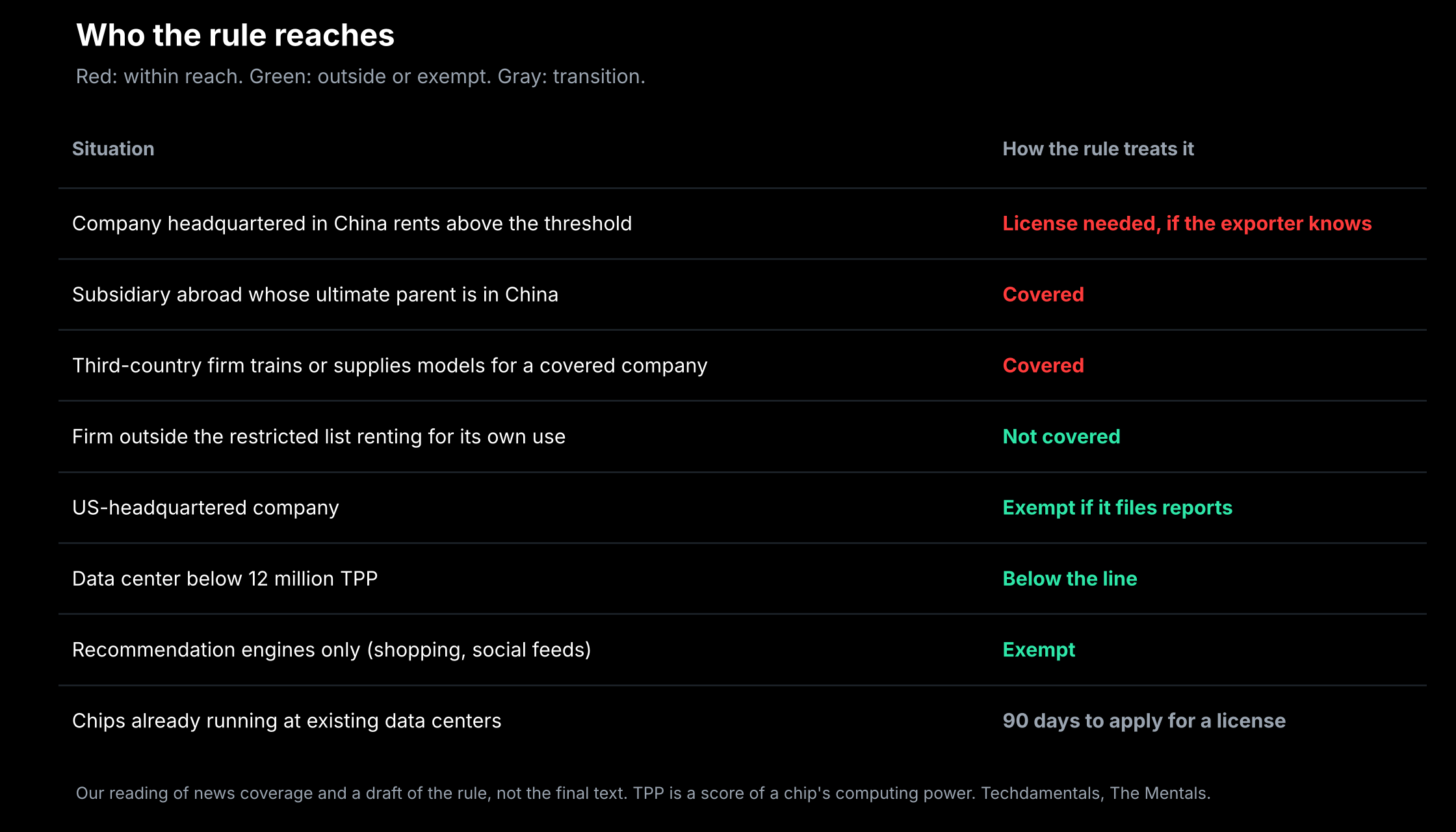
Three details deserve emphasis.
First, the test turns on headquarters. The draft does not appear to define the word. A Chinese lab working through a front company, or through an intermediary that is not on the restricted list, raises questions the rule may not answer.
Second, the license attaches to the person shipping the chips, and only if that person "knows" where the computing ends up. Proving knowledge is hard.
Third, the threshold is low enough to matter. About 750 chips' worth of computing is not a giant cluster. If that estimate holds, the rule reaches further than critics who call it too weak might assume.
What it means for Nvidia, and what it does not
Start with the numbers that are in Nvidia's own filing, which we read through a mirror of the quarterly report for the period ended July 26, 2026.
China, including Hong Kong, was 12.4 billion dollars of revenue in the first half of fiscal 2027, or about 7% of the total of 177.8 billion. That compares with about 20% in fiscal 2024 and 19% in fiscal 2025, according to a summary of earlier filings. The decline reflects years of changing export rules. The filing says shipments of its H200 chip to China were under 1% of data center revenue, that Beijing restricted purchases, and that Nvidia took charges tied to the earlier H20 chip.
So the rule does not touch a large share of the revenue Nvidia reports from Chinese customers. The harder question is the part the table cannot show: how much computing that ends up serving Chinese companies is bought by customers headquartered in other places. The filing says that reports of diversion can hurt the business "even when unsubstantiated and untrue," and it names the Remote Access Security Act as pending legislation. We found no Nvidia statement on the new rule.
Now the stock market. On Monday, November 16, 2026, Nvidia traded down roughly 3.5% to 3.9% during the day, AMD fell about 5%, and the semiconductor index fell more than 4%, according to intraday quotes from Yahoo Finance and Motley Fool. Those are not closing prices.
It is tempting to draw a line from the rule to those moves. We cannot. Yahoo's own report says investors were weighing the rule together with other news and that no source separates their effects. Nvidia's chief executive, Jensen Huang, resigned on Thursday, November 12, 2026, according to the company's filing with the Securities and Exchange Commission, and Nvidia fell 4.3% that day. Asian markets sold off sharply on November 16 in reports that did not mention the rule. Technology stocks were already falling. So the honest summary is that the rule arrived during a hard day for chips, and the data we have cannot say how much of the drop it explains.
Reasons for doubt
Here is where the critics are, and why we hold the strongest claims loosely.
Enforcement is the weak spot. The Carnegie Endowment argues that checking who a customer really is can be evaded through shell companies, VPNs and splitting work across providers. CNAS, another think tank, says cloud providers have no binding duty to verify customers and the government has little real-time view. The Government Accountability Office has found the Commerce Department stretched on hardware compliance. These are analysts' arguments, not findings about this rule.
Some supporters say it is a step, not a fix. Chris McGuire of the Council on Foreign Relations called it "a major step forward" but said loopholes remain, according to The Next Web. That is a single secondhand source.
Malaysia may feel it most. Joshua Kurlantzick of the same council said "For Malaysia, the controls could be disastrous." Also single-sourced. We found no on-record reaction from the governments of Singapore, Malaysia, Thailand, Brazil or Indonesia.
The policy points in two directions. In January 2026 the US opened case-by-case licensing of Nvidia's H200 chips to China. McGuire called that policy "strategically incoherent and unenforceable." As of May 2026, no H200 had shipped, reportedly because Beijing restricted purchases. So the US is tightening rental while allowing some sales, which makes the overall direction harder to read.
It could change quickly. Reports say President Trump is due to meet China's leader later this week. The May 2026 summit between them produced no chip deal. We do not know whether the rule is a negotiating chip, and we are not predicting that it is.
Nvidia's view is on the record from earlier. In May 2025 Huang said "the export control was a failure." That is his opinion, offered years before this rule, and it should be read as such.
What a famous case shows, and does not
Reports about a Singapore company called Megaspeed come up in almost every story about this rule, so here is what is and is not established.
Reports say Megaspeed has been a large Nvidia customer, with purchases described as "billions of dollars" and, in one account, roughly 2 billion. Singapore's government has said it is investigating possible export violations. The New York Times, relayed by a secondary outlet and citing anonymous sources, reported that the Commerce probe moved to the Department of Justice. The Justice Department declined to comment. Megaspeed denies sending chips to China. Nvidia said in December 2025 that it found no evidence of diversion.
So this is an open inquiry, not a finding. It is also a case about chips physically going somewhere they should not, not about renting computing time. It does not show how large the rental route was. We found no reliable estimate of how much Chinese demand for computing runs through Southeast Asia, and one large figure circulating, "hundreds of thousands" of chips, traces back to a single outlet we could not verify. We do not use it.
What to watch
Here are things worth reading for yourself in the days ahead, not predictions.
Read the rule's actual text when it is published in the Federal Register. The effective date, the comment deadline and how "headquartered" is defined will settle several things this issue had to hedge on.
Read Nvidia's earnings on Tuesday, November 17, 2026 for whether it discusses the rule, how it describes revenue by geography, and what it says about customers in the five named countries. A company can say a lot, or very little, in one quarter.
Watch whether the rule survives the week. Policies like this can be softened as quickly as they are announced.
What this does not tell you
It does not tell you the rule caused any stock move. Several things happened on the same day, and the sources that cover both say they cannot be separated.
It does not tell you how much computing reaches Chinese companies. No reliable estimate exists in what we could find.
It does not tell you how the rule will work. We read coverage and a draft, not the final text, and parts of the coverage conflict.
It does not tell you what Nvidia will report, or where any stock goes next. Nothing here is a forecast, and nothing here says what any company is worth.
The idea worth keeping is the three addresses. Next time a headline says a chip "went to" a country, ask whether it means where the bill went, where the chip sits, or who uses it.
That is the kind of reading that sits under a valuation rather than in a headline. Techdamentals shows the inputs behind every fair value rather than a single number, puts the fundamentals and the chart in one place, and reads the SEC filing to find the real reason a stock moved after earnings.
Try Techdamentals for 3 days, no card needed
This is educational content, not financial advice. Techdamentals is an educational tool and does not recommend any security.