
On Tuesday, September 8, 2026, Meta launched Muse, a shopping agent that can browse stores and place orders for a person. About twelve days later, around Sunday, September 20, 2026, Amazon blocked it. On Wednesday, November 25, 2026, a business magazine reported that the two companies are now in talks to end the blockade, with search results and advertising among the open issues and both chief executives needing to sign off. Neither company commented on the report.
So why did Amazon block Muse? The obvious answer is that Amazon was protecting its shoppers and its security. Hold that thought, because that is the reason Amazon gave, and the facts around it point to a second reason that Amazon did not say out loud.
My question is this: why did Amazon block Meta's agent, and what is being negotiated now? I will take it in three stops. First, what Amazon said and how it blocked Muse. Second, what a court said about software that shops for you, which is where the legal ground sits. Third, what Amazon has at stake, which comes down to one large business inside it.
Why should your own money care? More shopping is starting to run through software that acts for you, and the rules for who gets to stand between you and a store are being written right now. If you own a broad fund, you own pieces of the companies on each side.
What did Amazon say, and what did it do?
An agent, in this sense, is software that takes a task and carries it out for you. You tell it you want a pair of running shoes under a certain price, and it searches, compares and checks out. Muse does this inside Meta's apps. According to the reports I read, Muse had more than 10 million users in the United States and Canada as of October, and Mark Zuckerberg has said shopping is its top use. He has also said Meta plans to take "a small fee from transactions."
Amazon's stated reason was its Conditions of Use, which is the rulebook a person agrees to when they use the site. Amazon said Muse does not identify itself as a software agent, may capture a customer's sign-in details, and was not authorized. Those are the three points I found.
The method is worth a sentence. Websites normally tell automated visitors what they may do through a file called robots.txt, and automated visitors announce themselves with a label called a user-agent string. Amazon did not use robots.txt for Muse, because Muse has no user-agent string to point at. It blocked it some other way. Muse also runs in a cloud virtual machine, which is a computer that exists only as software on a company's servers. So the shopping happens on Meta's machines, not on your phone.
Notice the contrast with how Amazon behaves toward its own agent. Amazon says its shopping assistant, Alexa for Shopping, has reached more than 400 million customers. Andy Jassy, Amazon's chief executive, said in October that outside agents are "still not great," and in November that outside agents need a "fair exchange of value." The second phrase is the one I would keep in mind for the rest of this issue.
BUT a stated reason about security does not explain why a company would block a shopper's helper when the shopper is a paying customer. For that, I need to look at what the law says.
What does the law say about software that shops for you?
The most relevant ruling does not involve Muse. On Tuesday, August 4, 2026, the Ninth Circuit, a federal appeals court, threw out an order Amazon had won against Perplexity, a company whose Comet agent shops on Amazon. The court said the person using the agent is the one accessing the site, not the company that made the software. Rehearing was denied on Thursday, September 10, 2026, two days after Muse launched.
That ruling helps the agents. If your agent is you, then a store that blocks it is blocking you. But the court left room for a different case, one where the software company controls the agent. Muse is arguably that case, because it runs on Meta's machines and not on the shopper's. I am describing a possible distinction and not a ruling, since I found no court decision on Muse.
One thing the law does not settle is the business question. A store can set the terms on which it lets outsiders in, even where a court says an agent acts as the shopper. That is why the dispute turns into a negotiation and not only a lawsuit.
Other companies are drawing their own lines. In a test of 200 sites, about half of large retailers blocked agents, according to one report. eBay, United and Kohl's restrict them, and JPMorgan Chase blocked outside agents last month. Satya Nadella of Microsoft said on Wednesday, November 18, 2026, "If you don't accept the agent, somebody else will." That is a view about where the market goes, from a company that builds agent technology.
Walmart said on Tuesday, November 24, 2026 that its holiday-weekend deals can be bought through Muse. So one large retailer let Muse in at the moment another kept it out.
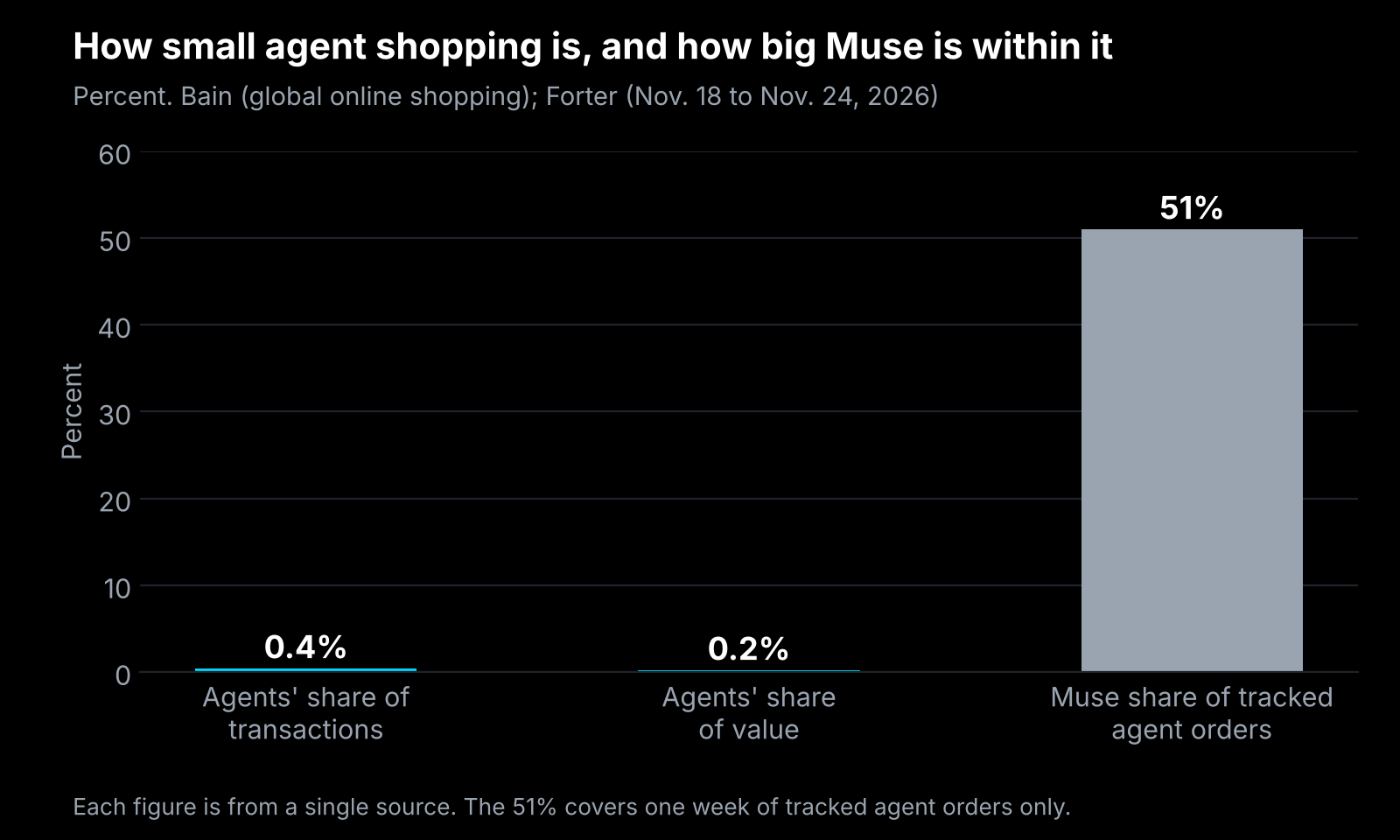
The numbers on the chart tell you how early this is. Bain, a consulting firm, reported on Friday, November 27, 2026 that agents were 0.4% of global online shopping transactions and 0.2% of the value. A separate fraud-prevention firm, Forter, counted that Muse placed 51% of the agent orders it tracked from Wednesday, November 18, 2026 to Tuesday, November 24, 2026. Both are single-source figures. Read together, they say agents are a sliver of shopping, and Muse is a large part of that sliver.
THEREFORE the fight is not about today's volume. It is about who controls the place where shopping starts.
What is Amazon protecting?
Here the reporting is consistent. Amazon's advertising business brought in 68.6 billion dollars in 2025, nearly 10% of its revenue, according to the reports I read. Advertising on Amazon works because shoppers search the site, see sponsored results and click. Merchants pay for placement in those results.
An agent changes that. If a person tells an agent what to find, the agent may read product pages and skip the search results page. There is no sponsored result to click, and no place to show an advertisement. Executives, according to one report, fear losing the relationship with the shopper. The "fair exchange of value" phrase from Jassy fits this reading: an outside agent that sends orders but not advertising views is a different deal than a shopper who visits.
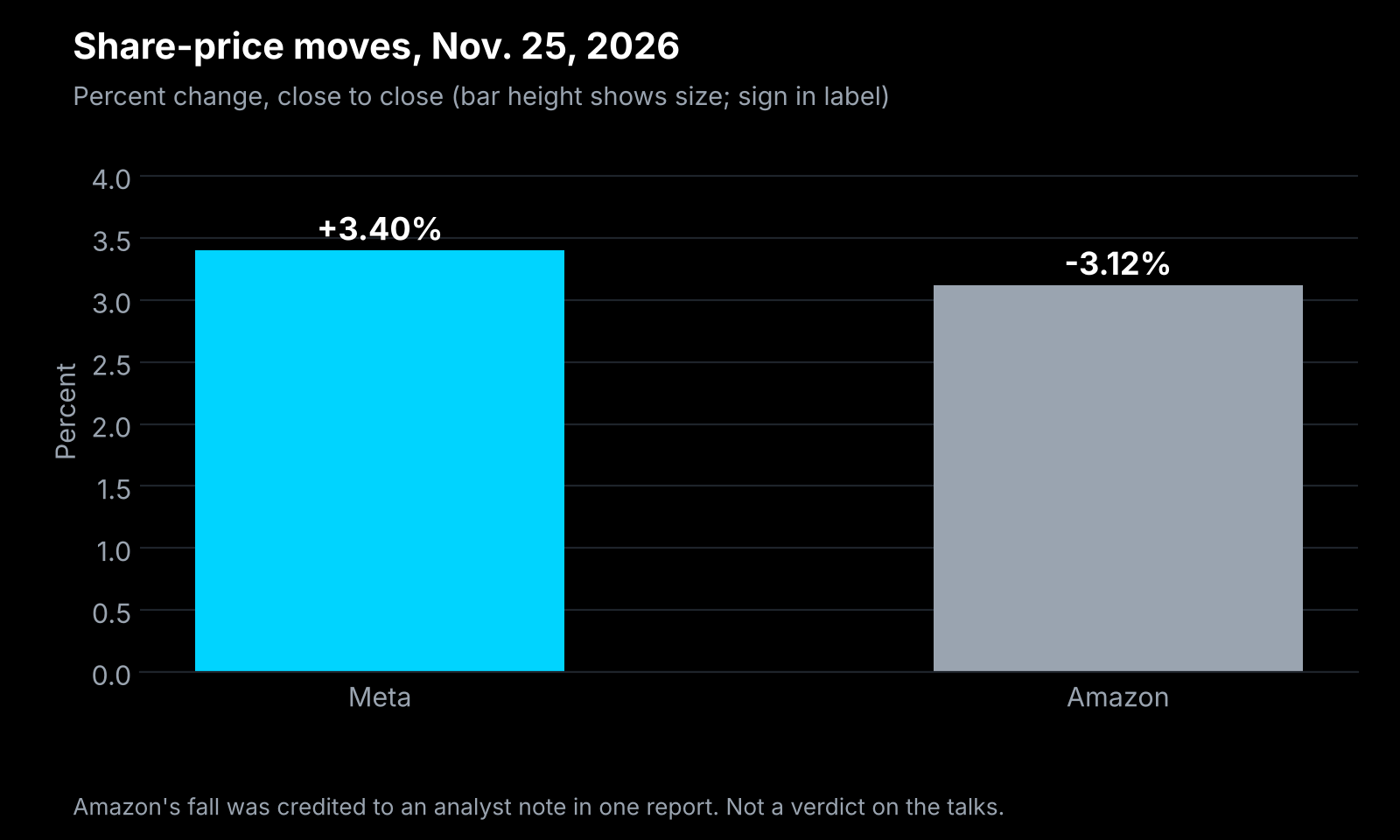
The stock moves on Wednesday, November 25, 2026 are worth showing, with a warning. Meta rose 3.40% and Amazon fell 3.12% that day, the same day the report of talks appeared. One report credited an analyst note for Amazon's fall, and I do not know whether the talks news reached the market before the close. So the moves should not be read as the market's verdict on the talks.
What would a deal look like? The report listed search results and advertising as open issues. Those are the same two things I described above, and that fits the idea that the block was about money and control as much as security. I want to be careful: Amazon has given its stated reasons, and I have no document showing its internal ones. The advertising reading is mine, built from what executives reportedly fear and from how the business earns money.
BUT a block that ends in a deal would not mean Amazon was wrong to worry about security. It could mean the security concerns get answered and the commercial terms get set. The two can both be true.
What this does not tell you
I do not know what Amazon and Meta will agree, whether they will agree at all, or when. The report of talks comes from one publication, and neither company confirmed it.
I did not read the Conditions of Use, the court opinion, or Amazon's statement in full. The reasons for the block come from news coverage. I also could not confirm the exact day Amazon began blocking Muse, which is why I wrote "around" September 20.
The market-share figures come from one firm each. The 51% figure covers one week of tracked orders and not all orders. Half of large retailers blocking agents comes from one test of 200 sites.
This also does not tell you whether agents will take a big share of shopping, or whether Amazon's advertising will be hurt. Those are open questions.
Why did Amazon block Meta's agent?
According to what I found, Amazon said Muse broke its Conditions of Use because it does not identify itself, may capture sign-in details and had no permission. A federal appeals court had just ruled that a shopper's agent is the shopper, but left open cases where the software company controls the agent, and Muse runs on Meta's machines. Behind that sits a business that earned 68.6 billion dollars in advertising last year, and that depends on shoppers seeing the page. Amazon's own chief executive said outside agents need a fair exchange of value.
That brings me back to the first answer, that Amazon was protecting its shoppers. It is part of the answer. The negotiation over search results and advertising suggests the rest of it is about who keeps the relationship with the person who is shopping.
Where to look next
Watch for either company to confirm or deny the talks. Watch whether Amazon's block on Muse is lifted, and on what terms for search results and advertising. Watch whether more retailers follow Walmart or Amazon. Watch for a court ruling on an agent that runs on its software maker's machines. And watch for reports on how many holiday-weekend orders agents carried, including on Monday, November 30, 2026.
If you want to see what any stock you follow is worth, its fair value range, sign up at techdamentals.com. It also shows a company's fundamentals alongside technical analysis of its chart. After each earnings report, it reads the company's own filing and compares the financials with what analysts expected, line by line, so you can see the real reason a stock moved. Try Techdamentals for 3 days, no card needed
This is educational content, not financial advice. Techdamentals is an educational tool and does not recommend any security.