Thursday, November 5, 2026 was the worst day for American stocks in about eighteen months. The Nasdaq fell 5.52%. The S&P 500 fell 4.36%. Of the 500 companies in that index, 431 went down and 71 went up.
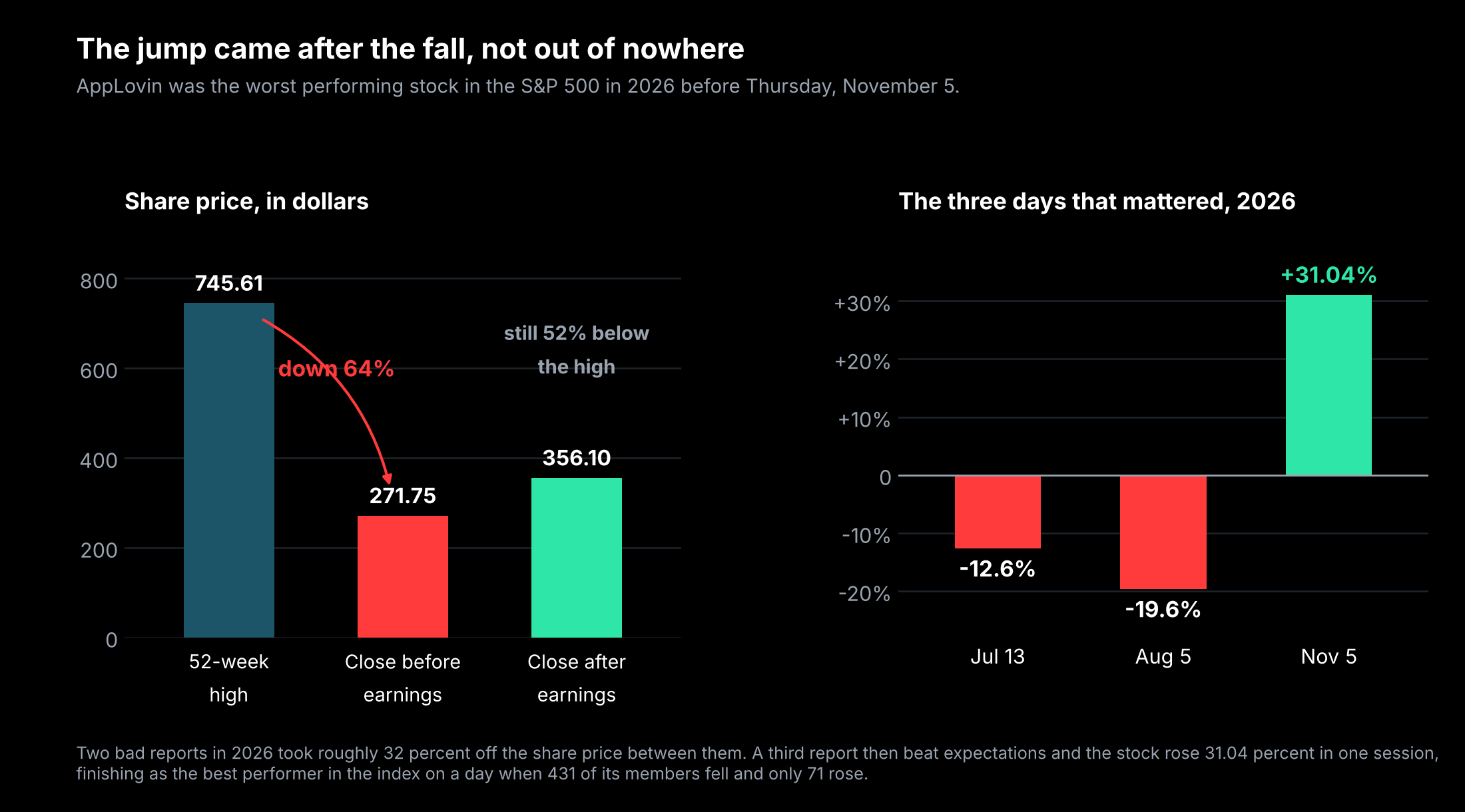
The single best performer was AppLovin, which closed up 31.04%.
Second place was less than 21%. So this was not a market where a few things held up. It was a market where one company did something extraordinary while nearly everything else was taken apart.
Here is the part that makes it make sense. Going into that day, AppLovin was the worst performing stock in the S&P 500 for all of 2026, down about 64% on the year.
Those two facts are connected, and understanding how is worth more than knowing either one.
What the company actually does
AppLovin runs advertising technology. When you play a free mobile game and an advertisement appears, somebody has to decide in a fraction of a second which advertisement you see and what the advertiser pays for it. AppLovin operates that auction.
Its system for choosing is called AXON, and the whole investment case for the company rests on whether that system keeps getting better at picking advertisements people respond to. Better picking means advertisers pay more for the same slot.
It used to also make games itself. It sold that business on June 30, 2025 for about $715.6 million, and now reports as a single operating segment. So there is no business mix to hide behind. Advertising is the entire company.
What it reported
AppLovin released results for the quarter ending September 30, 2026 after the market closed on Wednesday, November 4, 2026. The stock moved the following day.
| Reported | Expected | A year earlier | |
|---|---|---|---|
| Revenue | $2.185bn | $2.07bn | $1.405bn |
| Earnings per share | $4.30 | $4.03 | |
| Adjusted operating profit | $1.842bn | $1.73bn | $1.158bn |
| Free cash flow | $1.418bn |
Revenue grew 55%. Profit grew 72%. The adjusted operating margin was 84%, which is an unusual figure for any business.
Then guidance. For the current quarter the company projected a revenue range with a midpoint of about $2.38 billion, against roughly $2.25 billion that analysts expected. That midpoint is about 5.8% above what the market was looking for.
A beat of five or six percent is good. It is not, on its own, a 31% day.
So why 31%?
Because of where the stock was standing when the news arrived.
The share price reached $745.61 at its high over the previous twelve months. By the close on Wednesday, November 4, 2026, it was $271.75.
Two specific days did most of that damage. On July 13, 2026 the stock fell 12.6%. On August 5, 2026 it fell 19.6%, after revenue came in below expectations and management conceded that the pace of improvement in its advertising system had been "lighter than normal." Between them those two sessions erased more than $44 billion of market value.
So picture the position of anyone holding this stock on the afternoon of Wednesday, November 4. Twice this year the company has reported and twice it has been punished. The expectation going in was not "will they beat," it was "how bad is it this time."
When expectations are that low, an ordinary beat is a shock.
This is the mechanism worth taking away from the whole issue. A share price does not respond to results. It responds to the difference between results and what was expected. Two companies can report identical numbers and move in opposite directions, because they walked in with different expectations attached.
AppLovin walked in with almost none.
What "already in the price" actually means
That phrase gets used a lot without being explained, so here it is plainly.
A share price is not a measurement of how a company is doing. It is a number that a lot of people have already agreed on, and that agreement has assumptions baked into it. If everyone looking at a company assumes revenue will grow 40% next year, a price of $271.75 already contains that assumption. Growth of 40% then arrives and the price barely moves, because nothing changed. People got what they were already counting on.
The reverse is what happened here. By November 4, the agreed price contained an assumption that the advertising system had stopped improving, because that is what management said in August and the price fell 19.6% on it. The quarter did not have to be good. It only had to be better than a bar that had been set at the floor.
This is why a company can report genuinely strong numbers and fall, and why a company can report mediocre numbers and rise. The number matters less than the gap between the number and the assumption it is landing on top of.
The second reason, which is structural
There is a real difference between this company and most of what was falling around it that day, and it is worth seeing.
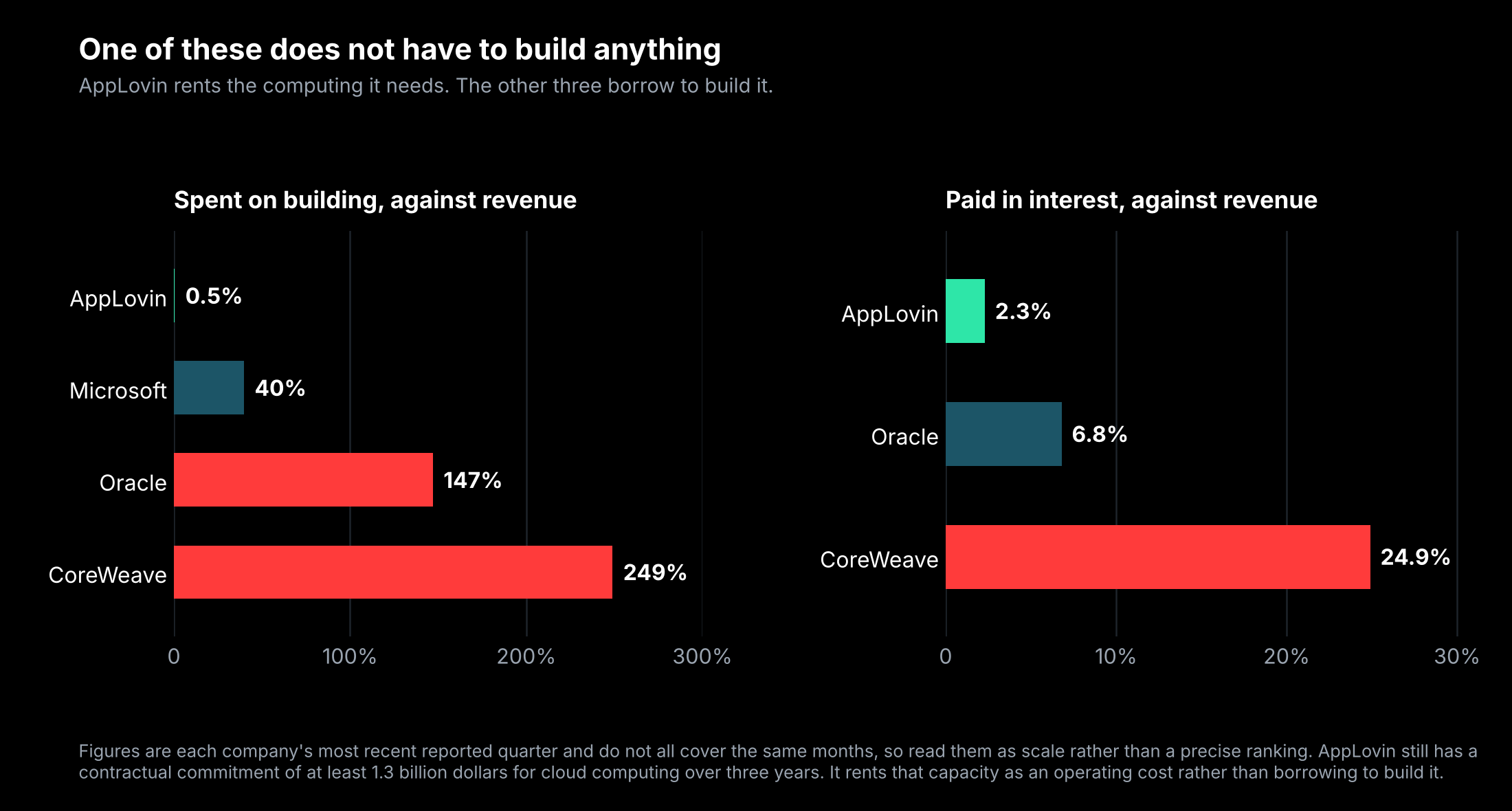
The names taking the heaviest damage on November 5 were the ones that borrow money to build data centers. Micron fell 17.46%, AMD fell 17.26%, CoreWeave fell 9.83%. What the market was questioning was whether all that construction spending earns a return.
AppLovin does not do any of that.
| Spent on building, as a share of revenue | Interest paid, as a share of revenue | |
|---|---|---|
| AppLovin | 0.5% | 2.3% |
| Microsoft | 39.8% | |
| Oracle | 147% | 6.8% |
| CoreWeave | 249% | 24.9% |
AppLovin's spending on physical equipment is so small it does not appear as its own line in the quarterly filing. For the first nine months of 2026, total cash used for investing was $25.4 million against $5.95 billion of revenue.
Compare the right-hand column. CoreWeave spends close to a quarter of everything it collects on interest payments. AppLovin spends 2.3%, and holds $3.17 billion of cash against $3.52 billion of debt, so on a net basis it owes almost nothing.
One honest qualification, because the simple version overstates it. AppLovin is not free of computing costs. It has a non-cancelable commitment of at least $1.3 billion over three years for cloud computing, of which $1.1 billion was already paid by September 30, 2026. It uses a great deal of processing power.
The difference is how it pays for it. It rents, as an ongoing operating cost. It does not borrow for twenty years to build. That distinction is why its share price does not behave like the companies that do.
The company also bought back its own shares
One more piece, and the way it is usually reported is slightly misleading.
Headlines said AppLovin authorized up to $3.2 billion of share repurchases. What actually happened in October 2026 was an increase of $3.2 billion to a program that already existed, originally set up in February 2022. Capacity afterwards stood at $3.6 billion, because only $394.3 million remained before the top-up. It was closer to a refill than a new announcement.
When a company repurchases its own shares, it reduces the number outstanding, so each remaining share represents a slightly larger slice. AppLovin has been doing this aggressively: $2.9 billion across the first nine months of 2026, and about $9.4 billion since the program began, at an average of roughly $90 a share.
The finance chief described the recent pace as the company "opportunistically ramping up." Which is to say they were doing it while the share price was falling.
Two legal items, one open and one closed
Both belong in the record, and they point in opposite directions.
The open one is a securities fraud class action. It covers investors who acquired shares between February 12 and August 5, 2026, and it alleges that AppLovin misled investors about improvements to its advertising system. It contrasts the chief executive's remarks in May 2026 about a "big acceleration" with the August admission that progress had been "lighter than normal." The deadline for investors to apply to lead that case is November 16, 2026. The allegations are untested in court and the company has not responded to them in anything we could find.
Worth noticing, though, is what this quarter's result was credited to. Morgan Stanley called it a "major model breakthrough." The chief executive credited a partial rollout of next-generation models. The improvement being celebrated is the same subject the complaint is about. That is a tension to hold, not a conclusion to draw. It is a reason to read the next few quarters closely rather than treat one 31% day as settled.
The closed one went the company's way. The Securities and Exchange Commission had been examining the company's data collection practices after critical research from investors positioned against the stock in February 2025. On August 5, 2026 the finance chief told investors the SEC "has recently advised us that it concluded its inquiry with no recommended action." That is a real clearing and it belongs in the same breath as the first item.
What this does not tell you
It does not tell you the stock is recovered. After rising 31.04%, the closing price was $356.10, still about 52% below the high from the previous twelve months. A large percentage gain from a low base is still a low base.
It does not tell you the beat will repeat. The chief executive was explicit that the next-generation rollout is partial and cautioned that "the transition is still in front of us," and declined to commit to a schedule. One analyst, Scotiabank's Nat Schindler, actually cut his expectation for the share price even while remaining positive, and Goldman Sachs only reiterated a neutral rating. This was not a universal upgrade.
It does not tell you that capital-light businesses always win. It tells you that on a day when the market was specifically questioning the returns on borrowed money spent building data centers, a business that borrows nothing and builds nothing was not exposed to that question. On a different day with a different worry, that protection would not apply.
And it does not tell you what the company is worth. Nothing here values anything.
The thing worth keeping is the first mechanism, because it applies everywhere. A stock that has already fallen 64% has very little expectation left in it. That makes it fragile on bad news and explosive on ordinary good news, and the size of the move tells you more about where sentiment was standing than about how good the quarter actually was.
A 5.8% beat on guidance produced a 31% day. Those two numbers are not describing the same thing.
That is why we show the workings instead of a single figure. Techdamentals pulls out what sits under the earnings headline, so the thing that actually moved the business is not something you learn about from the share price.