As this goes out on Thursday, November 5, 2026, the Nasdaq is down about 5% and the S&P 500 about 4%. Chip stocks are down roughly 9% as a group. Nvidia is off 8.2%, Micron nearly 14%, Dell nearly 13%, CoreWeave more than 12%.
Yesterday the Dow rose 1,569 points, its best day after a midterm election in 44 years. Today that is entirely gone.
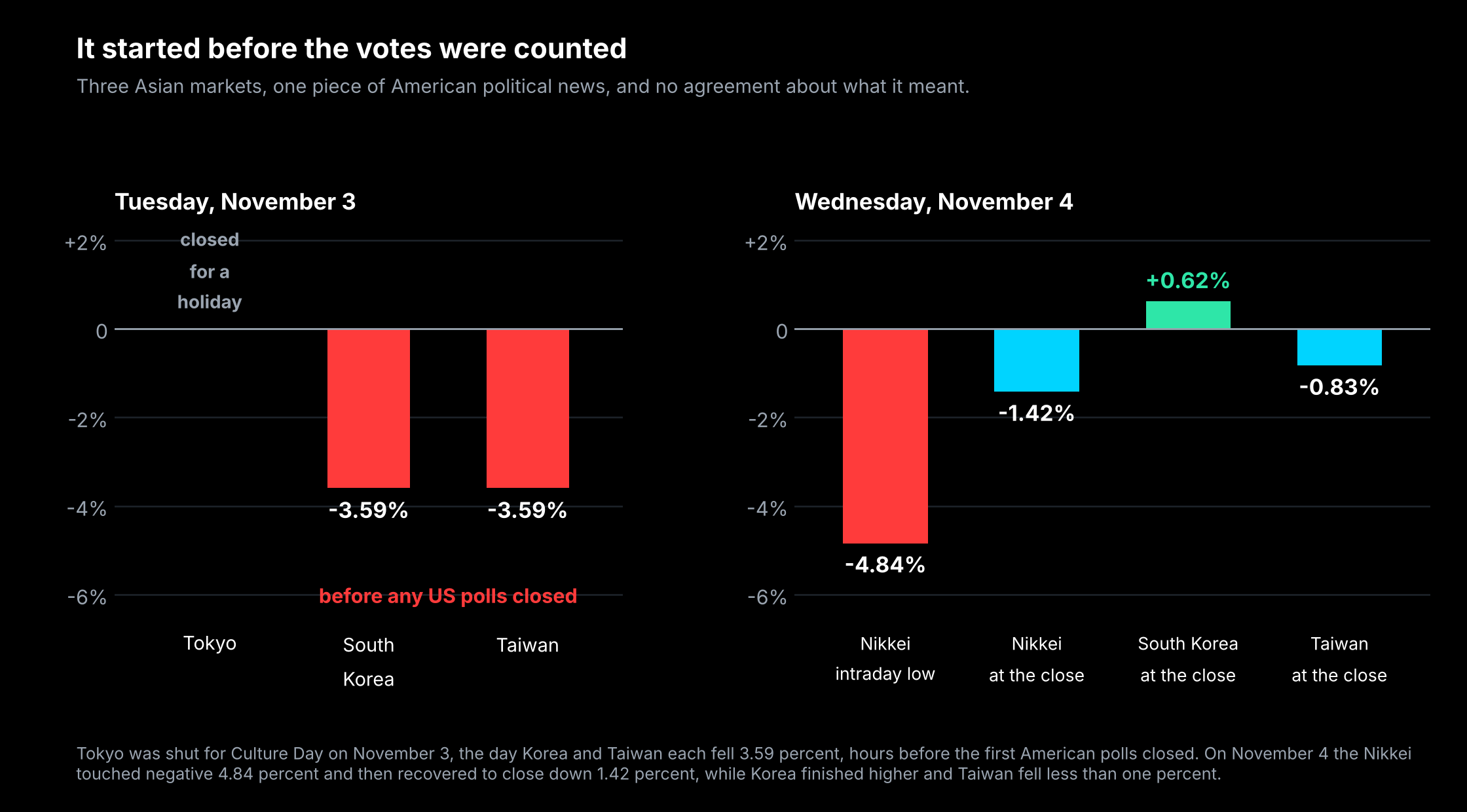
And one day before all of it, on Wednesday, November 4, 2026, Japan's Nikkei 225 fell as much as 4.84% during its session, which closed at one in the morning New York time, eight and a half hours before American markets opened.
So here is the question worth asking, and a reader asked us exactly this: did Japan see it coming?
No. And what actually happened is stranger and more useful.
The fact that settles it
On Tuesday, November 3, 2026, Tokyo was closed for Culture Day, a Japanese public holiday.
That same day, South Korea's main index fell 3.59% and Taiwan's fell 3.59%.
Both of those happened before a single American polling place had closed.
You cannot price a result that does not exist yet. The Asian decline in technology shares was already running while Americans were still voting. Whatever Japan did on Wednesday, it was joining something, not predicting it.
Four more reasons the forecast reading does not survive
The Nikkei recovered. It touched down 4.84% in the early afternoon and closed down 1.42%. A market pricing a durable new risk does not give back three and a half percentage points in the last ninety minutes of trading.
South Korea closed higher the same day. Up 0.62% on Wednesday. Taiwan fell 0.83%. Three markets, same region, same news out of Washington, three different answers. If this were a clean signal about American policy, they would not disagree.
The broad Japanese measure barely moved. The Topix, which weights companies by their size rather than their share price, fell 1.85% at the same moment the Nikkei was down 3.1%. And 95 of the Nikkei's 225 members were higher. We wrote about why that happens in how three stocks can move a whole market, and it is the same mechanism here: the Nikkei is price-weighted, so a handful of high-priced shares drag the headline around.
And the decline was five weeks old already. The Nikkei set its record close on June 25, 2026. By the Monday before the election it was down about 11% from its October peak, before Wednesday's session even opened.
What Wednesday actually sorted
Now the part that is genuinely interesting, and almost nobody reported it this way.
Wednesday was described everywhere as a post-election rally. The Dow rose 3.03%, the S&P 500 1.58%, the Nasdaq 1.44%. Notice the order. Technology came last on the biggest up day in nearly a year.
And underneath that green number, a specific group of companies was being destroyed.
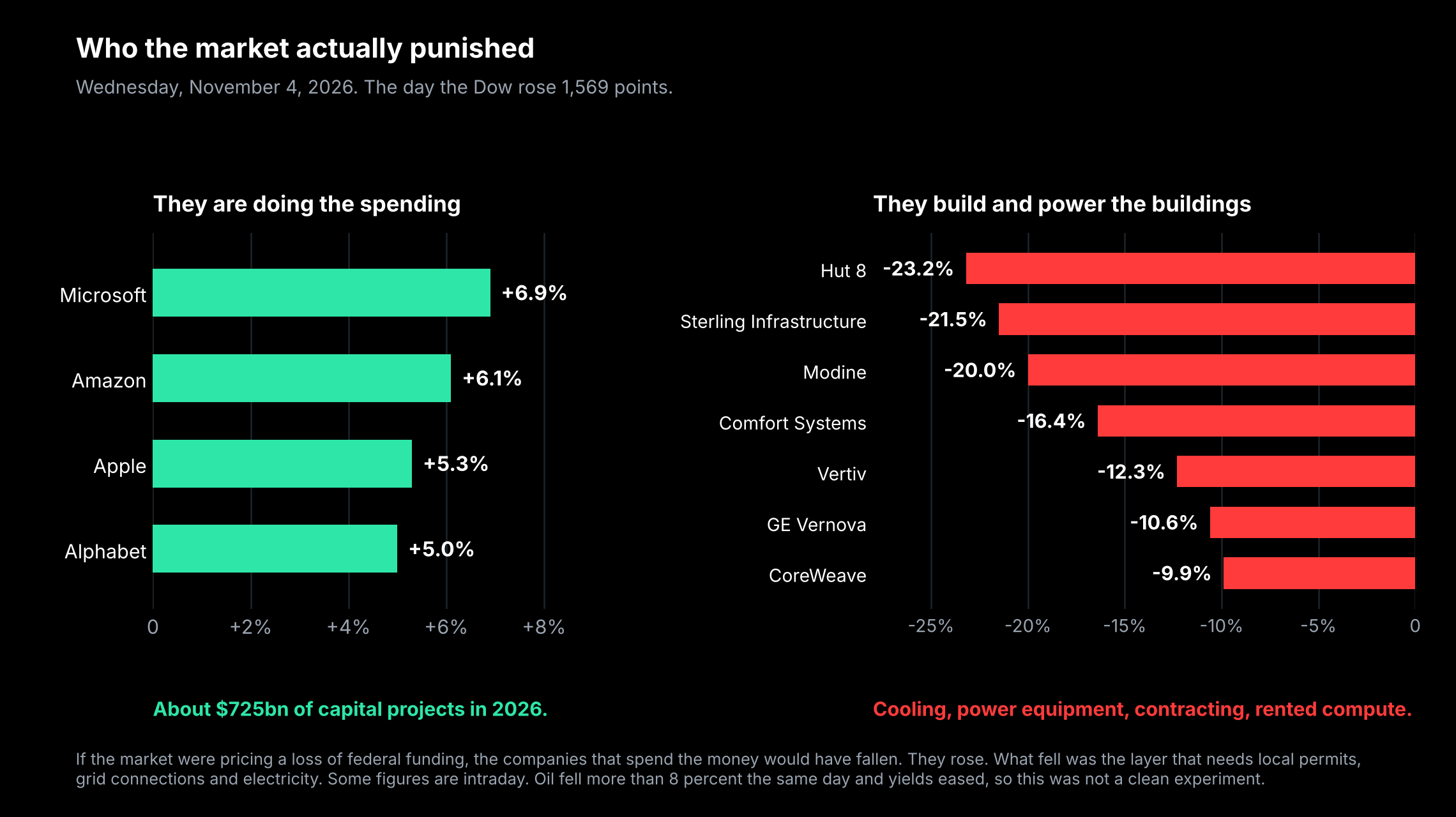
Hut 8 fell 23.2%. Sterling Infrastructure fell 21.5%. Modine fell about 20%. Comfort Systems fell 16.4%. Vertiv fell 12.3%. GE Vernova fell 10.6%. CoreWeave fell 9.9%.
Meanwhile the four companies that will spend roughly $725 billion on capital projects this year all went up. Microsoft about 6.9%. Amazon 6.1%. Apple 5.3%. Alphabet about 5%.
Read that again, because it is the whole story. The companies paying for the buildout rose. The companies that construct, cool and power the buildings collapsed.
That sorting tells you precisely what the market was pricing, and it was not what the headlines said.
Who those losers actually are
It is worth knowing what those seven companies do, because the list looks random until you see the pattern.
Vertiv makes the cooling and power distribution equipment that sits inside a data hall. Modine makes heat exchangers, the hardware that moves warm air away from racks. Comfort Systems and Sterling Infrastructure are contractors: one installs the mechanical and electrical systems, the other prepares the ground and builds the site. GE Vernova makes turbines and grid equipment. Hut 8 and CoreWeave own buildings full of chips and rent the computing out.
Not one of them designs a chip. Not one of them writes software. Every single one of them needs something a local government controls: a building permit, a zoning variance, a water allocation, or a connection to the electricity grid.
Now look at the other list. Microsoft, Amazon, Apple and Alphabet need none of those things to keep their existing businesses running. They have the cash, and if one county says no, they build in the next one.
That is the line the market drew on Wednesday, November 4, 2026. Not between companies exposed to federal funding and companies that are not. Between companies that need local permission and companies that do not.
The assumption worth correcting
The explanation circulating since Tuesday night goes like this. Democrats won both chambers of Congress, so federal support for artificial intelligence gets cut, so the companies in that business are worth less.
Here is the problem with it.
Federal money is somewhere between 1% and 4% of the American computing buildout.
In 2026, Amazon, Alphabet, Meta and Microsoft will spend about $725 billion on capital projects. Add Oracle and CoreWeave and the figure is roughly $820 billion. Against that, every federal dollar you can plausibly count, including semiconductor manufacturing grants, federal research, federal procurement and Department of Energy supercomputing, comes to something like $10 billion to $30 billion a year.
One detail makes the scale concrete. The CHIPS Act set aside $11 billion for semiconductor research. As of April 2026, the Commerce Department had actually paid out $16.1 million of it to recipients.
Microsoft spent more than that every forty minutes last quarter.
And the politics run the other way
This is the part that surprised us most while checking it.
It was not Democrats who went after semiconductor funding. In a March 2025 address to Congress, President Trump called the CHIPS Act "a horrible, horrible thing" and said Congress should "get rid of the CHIP Act and whatever's left over, Mr Speaker, you should use it to reduce debt."
Democrats defended it. Senator Maria Cantwell warned that repeal would halt fabrication plants already under construction.
We could not find a single Democratic leader who has proposed cutting funding for computing or semiconductors. What they have proposed is different in kind: requiring large electricity users to pay for the grid upgrades they cause, disclosure of water and power use, and scrutiny of tax provisions. Senator Schumer's energy plan asks for more federal spending, on transmission and grid upgrades, and it names semiconductor efficiency as a research priority.
Those are regulation and cost-allocation proposals. They are not appropriations cuts, and the difference is the whole argument.
What a new Congress can actually do
Overriding a presidential veto takes 67 votes in the Senate and 290 in the House.
Democrats will hold roughly 53 to 54 Senate seats and at least 224 House seats. The gap is thirteen or fourteen in one chamber and far wider in the other. Nothing restrictive becomes law over a veto, and the new Congress is not seated until January 2027.
Strategists said this plainly. Michael Strobaek of Lombard Odier expects any federal moratorium on data centers to "meet an immediate veto." Michael Arone of State Street went further: "the real risk facing the market is not the blue wave itself, but investors' overreaction to the blue wave."
Where the risk is real
None of that means the reader's instinct was wrong. It means the mechanism sits one level down.
Texas holds roughly 27% of American data center capacity, and on Tuesday it elected a governor who campaigned on pausing new data center approvals. Georgia, the second largest market, elected a governor who promised the same thing by executive order and also handed both seats on its utility commission to Democrats, the body that sets what those facilities pay for power.
Reported counts suggest 39 of 45 local ballot measures restricting data centers passed on the same night. UBS now estimates roughly 30% of planned 2028 American data center capacity is at risk from construction pauses.
None of that requires Congress. None of it can be vetoed. A county zoning board does not need sixty votes.
Which is exactly why Wednesday sorted the way it did. Michael Monaghan, who manages the Founders 100 fund, said investors were reassessing political resistance to this infrastructure "especially at state and local levels." The companies that need local permits, grid connections and electricity got marked down. The companies with the cash did not.
The federal lever that does exist
If you want to watch Washington on this, watch the tax code rather than the budget.
Provisions allowing immediate expensing of these investments reduced Microsoft's current federal tax expense by more than $11 billion in a single year, and Meta's by nearly $7 billion. That is larger than every dollar the CHIPS Act has ever disbursed for research.
A Democratic Congress cannot repeal that over a veto either. It runs to January 2029 unless something changes.
So what was Japan telling you?
Not a forecast. A reading.
The Nikkei is price-weighted, and the highest-priced shares inside it happen to be the computing supply chain. Advantest is about 12% of the index. Tokyo Electron is about 8%. SoftBank is 5.7%. One is chip testing equipment, one is chip manufacturing equipment, one is a holding company stuffed with technology stakes.
That makes the Nikkei an unusually sensitive instrument for exactly this trade. When the computing complex derates, that index moves harder than almost anything else on earth, because a third of it is three names pointed at the same thing.
So it is a thermometer, not a crystal ball. It told you the fever was already running. It could not tell you what came next, and on Wednesday it did not: it recovered to close down 1.42% on a day the American version of the same trade was being taken apart.
What this does not tell you
It does not tell you Asian markets never lead. Different time zones mean somebody always trades first. That is a scheduling fact, not foresight, and distinguishing the two is most of the work.
It does not tell you politics had nothing to do with this week. It had a great deal to do with it. Just at the county and state level, through permits and power bills, rather than through a federal budget line.
It does not tell you the decline is finished, or that it is not. Qualcomm and Arm both disappointed on Wednesday night, memory costs are still compressing device makers, and the complex has been derating since early October. Several things are happening at once and they will not resolve on the same schedule.
And it does not tell you what any of these companies are worth. Nothing here values anything. It explains what moved and why, which is the input to that question rather than the answer.
The lesson worth keeping is small and portable. A market that falls before yours did not necessarily see anything. It may simply have been open earlier. Time zones are not foresight, and the difference between the two is the difference between information and coincidence.
That is why we show the workings instead of a single figure. Techdamentals runs four separate valuation methods and displays the full range, because one number tells you where somebody landed and nothing about what it rests on.