Qualcomm reported its fiscal fourth quarter after the market closed on Wednesday, November 4, 2026. The stock fell roughly 6% in extended trading.
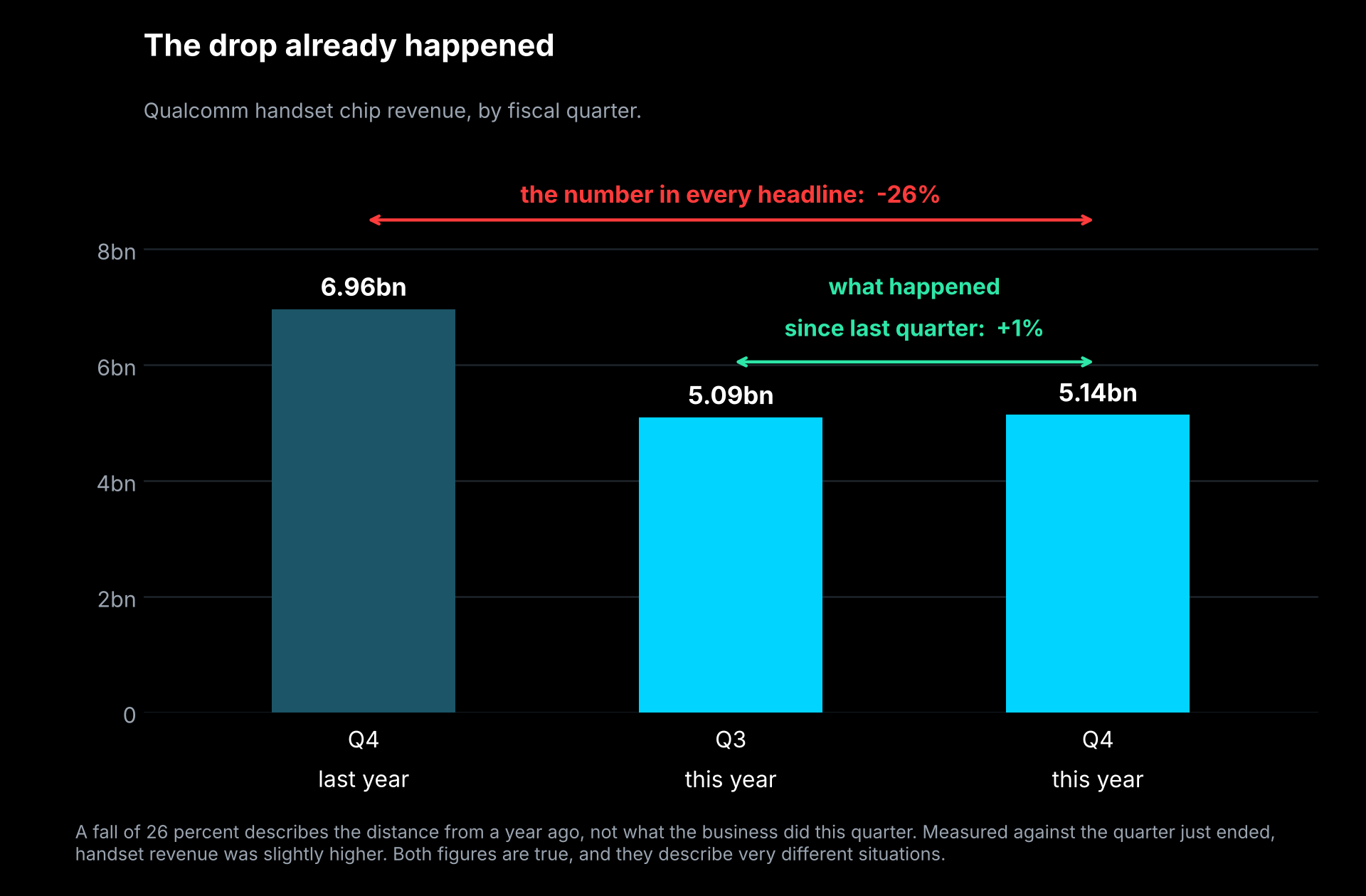
The number everyone pulled out was this one: handset chip revenue fell 26%, to $5.14 billion.
That figure is correct. It is also one of the more misleading true numbers you will read this quarter, and unpacking why gets you to what actually happened to this company, and to a much larger story about the thing inside your phone that nobody thinks about.
What the company actually reported
Fiscal fourth quarter, for the three months ended September 27, 2026:
| Result | A year earlier | |
|---|---|---|
| Revenue, adjusted | $10.44bn | $11.27bn |
| Earnings per share, adjusted | $2.17 | |
| Handset chips | $5.14bn | down 26% |
| Automotive | $1.99bn | up 89% |
| Internet-connected devices | $1.89bn | up 4% |
| Patent licensing | $1.30bn | down 7% |
Earnings per share came in a penny above what analysts expected. Revenue fell about 7% from a year ago.
Guidance for the current quarter puts revenue in a range whose midpoint, 10.8 billion dollars, is above what analysts were looking for, and adjusted earnings per share with a midpoint of 2.25 dollars, slightly below.
Read those two sentences again, because a lot of the coverage got this backwards. Qualcomm guided revenue up against expectations and earnings down. The disappointment was not demand. It was margin.
Correction one: the 26% already happened
Here is the first thing worth knowing, and almost nobody will tell you.
A fall of 26% measures the distance from a year ago. It does not tell you what the business did this quarter.
Handset revenue a year ago was $6.96 billion. Last quarter it was $5.09 billion. This quarter it was $5.14 billion.
So handset revenue was slightly higher than the previous quarter. The 26% describes a decline that happened over the previous three quarters and has, for now, stopped.
Both numbers are true. They describe completely different situations. One says a business is collapsing. The other says it collapsed and has found a floor. If you only read the year-over-year figure, you would have no way to tell which.
This is not a trick specific to Qualcomm. Year-over-year comparisons tell you about the past twelve months. Sequential comparisons tell you about the last three. Headlines almost always use the first, because it is usually the bigger number. When a business has turned, the two point in opposite directions, and the sequential one is the news.
Why the phone business shrank, and it is not about Qualcomm
Now the bigger story, because the cause has almost nothing to do with the company that reported.
Memory prices went up extraordinarily far in 2026.
Memory means the chips that store information: the DRAM your phone uses as working space while an app is open, and the flash storage that holds your photos when it is switched off. Every phone and every computer needs both. Neither is made by Qualcomm.
The price increases this year were not normal. According to TrendForce, which tracks contract prices across the industry, DRAM contract prices rose roughly 90% to 95% in the first quarter of 2026 alone, which the firm described as the steepest increase in its records. Flash memory rose 55% to 60% in the same period, then 70% to 75% in the second quarter.
The cause is the thing everything else this year has also been about. Memory makers moved their best production capacity toward server and data center products, where the money is, and away from the parts that go into consumer devices. The supply that remained was not enough.
So memory became a much larger share of what a device costs to build. HP's finance chief said memory went from 15% to 18% of a computer's build materials to about 35% in a single quarter. The research firm Omdia put it at roughly 40% by October.
Phone makers did what you would expect. They raised prices.
Xiaomi raised prices across its Chinese lineup effective August 2026. Its REDMI Turbo 5 went up about 13%. The Xiaomi 17 Pro went up 400 yuan and the 17 Pro Max by 500. The head of its Redmi brand said memory for an identical specification had risen close to fourfold in a year, adding roughly 1,500 yuan to the cost of building a phone with 12 gigabytes of memory and 512 gigabytes of storage.
Apple changed pricing on Mac and iPad at the end of June 2026 and on iPhone in September. Its chief executive said plainly that memory prices had put pressure on Apple's prices.
Note which phones get hurt worst here. If memory adds a roughly fixed dollar amount to every device, that amount is a far larger share of a 200 dollar phone than of a 1,200 dollar one. Research firm Counterpoint estimated the hit to build costs at 20% to 30% for the lowest-priced phones against 10% to 15% at the top end. IDC reported the segment under 100 dollars shrinking by almost 60% in a single quarter. A memory shortage is a regressive event, and it shows up first in the parts of the market that can least absorb it.
And then the thing happened that this entire article is really about.
People bought fewer phones.
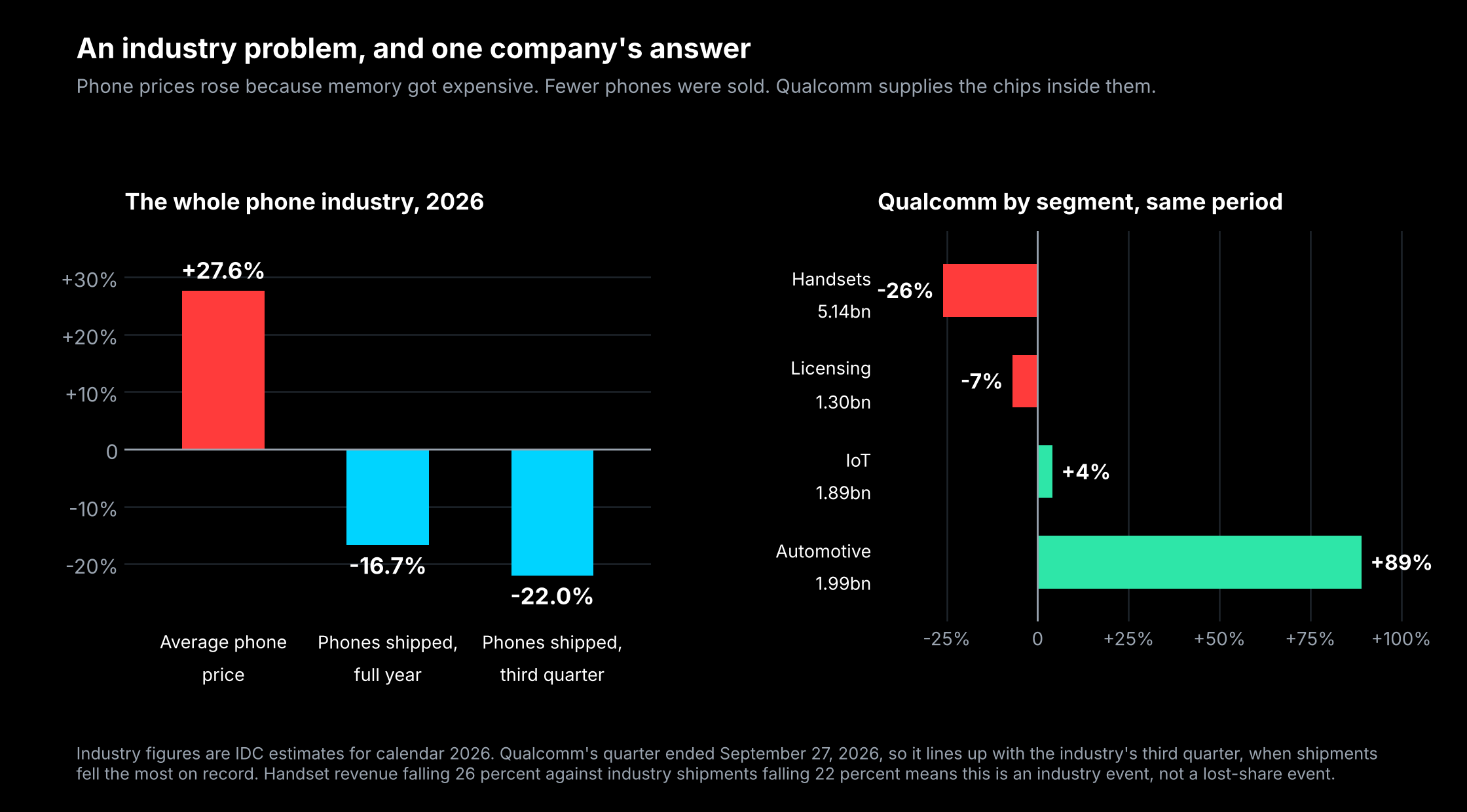
According to IDC, the average price of a smartphone rose 27.6% in 2026, reaching 581 dollars. Over the same year, unit shipments fell 16.7%. In the third quarter specifically, shipments fell 22%, which IDC called the largest year-over-year quarterly decline on record.
Qualcomm's fiscal quarter ended September 27, so it maps almost exactly onto that third quarter. Industry shipments fell 22%. Qualcomm's handset revenue fell 26%. Those two numbers being close together tells you something important: Qualcomm did not lose a customer or lose a design. The market it supplies got smaller.
The four companies and their four different claims
Here is a distinction worth holding onto, because four large companies have now blamed memory for something, and they did not all mean the same thing. Sorting them is a useful exercise in reading company statements carefully.
Apple said memory raised its own costs, and put a number on it. Reporting on November 2, 2026, Apple guided December-quarter gross margin to 45% to 46%, down from 47.9%. Its finance chief said most of that decline would be driven by higher memory costs. Its chief executive called memory pricing "unprecedented." Apple is the only one of the four to quantify the hit to its own margin.
Intel said memory hurt demand for its products, not its costs. Reporting on October 29, 2026, Intel attributed weakness in its client computing business to industry-wide memory prices and tight budgets. When it explained its own margin decline, it pointed at lower revenue spread over fixed costs, product mix, and an incident at its Fab 28 plant in Israel worth roughly $300 million of revenue and 200 basis points of margin. Memory was not in that list.
AMD said both, through different executives. Reporting on November 3, 2026, its chief executive said computer demand slowed late in the quarter as higher memory and component costs weighed on it, and separately acknowledged cost inflation in AMD's own supply chain being shared with customers. Its finance chief, explaining margins, pointed to the mix between data center and other businesses rather than to memory.
Qualcomm said both, in one document. Its earnings release describes a broad-based increase in input costs across wafer fabrication, assembly, test, advanced packaging and memory, and says it is raising its own prices in response. Separately, its commentary on the handset market attributes the shrinking size of that market to memory pricing.
Four companies, one input, four different stories about what it did to them. "Memory hurt us" turns out to mean at least two completely different things, and the distinction matters: a cost problem compresses your margin and can be priced through, while a demand problem shrinks your market and cannot.
The detail that makes this concrete
If you want a single fact that captures the strangeness of 2026, it is not from any of the companies above. It is from the supplier.
SK hynix is one of the three large memory manufacturers. On its October 2026 earnings call, its finance chief said that shipment volumes for phones and computers are expected to decrease because of the cost burden from rising memory prices.
That is a company explaining that its own price increases will reduce the number of devices its customers can ship, and saying so while reporting record demand from data centers. It is not a complaint. It is a description of a deliberate reallocation: the same factories, pointed somewhere more profitable.
What is actually replacing phones at Qualcomm
Which brings us back to the company that reported.
Automotive revenue grew 89%, to $1.99 billion. That is a quarterly figure. Annualized, the automotive business is running at roughly $8 billion. Qualcomm supplies the computing platforms behind in-car displays and driver assistance systems, which is a very different business from phone chips, with longer design cycles and far more durable contracts.
Management projects non-handset revenue to grow more than 60% in fiscal 2027, and describes this as the start of an inflection. It reiterated a target of $5 billion of data center revenue in fiscal 2027, a business that was essentially nothing two years ago.
So the question in the title is a real one. A company where handsets are shrinking at 26% and automotive is growing at 89% is, mechanically, becoming something else. How fast depends on arithmetic that is easy to do yourself: handsets are still roughly three times the size of automotive, so even 89% growth takes several years to change the center of gravity.
The part that genuinely was bad
None of this makes the quarter good, and the market reaction was not irrational. Here is the real problem.
Chip segment operating margin was 24% this quarter, and is guided to 20% to 22% next quarter. That is a meaningful step down.
The cause is the cost increase described above, running through Qualcomm's own bill of materials. The company is raising prices to offset it, but management said the full benefit does not arrive until the second half of fiscal 2027. That is a gap of several quarters where costs have risen and the offsetting price increases have not fully landed.
So the honest summary of the quarter is: revenue guidance better than expected, margin guidance worse, a shrinking business that has stopped shrinking, and a growing business that is still too small to carry the company. A stock falling 6% on that is a defensible reaction, just not for the reason the headline gives.
Two things in the filing worth noticing
The licensing business is a genuine puzzle. Patent licensing revenue fell 7% in the quarter even though Qualcomm renewed agreements with Apple, Transsion and Huawei during the year. Those renewals were widely treated as the main risk to that business being resolved.
The likely reconciliation is that licensing agreements set a rate per device, not a fixed payment, so securing the contract does nothing if the industry ships 22% fewer phones. But Qualcomm has not said that, and we will not put words in its mouth. What we can say is that for the full fiscal year, licensing revenue was essentially flat at $5.56 billion, which suggests a weak quarter rather than a broken franchise.
And watch out for the headline annual earnings figure. For fiscal 2026, Qualcomm's earnings per share were $12.70 on a reported basis and $10.54 on an adjusted basis.
That is backwards from the usual pattern. Adjusted figures are normally higher, because companies exclude costs they consider unrepresentative. Here the reported number is higher, and the reason is a one-time tax benefit worth about $5.32 per share recognized earlier in the year, from releasing a valuation allowance.
A valuation allowance is an accounting provision a company holds against tax assets it is not confident it can use. Releasing it means management now expects to use them, which is a real piece of good news, but it is a single accounting event and not something the business repeats. If you compare fiscal 2026 reported earnings with fiscal 2025, you will see growth that mostly is not there. This is the sort of thing that quietly distorts a long-run earnings chart.
One signal pointing the other way
Worth knowing, because it complicates the story in a useful direction.
The memory price increases are decelerating. TrendForce's DRAM contract price increases went from 90% to 95% in the first quarter of 2026 to an expected 10% to 15% in the fourth. Flash memory contract prices were flat in October 2026, the first month without an increase in 21 months.
Prices are still extremely high. They are no longer rising the way they were. If that holds, the cost pressure on device makers stops getting worse sometime in 2027, which is roughly when Qualcomm says its own price increases fully land. Those two things arriving together would be good for margins.
If it does not hold, the opposite.
What this does not tell you
It does not tell you the phone market recovers. IDC expects shipments to keep falling and prices to keep rising into 2027. A business that has stopped shrinking is not the same as a business that grows.
It does not tell you automotive keeps growing at 89%. That rate is measured against a small base from a year ago. Growth rates on small numbers are not durable, and the comparison gets harder every quarter.
It does not tell you what any of this is worth. Nothing here values Qualcomm or anybody else. It explains what the segments did and why, which is the input to that question, not the answer.
And it does not tell you the memory squeeze is over. It tells you the rate of increase has slowed from extraordinary to merely high, while the damage to device shipments is still getting worse. Cost shocks and demand damage do not arrive on the same schedule, and 2026 is a clean demonstration of the lag between them.
The lesson worth keeping is the smallest one. When a company reports a number that fell 26%, the useful follow-up question is not why. It is "compared with when?" Change the comparison period and the same business can look like a collapse or a recovery, with no new information involved at all.
That is why we show the workings instead of a single figure. Techdamentals runs four separate valuation methods and displays the full range, because one number tells you where somebody landed and nothing about what it rests on.