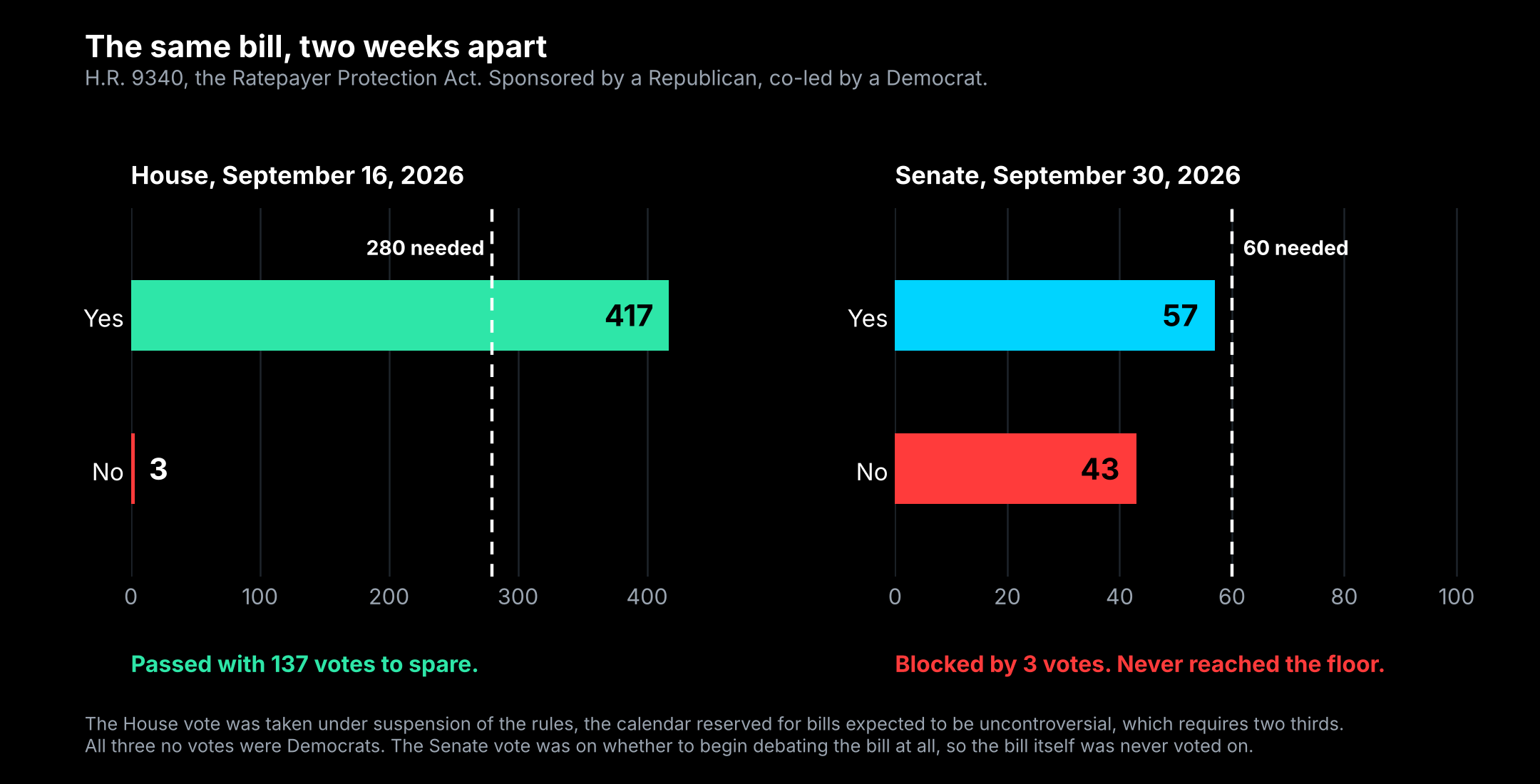
On September 16, 2026, the United States House of Representatives passed a bill about data centers and electricity by a vote of 417 to 3.
Four hundred and seventeen. Out of 420 members voting. In a chamber where naming a post office can be contentious.
Two weeks later, on September 30, 2026, it was blocked in the Senate 57 to 43 and never became law.
That gap is the most useful thing that happened in American energy policy this year, and almost nobody explained it. On Tuesday, November 3, 2026, voters elected governors in Texas and Georgia who campaigned on pausing data center approvals, and on Wednesday, November 4, 2026, the stocks tied to building those data centers fell hard while the rest of the market had one of its best days of the year. Hut 8 fell 23.23%. Sterling Infrastructure fell 21.46%. CoreWeave fell 9.90%. Meanwhile the Dow gained 1,569 points.
If you want to understand what that move is actually pricing, you have to understand why a bill with 417 votes still died.
This issue is about that. It is also about a belief most people now hold about data centers that the evidence does not support, including the version of it we expected to find.
What the bill would have done
The bill is H.R. 9340, the Ratepayer Protection Act. It was sponsored by Representative Gabe Evans, a Republican from Colorado, and co-led by Representative Kathy Castor, a Democrat from Florida. That pairing is the first clue.
To understand what it does, you need one piece of background about how electricity costs get divided up, because this is the whole fight.
When a very large electricity user connects to the grid, the cost splits into two parts.
The first part is the equipment that serves only them. The substation on their land, the line running to it. The customer always pays for this. Nobody disputes it.
The second part is everything else the grid needs because they showed up. New transmission lines. Reinforced equipment miles away. Additional generating capacity held in reserve so the lights stay on when they switch everything on at once. These are called network upgrades, and here is the part that matters: they are typically socialized, meaning the cost goes into the utility's general pot and gets recovered from every customer in the region, including households.
That is not a scandal or a loophole. It is how the system was deliberately designed. The premise is that growing electricity use benefits everyone, so everyone shares the cost of expanding the grid. For a century that premise mostly held, because load growth came from more homes, more factories and more air conditioning spread across a whole region.
A single facility drawing a gigawatt breaks the premise. The benefit is concentrated in one company. The cost is spread across everybody.
The bill would have told state regulators to consider requiring large users to pay the full incremental cost of upgrades their own demand made necessary, and to post financial assurances in case they walk away. It defined a large user as one with peak demand of 100 megawatts or more at a single site.
Hold on to that word consider, because it is the entire story.
The mechanism nobody explains
The bill works by amending a 1978 law called PURPA, the Public Utility Regulatory Policies Act. PURPA does something unusual. It does not tell states what their electricity rules must be. It creates federal standards that state regulators are required to formally consider and rule on, but are not required to adopt.
So under H.R. 9340, every state regulator would have had to open a proceeding, hold hearings and issue a decision within two years. They could then decide not to do it.
That is a real obligation. Forcing fifty regulators to hold public hearings on who pays for data center infrastructure would itself change things, because those hearings generate records, press coverage and political pressure.
It is also, unmistakably, optional at the end.
Why 417 members agreed
Because the cost shift is measurable, and in one region it is large.
PJM Interconnection runs the grid for thirteen states and the District of Columbia, from Illinois to New Jersey. Every year it holds an auction to secure generating capacity for a future period. The price that auction clears at flows through to customer bills.
For the 2024 and 2025 delivery year, that auction cleared at about 29 dollars per megawatt-day. For the following year it cleared around 270, roughly nine times higher. Total auction cost went from about 2.2 billion dollars to 14.7 billion.
Prices have stayed near the regulatory cap ever since. And PJM's own simulations show the cap is holding back a much larger signal: without it, the most recent auction would have cleared about 555 dollars per megawatt-day, roughly 13 billion dollars higher than what actually happened.
Here is the part that complicates the headline, and most coverage omits it. PJM's own report on that nine-fold increase lists five causes and does not mention data centers among them. It cites a higher load forecast, a required reserve margin rising from 14.7% to 17.8%, power plants retiring, a change in how capacity is credited, and one large utility moving into the auction from a separate arrangement. PJM named data centers explicitly in a later announcement, but for the biggest single jump its own documentation points mostly at retirements and rule changes.
The strongest case for the data center attribution comes from somewhere else. Monitoring Analytics, the independent market monitor that federal regulators designate to watch PJM, attributes 38 to 40% of recent auction costs to data centers. Across the last four auctions it puts the figure near 29 billion dollars out of about 64 billion. That organization has publicly argued for restructuring PJM's capacity market, and it has not published the method behind the attribution, so weigh it accordingly.
Here is the detail that made this politically radioactive. Most of that attributed cost is for data centers that have not been built yet. Customers are paying now to hold capacity in reserve for facilities that may never open. A Goldman Sachs analysis expects only about 50 to 60% of near-term scheduled data center capacity to arrive on schedule.
So in the PJM states, households are already paying measurably more, partly for buildings that do not exist.
One boundary on all of this, so you can size it honestly: capacity charges are only about 10 to 20% of a typical PJM bill. However dramatic that auction looks, it can only move a household bill so far. Estimates of the actual effect run from about 10 dollars a month in Washington DC to roughly 16 to 18 dollars a month in parts of Ohio and Maryland.
That is why a Republican from Colorado and a Democrat from Florida wrote a bill together, and why 417 members voted for it under suspension of the rules, the procedure reserved for legislation expected to be uncontroversial, which requires a two thirds majority to pass. Three more grid and data center bills passed the House by voice vote the day before, meaning nobody even demanded a recorded tally.
Why it died anyway
Not from industry. Not from Republicans. From the left.
All three House no votes were Democrats: Summer Lee of Pennsylvania, Delia Ramirez of Illinois and Rashida Tlaib of Michigan.
In the Senate, 43 Democrats and independents blocked it. Senator Chuck Schumer called it a "toothless messaging bill" and said: "Optional is the operative word." Senator Martin Heinrich of New Mexico called it "all message and no substance" and said he wanted "real teeth that will require data centers to pay their fair share of the grid upgrades they require."
Their objection was the word consider. A bill that tells regulators they may require data centers to pay does not, they argued, change anybody's electricity bill.
Four Democrats broke ranks to advance it: Maggie Hassan of New Hampshire, Amy Klobuchar of Minnesota, and both senators from Georgia, Jon Ossoff and Raphael Warnock. Georgia is the second largest data center market in the country and has at least twelve county-level moratoriums on new construction. Those two senators were voting their mail.
There is a second, less flattering reading, and honesty requires including it. This vote happened five weeks before a midterm election. Republicans had scheduled a run of affordability bills. Senator Jon Husted of Ohio, the Senate sponsor, said that if Democrats blocked it "they will prove beyond a shadow of a doubt that they do not care about affordability." Majority Leader John Thune called Democrats "the party of no." Reporting at the time described the fight as both a genuine dispute about substance and a contest over campaign messaging. Both things were true at once.
One more detail worth your attention, because it is the sharpest thing in this whole story. Evans's own press release describes the bill as requiring data centers to bear infrastructure costs in one paragraph and as suggesting cost recovery in another. The White House statement of support said the standards "would require large-load electricity customers to pay for the full incremental costs to serve their loads."
The bill text says regulators must consider. The sponsor and the administration both described it as stronger than it was, which is precisely what Schumer and Heinrich were complaining about.
The thing we expected to find, and did not
Here is where we have to correct something, including our own assumption going in.
The obvious story is that opposition to data centers is bipartisan because it is about electricity bills. Bills are not partisan. Everyone gets one.
The polling does not support that.
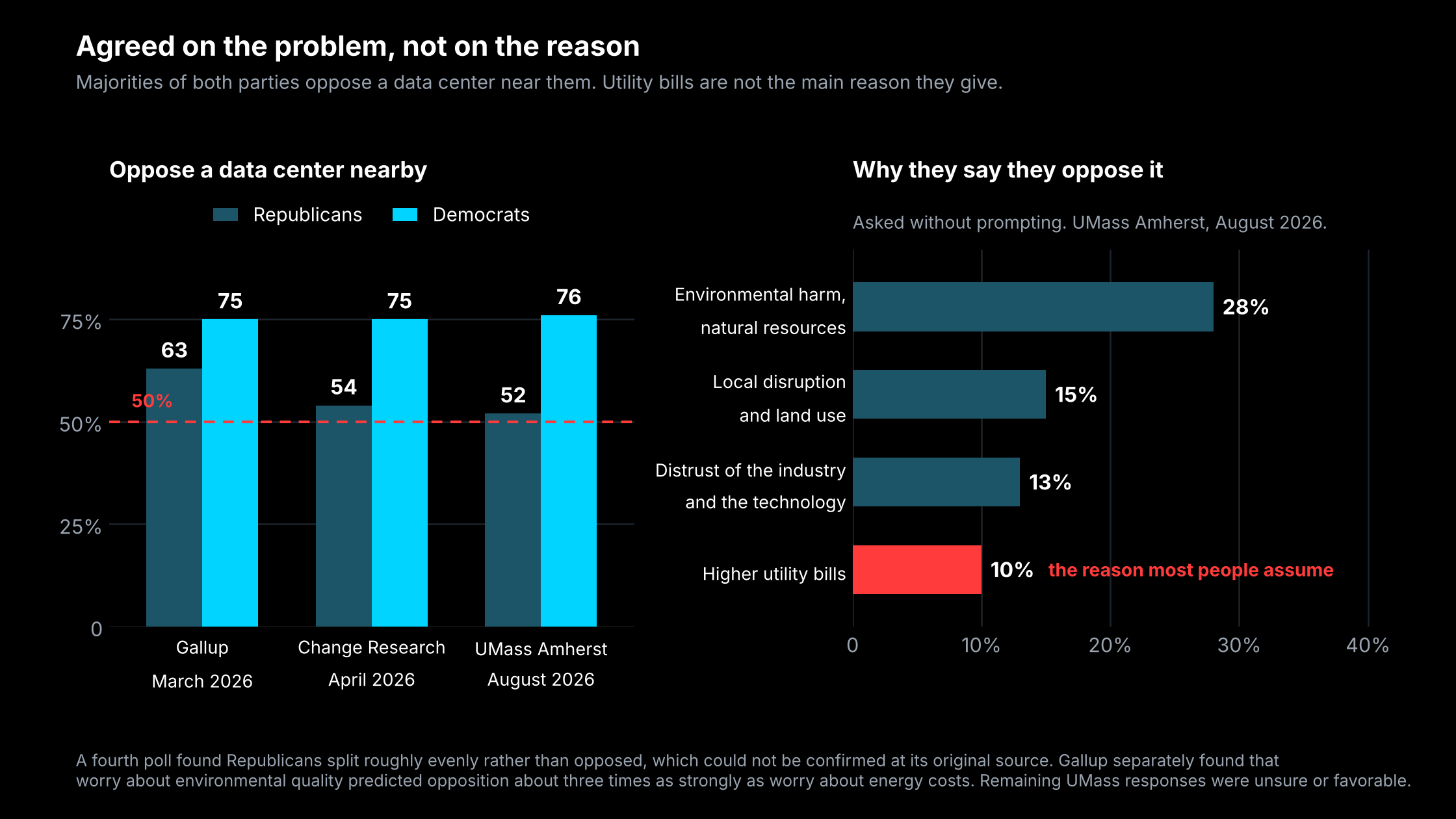
Majority opposition in both parties is real and well documented. Gallup, surveying 1,000 adults by telephone in March 2026, found 71% oppose a data center being built in their area: 63% of Republicans and 75% of Democrats. A University of Massachusetts Amherst poll in August 2026 found 65% opposed, with Republicans at 52% and Democrats at 76%.
But when people are asked, without prompting, why they oppose it, utility bills are not the main answer. In the UMass poll the reasons opponents gave were:
| Reason given, unprompted | Share |
|---|---|
| Environmental harm and natural resource use | 28% |
| Local disruption, land use, poor community fit | 15% |
| Distrust of the industry and the technology | 13% |
| Higher utility bills and economic burden | 10% |
Gallup's version of the same question puts utility bills at 15% among opponents.
And Gallup ran the cross-tabulation that settles it. Among people worried about energy affordability, 73% opposed a local data center. Among people not worried about energy affordability, 65% opposed it anyway. That is an eight point difference.
Compare that with environmental concern. Among people worried about environmental quality, 78% opposed. Among those not worried, 52%. A twenty six point gap, more than three times as predictive.
So the honest finding is that the thing uniting voters against data centers is mostly not the electricity bill. It is land, water, noise, and a general distrust of the industry. The bill is a strong argument in Congress and a fourth-place concern at the kitchen table.
There is also a partisan gap in every single poll, running from 12 points to more than 30. And in at least one survey, Republicans were roughly evenly split rather than opposed. Anyone telling you this issue has no partisan dimension is overstating it.
One more complication, because leaving it out would be dishonest. Democratic-aligned campaigns and outside groups spent roughly 140 million dollars on anti-data-center advertising this cycle. Opposition that rises while nine figures are spent promoting it is not clean evidence of a spontaneous, party-neutral backlash.
Does the cost shift actually exist?
This deserves its own answer, because the research genuinely disagrees, and not just about size.
A working paper from MIT's Center for Energy and Environmental Policy Research, published in June 2026, found that the arrival of a first large data center raised a utility's retail electricity prices about 2.7% on average, with residential customers up 2.1%, roughly three dollars a month. For investor-owned utilities the effect was larger, around 5.6%.
A paper from the Federal Reserve Bank of Dallas modeled wholesale markets and found data center load raised national wholesale prices about 6.9% by 2025, and about 15% in Northern Virginia.
But a paper from EPRI, a utility-funded research institute, used a different method over an overlapping period and concluded data centers lowered residential rates by roughly 6%. A review commissioned by the Data Center Coalition, the industry's trade association, found no historical evidence that data centers drive residential cost increases, while conceding that data center load caused about half of PJM's capacity price increase.
Notice the pattern. The studies finding no effect are largely funded by the industry or by utilities. The studies finding an effect are not. That does not automatically make one side right. It does mean you should know who paid before you weigh the result.
What nearly everyone agrees on: the effects so far are small relative to a total bill, the largest effects are still ahead, and the main drivers of rising electricity prices between 2023 and 2026 were natural gas prices, spending on poles and wires, inflation and wildfire hardening.
And here is the baseline, which almost no coverage provides. Average United States residential electricity rose from 15.98 cents per kilowatt hour in 2023 to 17.23 cents in 2025, about 7.8% over two years. For the twelve months ending September 2026, the consumer price index for electricity rose 4.4%, against all-items inflation of 3.7% and an overall energy index of 20.4%.
Electricity has risen slightly faster than general inflation and far slower than energy overall. The national numbers are not a crisis. The regional numbers are where the story lives, and PJM is the outlier: its wholesale prices rose about 41% in 2026 against an 11% average across major hubs.
Where this actually gets decided
Not in Congress. This is the part investors most often get backwards.
Even with both chambers changing hands, overriding a veto takes 67 Senate votes and 290 House votes. H.R. 9340 cleared the House with 417, far above that bar, and mustered 57 in the Senate, three short of merely opening debate and ten short of an override. Any bill strong enough to divide the parties dies in the Senate long before the veto math matters.
Meanwhile the actual rules are being rewritten in two places that need no new legislation.
Federal regulators. In June 2026 the Federal Energy Regulatory Commission ordered every grid operator it oversees to justify or revise its rules for connecting large loads, defined as 50 megawatts or more. The orders require large loads to sign cost recovery agreements with a minimum financial contribution backed by credit support, explicitly so the risk of a data center never being built sits with the customer rather than with everybody else.
States. At least 23 states have already approved a large-load tariff, with more pending. The designs converge on four tools: a minimum charge of 60 to 90% of contracted capacity so the utility is paid whether the facility runs or not, contracts of 10 to 30 years matched to the life of the assets, collateral of up to 1.5 million dollars per megawatt, and exit fees.
Oregon shows the arithmetic. Portland General Electric's new data center rate class, approved in May 2026, is projected to raise data center rates 29% while lowering residential rates 1.3% and small business rates 3.7%.
That is the cost shift running in reverse, done by a state commission, with no act of Congress involved.
What this does not tell you
It does not tell you data centers will stop being built. Texas alone has more than 400 gigawatts of large-load interconnection requests queued. The governors elected on Tuesday, November 3, 2026, pledged pauses on approvals, which are temporary and conditional, and which in Texas continue a pause the outgoing Republican governor began in August 2026. This is a change of pace and of who pays, not a shutdown.
It does not tell you the opposition is one-sided. Governors of both parties have vetoed data center restrictions: Maine's Democratic governor in April 2026, Georgia's Republican governor in 2024. Of 41 local data center measures on ballots across ten states this week, 28 were restrictive and 13 were written to make data centers easier to build. Communities voted in both directions on the same night.
It does not tell you your bill went up because of a data center. In most of the country the evidence for that is weak and contested. In the PJM states it is considerably stronger. Which one applies to you depends entirely on where you live, and that is a question with an actual answer you can look up.
And it does not tell you what any of these companies are worth. Nothing here values anything. It explains why a particular group of stocks moved together on one day, and what would have to happen for that move to be justified.
The lesson worth keeping is about the difference between agreement and action. Four hundred and seventeen members of Congress agreed that somebody other than ordinary customers should pay for the grid that data centers require. They still could not pass a law, because agreeing on the problem is not the same as agreeing on the remedy, and the second one is where every fight actually happens.
That gap is worth remembering the next time a headline tells you there is overwhelming support for something.
That is also why we show the workings instead of a single figure. Techdamentals runs four separate valuation methods and displays the full range, because one number tells you where somebody landed and nothing about what it rests on.