Two companies reported on Thursday evening. Here is what happened to each.
SanDisk grew revenue 378% from a year earlier. Its gross margin was 85%. It raised guidance, announced a stock split, and the shares fell about 10%.
Intel grew revenue 21%. Its data center business grew 78%. The shares fell as much as 30%, to a level the company had not seen in a single session since 1974.
Same evening, same industry, opposite businesses, and both were punished.
The thing connecting them is a shortage of computer memory, and the way it travelled from one to the other explains something about how costs actually move through an economy that very few people have ever had laid out for them.
Because here is the part that will surprise you: Intel does not purchase meaningful quantities of memory. Memory is not a large line in the cost of making a processor. The memory shortage did not raise Intel's costs at all.
It destroyed Intel's customers.
What happened to memory prices
Start with the raw move, because the scale of it is hard to believe.
Memory here means two things. DRAM is the working memory your computer uses while it is running, the thing measured in gigabytes when somebody says a laptop has 16 gigabytes. NAND flash is the storage, where files sit when the machine is off. Both are made in the same kind of factory, by the same handful of companies.
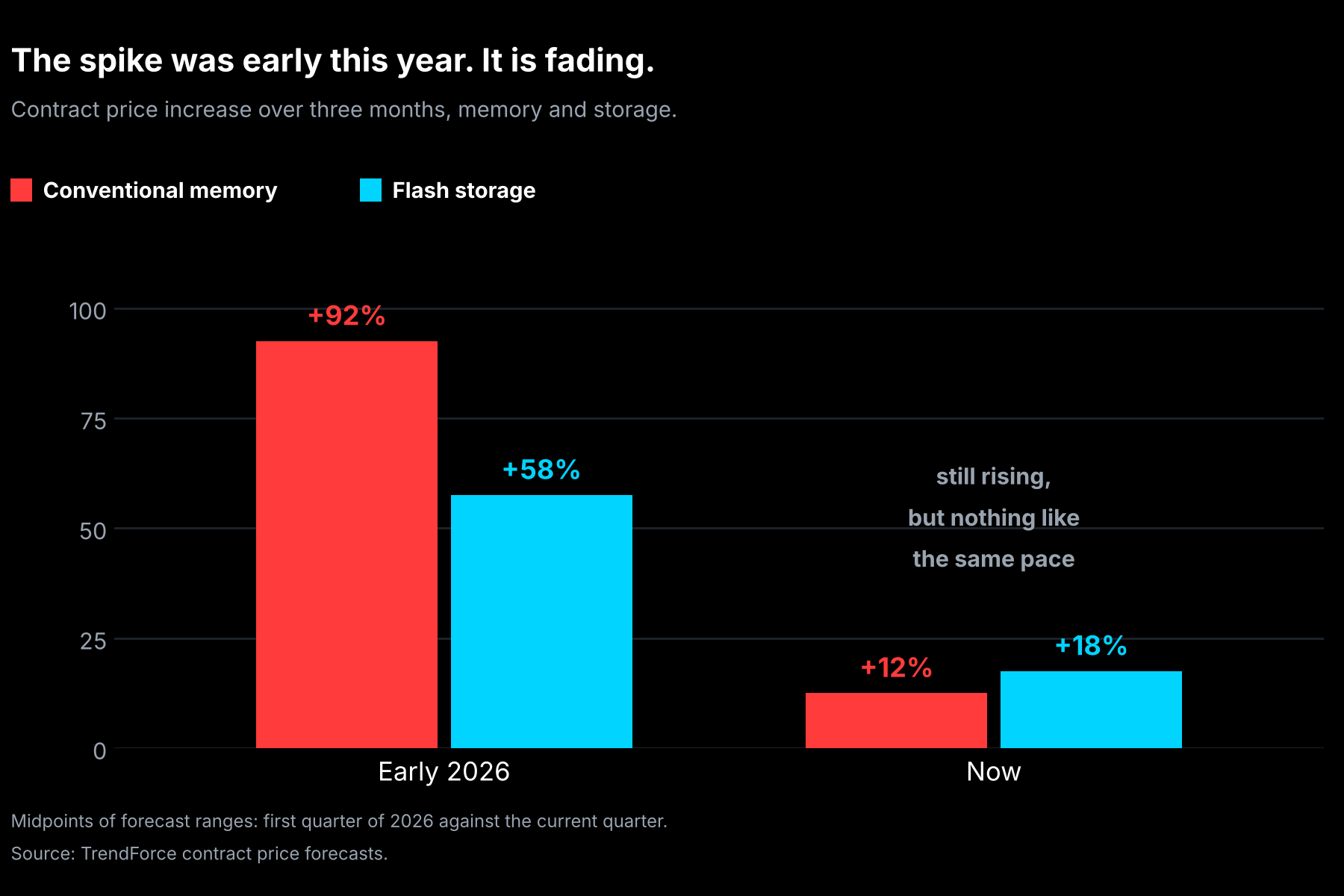
In the first quarter of this year, contract prices for conventional DRAM rose 90% to 95% in three months, according to the research firm TrendForce. PC memory rose more than 100%. Server memory rose about 90%, the largest quarterly increase on record. NAND rose 55% to 60%.
Not in a year. In a quarter.
Why? Three things at once, and the first is the one everybody knows.
Artificial intelligence data centers are absorbing the supply. By one analysis, data centers will consume about 70% of all memory devices produced this year, and the industry will meet only about 60% of total global demand.
The second reason is more interesting and almost nobody explains it. AI accelerators use a special kind of memory called high bandwidth memory, which is ordinary memory stacked vertically several layers tall and placed right next to the processor so data can move faster.
Here is the thing. It is not made in special factories. It is made from ordinary memory chips, on the same wafers, in the same plants. And it is wildly inefficient per gigabyte: it consumes roughly four times the cleanroom capacity of standard memory for the same storage.
So every gigabyte sold into an AI system removes about four gigabytes worth of manufacturing capacity from everything else.
Think of a bakery that can make a hundred loaves a day. A new customer wants layered pastries instead, and each pastry uses the oven time of four loaves. The bakery takes the order, because pastries fetch far more. Bread does not vanish. There is just much less of it and it costs a great deal more. Nothing about the oven changed. The mix changed.
The third reason is a choice. Three companies control roughly 90% of global memory sales. They are maintaining production cuts, retiring older product lines, and allocating capacity by profitability. That is legal and rational and it is also a decision rather than an act of nature.
One honest correction you will not read elsewhere. The price increases are decelerating sharply. TrendForce forecasts conventional DRAM rising 10% to 15% this quarter against that 90% earlier in the year, and NAND 15% to 20%. Micron's finance chief guided to "a more moderate rate of price increases." Prices are still rising. The rate of increase has collapsed, and anybody telling you memory prices are accelerating is working from stale data.
The chain, and the company that confessed
Now follow the money, because this is the part that matters.
When memory costs triple, somebody has to absorb it. Here is the order.
The memory makers capture it. SanDisk's 85% gross margin and Micron's 87% are the evidence. These are not normal numbers for a commodity component.
The PC makers eat it first. And one of them told investors exactly what that felt like.
In February, HP disclosed that memory had gone from about 15% to 18% of a PC's build cost to 35% in a single quarter. Treat that figure as a marker of the moment rather than today's number, because it is eight months old, but the direction is not in doubt.
Then in August, HP's chief financial officer said this on an earnings call, and if you read one quote in this article make it this one:
"We continue to expect memory and storage costs to increase further as a percentage of the bill of materials."
And: "We use pricing as the last lever."
And then the sentence that predicted everything that happened on Thursday:
"PC units will decline high teens in the second half as pricing actions pressure demand."
Read that again. HP's own finance chief, in August, forecasting that HP's own price increases would reduce the number of computers people purchase by close to twenty percent.
The numbers in that quarter show the squeeze precisely. HP's personal computer revenue hit a record $11.8 billion, up 18%, while unit volumes fell. Higher prices on fewer machines. Operating margin in that division was 4.6%, below its own target range.
Dell said the same thing more colorfully. Its chief operating officer, asked what was constraining the business: "The constraints remain the same. DRAM, DRAM, DRAM, followed by NAND, NAND, NAND." And on pricing: "So there's a notion of inflation inside our growth."
One honest note on Dell, because it cuts against the simple story: Dell's gross margin actually improved, and it raised its margin outlook. Dell named memory as its binding constraint and is passing the cost through successfully. The squeeze is not uniform.
What this did to Intel
Now we can state the mechanism properly, and it is not the one most coverage is running.
Memory prices rose. PC makers raised prices. People stopped purchasing computers at the new prices. PC makers cut orders and worked down inventory. Intel sold fewer processors.
That is a demand problem, not a cost problem, and Intel's own executives said so repeatedly and unprompted.
Chief executive Lip-Bu Tan called it "the unprecedented memory crunch, and the resulting softness in PC demand," and said "customers began signaling a PC slowdown based on the memory prices and availability." He added: "The pace of this PC correction has accelerated over the last two months as our partners are aggressively managing inventory."
Chief financial officer David Zinsner: "industry-wide PC consumption is being impacted by memory shortages and limited IT budgets," and "We do not expect a sustained recovery until memory availability improves and pricing begins to normalize." Asked about next year, he was blunt: "make no mistake, we are not optimistic about next year in terms of memory."
A note on the share price, because the headlines are running ahead of the facts. Intel closed Thursday at $92.07. On Friday it touched $64.25, down 30.2%, and every headline you have seen declares it the worst day since July 1974. But the stock then recovered to around $66.34, or down about 28%. The 1974 session was a fall of roughly 29.9%. So whether this is the worst day in Intel's listed history, or merely the worst since 1974, or neither, depends entirely on where it settled, and the publications calling it are using an intraday low rather than a close. Check the closing figure before repeating any of them.
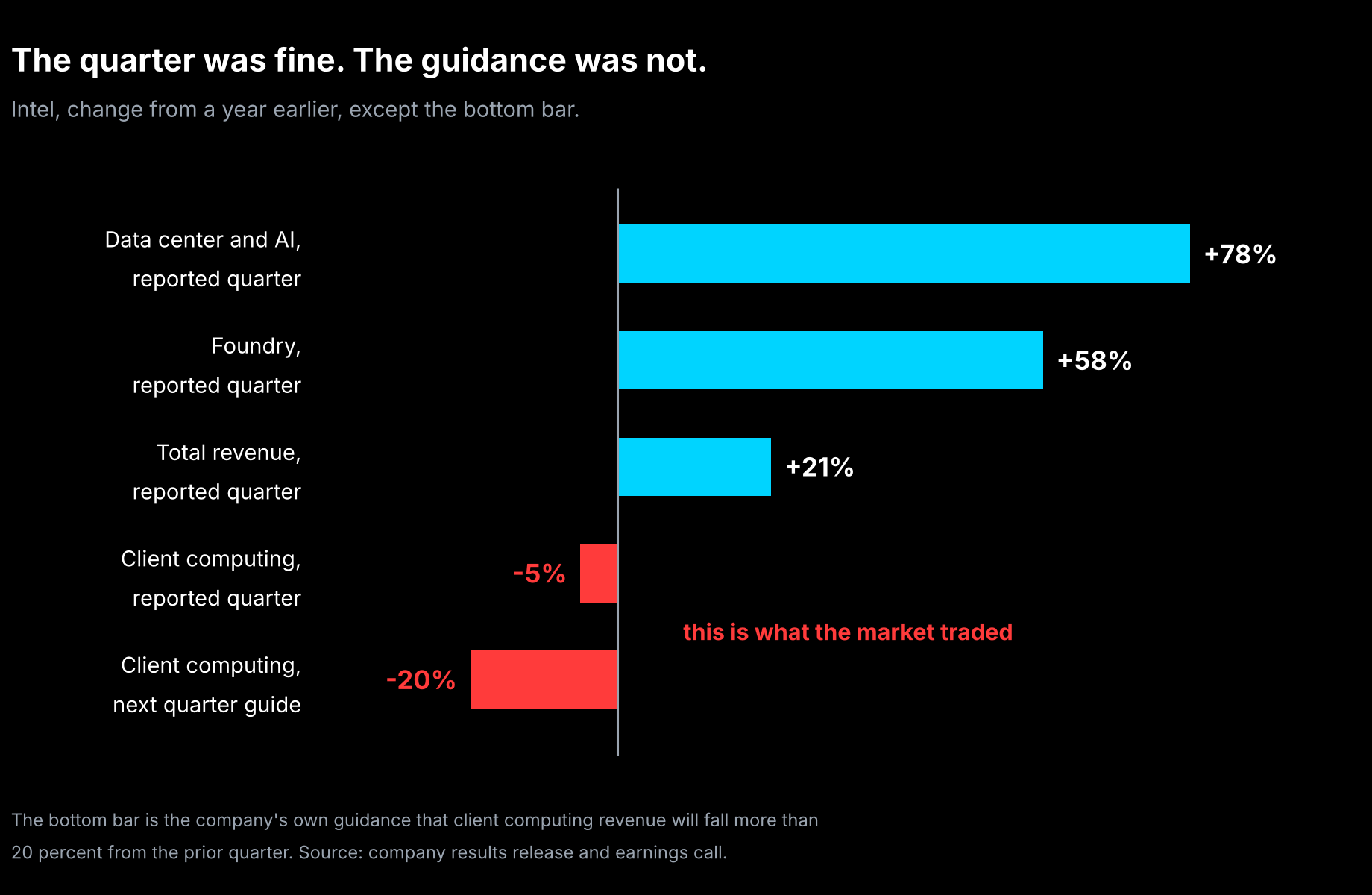
The guidance is where the damage was. Intel told investors its client computing revenue would decline more than 20% sequentially, that the market for PC units would shrink about 12% this year, with second-half units down more than 20%, and about 10% again next year.
And here is the detail that proves this is a volume story rather than a cost story. Asked why gross margin was collapsing from 44.1% to 38.0%, Zinsner did not blame component prices. He said: "The sequential decline in Q4 gross margin primarily reflects lower overall revenue against our fixed cost base."
That is a factory-utilization explanation. A chip plant costs the same to run whether it is full or half empty. Fewer processors over the same overhead means a worse margin on each one. Nothing to do with what Intel pays for anything.
Now the part where I have to be fair to the facts, because memory was not the only thing.
The quarter itself was decent. Revenue $16.5 billion, up 21%. The data center and AI business grew 78% to $7.3 billion. The foundry business grew 58%. Those are not the numbers of a collapsing company.
Three separate problems landed on top of the PC weakness:
A fatal accident at Intel's factory in Israel caused an extended shutdown. Tan called it "an unfortunate and tragic accident." Zinsner quantified the effect: roughly $300 million of revenue and 200 basis points of gross margin, with a similar impact expected next quarter. That is about a third of the margin decline, and it has nothing to do with memory.
A separate shortage of advanced substrates, the material that connects a chip to a circuit board, is constraining the server business. Different component, different problem.
And the competitive position, which predates all of this. When Bank of America downgraded the stock, its published reasoning cited PC shipments, substrates, a lack of visible traction with outside foundry customers, and rivals growing two to four times faster. It did not mention memory prices at all.
That gap is worth noticing on its own. The company framed this as a memory story. The analysts cutting their ratings framed it as an Intel story. Both are looking at the same quarter.
Why the winners are also falling
Here is the thing that should stop you, and it is the reason this article is not simply "memory good, Intel bad."
The memory companies are being sold too.
SanDisk grew revenue 378%, posted an 85% gross margin, raised guidance, announced an eight-for-one stock split, and the shares dropped about 10% on the day.
And it is not just one day. Over the month into these results, SanDisk fell about 24%, Seagate about 29%, Western Digital about 15%, and Micron about 11%. Every major memory and storage name was down double digits going into the best earnings of their corporate lives.
Why would that happen?
Because the good news is already contracted, known, and in the price. Micron says more than 75% of its output is already committed for 2027. SanDisk has about half its 2027 capacity and two-thirds of 2028 spoken for. These companies have pre-sold years of production. There is no surprise left to deliver.
And because memory has done this before. Repeatedly.
This is the most cyclical business in technology and the record is unambiguous. DRAM prices fell 51% in 1996 and another 65% in 1997. They fell roughly 50% during 2008, and Qimonda went bankrupt the following year. DDR3 prices fell about 85% in 2011, and Elpida, then the third-largest memory producer on earth, went bankrupt in 2012. NAND prices fell 39% between 2022 and 2023.
Five cycles. Five crashes of 40% to 85%. Two dead major producers.
And here is the one every investor should know. Micron's shares peaked near $64 in May 2018 and were near $28 by that December, a decline of 56%, while its earnings were still at record levels.
That is precisely what memory stocks have been doing for the past month. Falling on spectacular results. The market is not celebrating this boom. It is pricing its end.
Whether it is right is a separate question. But anyone writing that memory companies are winning should look at a chart first.
What this does not tell you
It does not tell you memory raised Intel's costs. It did not. Intel's own finance chief attributed the margin decline to lower revenue against fixed costs. If you take one thing from this piece, take the distinction between a cost shock and a demand shock, because they look identical in a headline and behave completely differently.
It does not tell you memory was Intel's only problem. A factory shutdown following a fatal accident accounts for roughly a third of the margin decline. There is a separate substrate shortage. And there is a competitive position that has been deteriorating for years, which is what the analysts actually cited.
It does not tell you prices keep climbing at this rate. They are decelerating hard, from roughly 90% a quarter to roughly 10% to 15%. Still up. Nowhere near the same pace.
It does not tell you the shortage is over either. Micron says conditions will be tighter in 2027 and 2028 than in 2026 and that it has no line of sight to when supply and demand balance. Those two paragraphs are both true and they are not in conflict: prices can keep rising slowly from a very high level for a long time.
It does not tell you memory is in a bubble. I went looking for a credible named analyst saying that and could not find one. The actual argument against these stocks is narrower and more defensible: margins are near their peak, growth is moderating, the good news is contracted, and this industry has never not been cyclical.
And it does not tell you what any of these companies are worth. A business earning an 85% gross margin on a commodity component is earning something that has historically not lasted. That does not make the earnings fake. It makes the question "what happens when it normalizes" rather than "what did it earn."
What the week actually offers is a lesson about where costs go, and it generalizes well beyond chips. A cost shock does not stop at the company that pays it. It moves down the chain, getting passed along at each step, until it reaches somebody who can simply decline. Then it reverses direction and travels back up as lost volume, and it lands hardest on whoever is furthest from the original problem and least able to see it coming.
Intel never purchased a memory chip. It just had the worst day of its corporate life because of memory prices.
That is why a single number cannot carry a verdict, and why we show the workings. Techdamentals runs four separate valuation methods and displays the full range, because one figure tells you where somebody landed and nothing about what it rests on.